Plant Seed Identification Guide: Teaching You to Recognize Plant Seeds
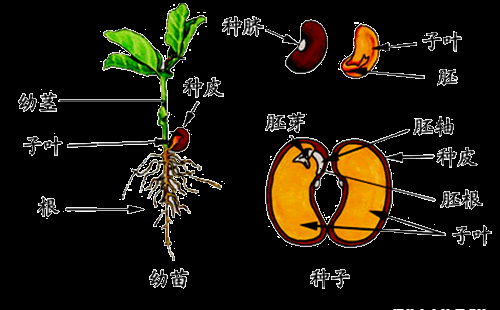
Soak soybean or broad bean seeds in water overnight. After the seed coat splits, break open the two cotyledons and identify which part is the plumule, which is the radicle, and which is the hypocotyl.
The Cycle of Life in Nature
Humans and animals eat plants, and their dung and corpses return to the soil; the fallen twigs and leaves of plants also return to the soil. Microorganisms, fungi and earthworms in the soil decompose and break down these remains of animals and plants into nutrients that plants can absorb. Plants absorb water and these nutrients from the soil, grow, and supply humans and animals with food.
If any link in this cycle goes wrong, it will cause disorder in the entire system and give rise to many headache-inducing problems.
Teaching You to Recognize Plant Flowers
Plants bloom in order to bear fruit, and the fruit contains seeds; the seeds fall into the soil and grow again, so that the plant's life is propagated. This way of reproducing is called sexual reproduction. Of course, some plants can also reproduce by cuttings, or by burying their tubers in the soil; this way of reproducing is called asexual reproduction. Among the more than 350,000 species of plants known to people, more than 250,000 reproduce sexually.A plant flower is made up of parts such as the calyx, receptacle, petals and stamens and pistils. A flower that has all these parts is called a complete flower, but the flowers of many plants are not complete.
The stamens and pistils are distinct. Some plant flowers have both pistils and stamens, such as the flowers of peach trees, tomatoes and rapeseed; but some plant flowers have only pistils or only stamens, such as the flowers of corn, pumpkin and cucumber. Some plants are monoecious, such as corn, pumpkin and castor bean, with a single plant bearing both male and female flowers; some plants are dioecious, such as ginkgo, mulberry and asparagus, with a single plant bearing only male flowers or only female flowers.
The tip of the stamen is the anther, which produces pollen grains. The tip of the pistil is the stigma, which is connected to the ovary through the style.
Please pick a flower to observe. Is it a complete flower? Does it have a pistil? Does it have stamens?
The stigma secretes a sticky substance, and when pollen grains land on the stigma, they are stuck fast. The pollen grains are then stimulated to grow a pollen tube, and at the same time develop two sperm cells inside the tube. The pollen tube gradually elongates, and after entering the ovule, one sperm cell combines with the egg cell to form the embryo, while the other sperm cell combines with other cells in the ovule to form the endosperm that stores nutrients.
Knowledge of Carnivorous Plants: Teaching You to Recognize Bladderworts
Bladderworts are small carnivorous plants with movable bladder-like insect-trapping structures that can suck small organisms into the bladder and digest and absorb them. There are many varieties of bladderwort with different forms; they generally grow in patches in wetlands, ponds and even on moss-covered tree trunks in tropical rainforests, and most have a long flowering period, producing patches of lovely small flowers.
Overview of Bladderworts
The carnivorous plants of the family Lentibulariaceae include 3 genera - Utricularia, Genlisea and Pinguicula - with about 300 or more species. Among them, the genus Utricularia has about 218 species and is distributed in most parts of the world, making it the carnivorous plant with the widest global distribution and the greatest number of varieties. According to their ecological habits, the genus Utricularia can be divided into three major groups: terrestrial, aquatic and epiphytic. Terrestrial species account for about 80% of the total, aquatic species about 15%, and the rest are epiphytic.
Morphology of Bladderworts
Bladderworts are perennial herbaceous plants (a few are annual), and can grow in ponds, ditches, wetlands, and on tree trunks in tropical rainforests, among other places. Bladderworts have long creeping stems and branches, have no roots, and their leaves are whorled or borne singly on the creeping branches; the leaves of aquatic species are thread-like and mostly forked, and the insect-trapping bladders are borne at the base of the creeping branches or leaves. The flower stems are slender, with a raceme or a single terminal flower, the corolla is two-lipped, and the base mostly has a spur. The capsule is spherical, and when mature it splits open and releases tiny seeds.
The Insect Traps of Bladderworts
The insect-trapping bladders of bladderworts are borne at the base of the creeping branches or leaves, mostly flattened-spherical and semi-transparent, with a diameter of 0.25-10 mm. Around the opening of the bladder grow antennae, which are used to attract small organisms and also have a certain guiding function, leading prey to the bladder opening. At the opening of the bladder there is a membrane flap that can open and close, and on the outer side of the flap grow trigger hairs. When small organisms such as water fleas and wrigglers (mosquito larvae) come to the bladder opening in search of shelter or attracted by the nectar secreted by the bladder, once the trigger hairs are touched, the originally half-collapsed bladder rapidly swells up, creating a powerful suction force, and at the same time the membrane flap opens, drawing the water flow at the bladder opening together with the prey into the bladder, and then quickly closes the membrane flap; the whole process takes only about one hundredth of a second. At this point the bladder begins to secrete digestive fluid, and bacteria also greatly help with the breakdown of nutrients. Generally it takes only a few hours to several days for the prey to be digested, the nutrients to be absorbed by the bladder wall, and the excess water to be discharged, after which the bladder returns to its original state and waits for the next prey. The shortest interval between two hunting events can be as little as 15 minutes. After many hunts, the remaining residue accumulates inside the bladder, gradually darkening its color until it finally rots and falls off.