How to Grow Heliconia rostrata? A Complete Guide to Cultivation Methods and Tips
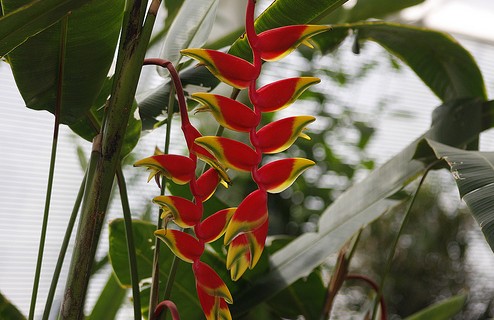
Heliconia rostrata, also known as hanging lobster claw. The plant is tall with an elegant form, and the inflorescence comes in two colors, red and yellow. The leaves resemble banana leaves and are leathery. The spike inflorescence hangs downward in a “zigzag” shape, the inflorescence axis is red, and the bracts are also red with golden yellow tips, l5~20 of them, arranged in two rows, closely resembling pairs of beautiful little birds, extremely unique. The ornamental period lasts as long as 3 months.
Heliconia rostrata
Heliconia rostrata prefers a warm, humid and semi-shaded environment, fears scorching sun exposure, and is not cold-tolerant; the winter room temperature must not be lower than l2°C. It is best suited to deep, fertile, well-drained sandy loam.
Heliconia rostrata is tall, and during the growing period it needs sufficient water and fertilizer. Usually apply a light fertilizer once every half month, and after the flower stalk emerges, apply phosphorus and potassium fertilizer 2 more times. In summer, pay attention to proper shading to avoid scorching the leaves. In winter, cut off dead leaves and prune the plant shape appropriately to keep it looking elegant.
When maintained indoors, it is susceptible to scale insect damage, so timely control should be taken. If cared for and managed properly, it can bloom continuously for more than l0 years. It is commonly propagated by division and sowing.
How to Grow Heliconia rostrata as a Potted Plant
Heliconia rostrata Potted Cultivation Methods
Heliconia rostrata, also known as hanging lobster claw or hanging scorpion-tail heliconia, is native to Peru. It prefers high temperatures and ample sunlight, and the soil should be deep, fertile and slightly moist. In summer, provide slight shade and pay attention to ventilation. The plant is tall with an elegant form, and the inflorescence comes in two colors, red and yellow. The leaves resemble banana leaves and are leathery. The spike inflorescence hangs downward in a "zigzag" shape, the inflorescence axis is red, and the bracts are also red with golden yellow tips, 15~20 of them, arranged in two rows, closely resembling pairs of beautiful little birds, extremely unique. The ornamental period lasts as long as 3 months.
It prefers a warm, humid and semi-shaded environment, fears scorching sun exposure, and is not cold-tolerant; the winter room temperature must not be lower than 12°C. It is best suited to deep, fertile, well-drained sandy loam.
Heliconia rostrata is tall, and during the growing period it needs sufficient water and fertilizer. Usually apply a light fertilizer once every half month, and after the flower stalk emerges, apply phosphorus and potassium fertilizer 2 more times. In summer, pay attention to proper shading to avoid scorching the leaves. In winter, cut off dead leaves and prune the plant shape appropriately to keep it looking elegant.
Propagation and Breeding
Propagate by division and sowing. Division is the main method. It has strong tillering ability and grows quickly, and division propagation makes it very easy to cultivate young plants. Division is generally carried out in spring. When dividing, dig the plant out of the ground, remove the soil, and then find the natural separation points of the stems and roots. Break them apart by hand or use a sharp blade to cut the underground stems into several pieces, and plant them in loose, fertile sandy loam rich in humus, at a depth of 8~10cm. During the growing season, provide sufficient water and fertilizer, and apply a liquid fertilizer rich in phosphorus and potassium once a month. When newly transplanted, pay attention to shading, otherwise sunscald is likely to occur. For seed propagation, the germination temperature needs to be 25-28°C, germination occurs about 20 days after sowing, and seedlings grown from seed bloom after 3-4 years of cultivation.
When maintained indoors, it is susceptible to scale insect damage, so timely control should be taken. If cared for and managed properly, it can bloom continuously for more than 10 years. It is commonly propagated by division and sowing.
Whether planted in the ground or in pots, use loose, fertile loam. During the growing period, water thoroughly and fertilize once every half month, and strictly avoid low temperatures and dryness. During the summer flowering period, provide proper shade and apply phosphorus and potassium fertilizer 2 more times. In winter, cut off dead leaves to keep the plant shape attractive. The overwintering temperature should be above 12°C. Plants set out from division can bloom in the second year, and with good cultivation and management, they can bloom continuously for more than 10 years. There are many horticultural varieties, including red-flowered, orange-flowered and pink-flowered ones.
Pests and Diseases
The main pests and diseases include powdery mildew and black spot. They generally occur on the inflorescence, and can be controlled by spraying 0.3%~0.5% Baume degree lime sulfur mixture; or a 50% carbendazim 800-fold dilution. Common pests include aphids and ants, which feed on the plant. For aphid control, spray aphid-killing agents; for ant control, spray 50% omethoate emulsifiable concentrate at 800~1200 times dilution or 80% dichlorvos emulsifiable oil at 1000 times dilution.
For indoor potted plants, if ventilation is poor, scale insect damage is likely to occur, and it can be controlled by spraying 25% phosmet emulsifiable concentrate at 1000 times dilution.
Cultivation and Management of Heliconia rostrata
Heliconia rostrata generally refers to Heliconia rostrata Ruiz & Pavon: a perennial herbaceous plant in the family Musaceae, genus Heliconia. The plant height can reach 6 m. The leaves are oblong, green on the upper surface and bright purple on the underside; the terminal inflorescence is upright and sparsely covered with short soft hairs; the bracts are green and suddenly exposed when opening, the tepals are red with green tips, narrowly cylindrical, the fruit is three-angled, grayish-blue, with no more than 3 seeds. It blooms from May to October.
[Cultivation Methods] Sow seeds or propagate by division in early spring. In early spring, when new shoots emerge from the side branches beside the mother plant, cut them off and plant them as divisions. When newly transplanted, pay attention to shading, otherwise sunscald is likely to occur. Before long, new upright stems grow out from the tips of the lateral underground stems. For seed cultivation, the germination temperature needs to be 25-28°C, germination occurs about 20 days after sowing, and seedlings grown from seed bloom after 3-4 years of cultivation.[Cultivation Management] It prefers high temperatures and ample sunlight, and the soil should be deep, fertile and slightly moist. In summer, provide slight shade and pay attention to ventilation.
It can be potted, but is even better planted in the ground. Whether planted in the ground or in pots, use loose, fertile loam. For potting, use leaf mold or peat soil in a large pot. When the young shoots grow to 20~25cm, water and fertilizer management should be strengthened, sufficient moisture should be maintained, and ample light should be provided. During the growing period, fertilize once every half month, and strictly avoid low temperatures and dryness. After the inflorescence emerges, the proportion of phosphorus and potassium fertilizer should be increased, which can make the flower colors more beautiful. Flowering mainly depends on the age of the plant; generally, plants that sprout before early April can be expected to bloom the following year; if they only sprout after the end of April, they will not bloom until the third year. In winter, cut off the remaining branches and withered leaves to keep the plant shape attractive. With proper management, many flower spikes are produced in summer and blooming is continuous, with each inflorescence opening one flower every 3 days, and the entire ornamental period can last as long as 4--5 months. The overwintering temperature should be above 12°C. This species grows extensively and has strong resistance, and pests and diseases rarely occur.
For indoor potted plants, if ventilation is poor, scale insect damage is likely to occur, and it can be controlled by spraying 25% phosmet emulsifiable concentrate at 1000 times dilution.