What causes yellowing leaves on bromeliads?
Bromeliad is generally short for ornamental bromeliad, and it is a fairly well-known holiday flower. Many gardeners find that after keeping a bromeliad at home for a while, its leaves turn yellow, and they do not know what has gone wrong with the bromeliad. After reading this article, gardeners will understand.
The bromeliad is actually the pineapple, except that the kind of flower we see in the flower market should really be called an ornamental bromeliad. Sometimes vendors casually shorten the name and call it a bromeliad, and gardeners vaguely follow along and call it that too. Now that the name is clear, let us talk about the basic characteristics of ornamental bromeliads. Although this is not directly related to yellowing leaves on ornamental bromeliads, gardeners should understand it.
An ornamental bromeliad blooms only once in its lifetime. After blooming, it produces one to several offset buds at the base of the old plant. At this point, it should not be divided too early, otherwise it will not easily survive. The method of division is: first cut off the flower stem from the base, then leave 5-8 cm of the old plant's leaves and remove all the rest. The base of the remaining leaves just forms a tube that can hold water. When cutting, be very careful not to damage the small offsets. When the offsets are about 10 cm tall, use a sharp knife to gently cut at the point where the offset connects to the mother plant, plant the small offsets into potting soil made with leaf mold, and after careful care for one year, they will produce brilliant flowers again.
In other words, the ornamental bromeliad a gardener buys is already in bloom, and as the blooming period gradually passes, the bromeliad slowly dies, so yellowing leaves are only natural. This is a normal situation. Some gardeners will say, then why have I not seen any offset buds at the base? Gardeners should know one thing: the bromeliad is originally a tropical flower. Although it can be bought in the flower market, it is produced in greenhouses. This kind of flower is fine as an ornamental flower, but ordinary household cultivation cannot keep it alive for long. Dry, cracked, curled, and yellowing leaves are very normal. In addition, many gardeners have a certain sentiment: no matter what flower they buy, they hope it can be grown on generation after generation. In fact, this is not scientific, because although southern flowers can now be viewed in the north, they are all produced in greenhouses. Once they reach a gardener's home, the environment is still ordinary, so gardeners need not force it.
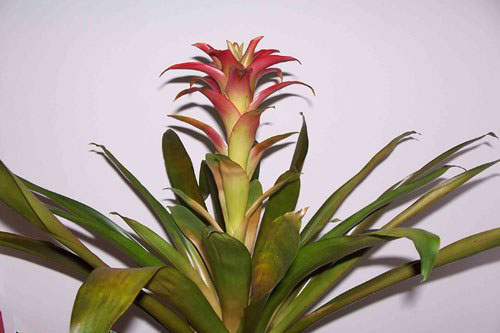
Many gardeners have asked me what to do after an ornamental bromeliad blooms. In fact, every time I say that it is about time to just throw it away, but gardeners cannot bear to. This is the sentiment mentioned earlier. Look at the ornamental bromeliad in the picture above; it is already in its late stage. There is no need to try to save it, and it cannot be saved.
What should be done about yellowing bromeliad leaves? Solutions for yellowing bromeliad leaves
Bromeliad is generally short for ornamental bromeliad, and it is a fairly well-known holiday flower. It is actually the pineapple we commonly see, except that the kind of flower we see in the flower market should really be called an ornamental bromeliad. Sometimes vendors casually shorten the name and call it a bromeliad. Many gardeners find that after keeping a bromeliad at home for a while, its leaves turn yellow, and they do not know what has gone wrong with the bromeliad. After reading the introduction below, everyone will probably know how to solve the problem of yellowing leaves.Yellowing and withered leaves may be caused by the following reasons:
1. The alkalinity of the irrigation water may be too strong, or it may contain high calcium and sodium.
2. The indoor air humidity is too low.
3. Overfertilization or too high a concentration of liquid fertilizer causes salt damage, plasmolysis, and dehydration.
4. Poor drainage causes the roots of the bromeliad to rot.
Solutions:
If the leaves at the root are yellowing, it is fine; it is a normal phenomenon, and you can just cut them off. The bromeliad originates from tropical regions and fears cold, so when growing it in winter, the temperature must reach above 5°C, so as to avoid disease. Because the bromeliad in its native state grows under the tropical rainforest canopy, it does not need too much sunlight. On the contrary, too much sunlight can also cause yellowing leaves and dry flower tips. Therefore, the bromeliad is best placed in a semi-shaded, ventilated place to prevent exposure to the scorching sun.
Apply fertilizer 1-2 times a month. The potting soil can be kept moist. The leaf base of the bromeliad has a leaf cup, and inside the leaf cup there is a water reservoir. As long as there is water in the reservoir, it is fine. However, the water inside is best changed once every half month to prevent it from becoming foul. Usually, also sprinkle some water on the leaves and flowers to increase environmental humidity. After winter begins, it should be moved indoors to keep warm, and the room temperature only needs to be maintained at 5°C. If there is particularly cold weather, you can put the whole pot in a plastic bag to add warmth.
Repot and change the soil once every 1-2 years. The potting soil can be made by mixing 5 parts mountain soil, 4 parts sand, and 1 part rice husk ash or decomposed sawdust. It is even better if a small amount of bone meal is added to the soil. Use deionized water or mineral water. Tap water has a higher pH.
The day before watering, it is best to store the water in the greenhouse for one day. You can also use a thermometer to measure its water temperature to ensure it is above 20°C.
When mixing fertilizer, directly use deionized water to mix it with it. Generally, the ratio of nitrogen, phosphorus, and potassium in it is about 20:10:20, because bromeliads do not like too much phosphorus fertilizer. If there is too much phosphorus fertilizer, it will affect the growth of their root system.
Then nitrogen and potassium are relatively favored, but if there is too much nitrogen fertilizer, it will also cause excessive leaf growth. Generally, the ratio of nitrogen fertilizer to potassium fertilizer is about the same; nitrogen, phosphorus, and potassium are 20:10:20. The usual fertilization cycle is about half a month. During its growth process, you can also take it out of the pot and observe the color of its root system. If the color of the roots is relatively dark, it proves that the fertilizer concentration is relatively suitable for its growth. If the roots are a little whitish, you can appropriately increase the concentration a bit, or shorten the interval a little. When fertilizing, pay attention to increasing the application of potassium fertilizer and magnesium fertilizer, reducing the amount of phosphorus fertilizer, and strictly controlling the application amounts of copper and boron.
Summary: The above is an introduction to the causes of yellowing bromeliad leaves and the solutions. I hope everyone will exchange more experience in bromeliad care.
Causes of yellowing leaves on ornamental bromeliads
Basic characteristics of ornamental bromeliads
An ornamental bromeliad blooms only once in its lifetime. After blooming, it produces one to several offset buds at the base of the old plant. At this point, it should not be divided too early, otherwise it will not easily survive.
The method of division is: first cut off the flower stem from the base, then leave 5-8 cm of the old plant's leaves and remove all the rest. The base of the remaining leaves just forms a tube that can hold water. When cutting, be very careful not to damage the small offsets.
When the offsets are about 10 cm tall, use a sharp knife to gently cut at the point where the offset connects to the mother plant, plant the small offsets into potting soil made with leaf mold, and after careful care for one year, they will produce brilliant flowers again.
Causes of yellowing leaves on ornamental bromeliads
The ornamental bromeliad a gardener buys is generally already in bloom. As the blooming period gradually passes, the bromeliad slowly dies, so yellowing leaves are only natural. This is a normal situation.
Some gardeners will say, then why have I not seen any offset buds at the base? Gardeners should know that the bromeliad is originally a tropical flower. Although it can be bought in the flower market, it is produced in greenhouses. This kind of flower is fine as an ornamental flower, but ordinary household cultivation cannot keep it alive for long. Dry, cracked, curled, and yellowing leaves are very normal.
In addition, many gardeners have a certain sentiment: no matter what flower they buy, they hope it can be grown on generation after generation. In fact, this is not scientific, because although southern flowers can now be viewed in the north, they are all produced in greenhouses. Once they reach a gardener's home, the environment is still ordinary, so gardeners need not force it.