High-quality, High-yield Cultivation Techniques for Japanese Apricot (Green Plum) with Pollinator Trees and Bee Release at Blooming
The Japanese apricot (green plum) originated in China. To achieve high yield and high quality, the following conditions are needed: suitable climate conditions and cultivation environment, selection of fine varieties, rational arrangement of pollinator trees, bee release at blooming, and scientific cultivation.
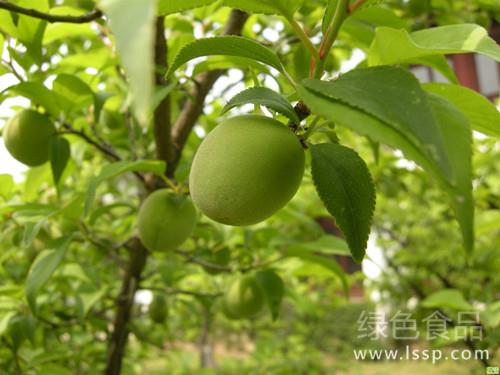
Japanese apricot
1. Choose a suitable cultivation environment: The Japanese apricot is suited to a warm climate and is relatively cold-tolerant. It suffers freeze damage only at -8°C to -9°C during the blooming period, while young fruit has reduced cold tolerance and is damaged at -3°C to -5°C. Generally, establish the Japanese apricot base in a flat large mountain hollow or on a mid-slope with good light conditions, no surrounding pollution, sufficient water sources, and deep, fertile, moist, well-drained soil.
2. Plant high-yield, high-quality varieties, arrange them rationally, and release bees at blooming: At present, the main fine varieties cultivated for Japanese apricot include Taomei, Limei, Baimei, and Ruanzhi Dali Mei. When planting, in addition to selecting these varieties, fine varieties with the same or similar blooming period should be arranged in a certain proportion as pollinator trees, such as using 80%-90% Limei as the main cultivar with 10%-20% Taomei, or 70% Taomei with 30% Limei, or 60% Limei with 40% Taomei, and other pollination combinations. For existing Japanese apricot orchards with insufficient pollinator varieties, the top-grafting variety replacement method should be adopted to graft in a certain proportion of pollinator trees. In cultivation, besides arranging pollinator trees with the same or similar blooming period, bees should also be released at blooming; generally, 1-2 colonies of honeybees are released per mu of Japanese apricot orchard.
3. Rational planting: On mountainous and poor land, plant 40-60 trees per mu; on flat and fertile land, plant 30-40 trees per mu. For existing Japanese apricot orchards that are too densely planted, mutually shading, and affecting photosynthesis, thinning of trees and heavy pruning should be carried out promptly.
4. Strengthen fertilizer and water management: For young Japanese apricot trees, fertilization should follow the principle of frequent light applications of quick-acting fertilizer. Bearing trees are fertilized 3 times a year: the first after fruit harvest, the second before blooming, and the third after bloom fall during the small-fruit stage. Apply sufficient high-quality organic fertilizer before blooming, mainly human and livestock manure, cake fertilizer, and farmyard manure; this fertilization should account for 2/3 of the annual fertilizer amount. At the flower bud stage and small-fruit stage, apply foliar fertilizers such as potassium dihydrogen phosphate via root-outside spraying, and at the same time apply an appropriate amount of lime to supplement calcium and neutralize soil acidity and alkalinity. During the blooming and young-fruit stages, if drought occurs, irrigate promptly; during full bloom, if heavy fog or frost occurs, spray clean water in the morning to wash off fog and frost and prevent the stigma of female flowers from drying, which helps increase the fruit-setting rate. After fruit harvest each year, cover with a layer of 3-6 cm of new soil to protect the root system and promote new root growth.
5. Pruning and shaping: The Japanese apricot prefers light. Timely pruning and shaping help form a natural open-center crown and promote ventilation and light penetration in the canopy. Shaping starts from young trees: keep the trunk about 60 cm high and cut the top, retain 3 main branches in different directions on the trunk with a branching angle of 40-50 degrees, then pinch the main branches at 50-60 cm to promote branching, and retain 2-3 branches on each main branch. This basically forms the canopy framework, after which the tree is allowed to continue branching to form a natural open-center crown. Bearing trees should be pruned promptly: the first pruning is after the spring shoots sprout during the small-fruit stage or after fruit harvest, and the second is before blooming. Cut off shaded branches, dead branches, weak branches, pest- and disease-damaged branches, and water sprouts to promote ventilation and light penetration in the canopy, help concentrate nutrients, and reduce pest and disease damage.
6. Strengthen pest and disease control:
(1) Insect pests: During the small-fruit stage and spring shoot sprouting stage, focus on controlling aphids and new shoot pests. Spray with Ke Ya at 500 times, or Kang Ya Qing at 1500-2000 times, or Pirimicarb at 3000 times, or Kung Fu at 1000 times. In summer, use pesticides such as pyrethroids to control various leaf-eating insects.
(2) Diseases: Spray 0.1%-0.2% borax once each at the flower bud stage and small-fruit stage to control Japanese apricot gummosis. During the new shoot stage and Japanese apricot fruit enlargement stage, promptly control black spot. Commonly used pesticides include copper oxychloride at 500 times, copper hydroxide at 600-800 times, Kocide at 800 times, and thiophanate at 800 times. For pest and disease control, combine with winter orchard cleaning, whitewashing the trunk, and spraying pine resin mixture or lime sulfur mixture to wash branches, so as to eliminate overwintering pest and disease sources.
7. Harvesting: During the ripening period of Japanese apricot, in order to improve quality and yield, regulate the balance of the tree's physiological functions, and enable the tree vigor to recover promptly, fruit should be harvested in stages, harvesting ripe fruit first, in 2-3 batches, gradually reducing the tree's burden and preventing water imbalance. At the same time, pick carefully to prevent breaking Japanese apricot branches and bruising the fruit.