How to Grow Red Knotweed? Cultivation Methods for Hongcao, Oriental Knotweed, and Dog's Tail Red
Red Knotweed (Hongcao, Oriental Knotweed, Dog's Tail Red)
Scientific name: polygonum orientale
Aliases: Hongcao, Red Grass, Large Red Knotweed, Oriental Knotweed, Large Hairy Knotweed, Youlong, Dog's Tail Flower
Family and Genus: Polygonaceae
Morphological Characteristics: - Annual herb. Inflorescence drooping to one side, pale red, red, or white. Fruit spike red.
Ecological Habits: Wild or cultivated. Grows in ditch-side wetlands, village roadsides, at altitudes of 30-2700 m. Prefers warm and humid environments, prefers ample sunlight; suitable for planting in fertile, moist places, also tolerant of poor soil, highly adaptable.
Flowering period: Autumn.
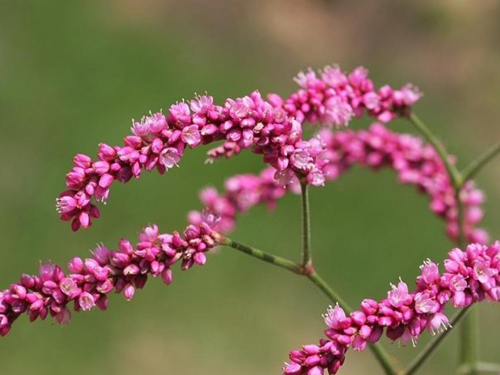
Flower meaning: Parting sorrow, glory. Nalan wrote "Red knotweed moon at Yanziji head, green willow mist at Wuyi Lane," and Qiong Yao wrote "Red knotweed flowers bloom north and south of the Yangtze, all are blood in the eyes of parting souls."
Landscape use: Ground cover under open woodland, cut flowers. An indispensable element of autumn natural scenery in waterside wetlands.
Red Knotweed Polygonum orientale L. Red Knotweed Illustrated Guide: How to Grow Red Knotweed / How to Propagate Red Knotweed
Red Knotweed ProfileRed Knotweed Polygonum orientale L.
Cultivation Methods and Precautions for Red Knotweed Introduction to Red Knotweed
Red Knotweed is a plant in the Polygonaceae family, an annual herb, reaching up to 3 m in height. Aliases: Hongcao, Large Red Knotweed, Large Hairy Knotweed, Youlong, Dog's Tail Flower.
Stem erect, jointed, hollow. Leaves have coarse hairs and glandular dots on both sides. Raceme terminal or axillary, drooping; blooms pale red or rose-red small flowers in early autumn.
Red Knotweed often grows on ditch banks, grasslands on both banks of rivers, and moist swampy areas. Because of its rapid growth, tall and luxuriant form, green leaves, and dense bright red flowers, it is highly adaptable and suitable for ornamental purposes, making it suitable as an ornamental plant.
The fruit of Red Knotweed is used in medicine, called "Shuihonghuazi," with effects of promoting blood circulation, relieving pain, resolving accumulations, and promoting diuresis. Except for Tibet, it is widely distributed throughout China, and also found in Korea, Japan, Russia, the Philippines, India, and other countries in Europe and Oceania.
Red Knotweed inflorescence droops to one side, pale red or white. Flowering period autumn. Fruit spike red. An indispensable element of autumn natural scenery in waterside wetlands, praised in numerous poems since ancient times.
Morphological Characteristics of Red Knotweed
Red Knotweed is an annual herbaceous plant in the genus Polygonum of the family Polygonaceae. The stem of Red Knotweed is erect, stout, 1-2 m tall, much branched above, densely covered with spreading long soft hairs.
Leaves broadly ovate, broadly elliptic, or ovate-lanceolate, 10-20 cm long, 5-12 cm wide, apex acuminate, base rounded or nearly cordate, slightly decurrent, margin entire, densely ciliate, both sides densely covered with short soft hairs, veins densely covered with long soft hairs; petiole 2-10 cm long, with spreading long soft hairs; ocrea tubular, membranous, 1-2 cm long, covered with long soft hairs, with long cilia, usually with herbaceous, green wings along the apex.
Raceme spicate, terminal or axillary, 3-7 cm long, flowers dense, slightly drooping, usually several forming a panicle; bracts broadly funnel-shaped, 3-5 mm long, herbaceous, green, covered with short soft hairs, margin with long cilia, each bract contains 3-5 flowers; pedicel longer than bract; perianth 5-parted, pale red or white; tepals elliptic, 3-4 mm long; stamens 7, longer than perianth; disc conspicuous; styles 2, united in the lower middle part, longer than perianth, stigma capitate. Achene nearly circular, biconcave, 3-3.5 mm in diameter, black-brown, glossy, enclosed in persistent perianth.
Mature Red Knotweed stems are 1-2 m tall, erect, branched, jointed, densely hairy. Leaves broadly ovate or ovate, entire, sparsely covered with long hairs on both sides, often denser on veins, long-petioled, ocrea tubular. Inflorescence spicate, terminal or axillary, pink or rose-red.
Achene flat-round, seeds flat-ovate, red-brown or black-brown, apex slightly pointed, seed coat thin. Very adaptable, prefers growing in waterside wetlands.
Flowering period June-September, fruiting period August-October. Red Knotweed has medicinal, ornamental, and sprout vegetable uses.
Ecological Habits of Red Knotweed
Red Knotweed is native to China and Australia. It prefers warm and humid environments, prefers ample sunlight; suitable for planting in fertile, moist places, also tolerant of poor soil, highly adaptable.
Red Knotweed often grows on ditch banks, grasslands on both banks of rivers, and moist swampy areas. Grows in ditch-side wetlands, village roadsides, at altitudes of 30-2700 m. Very adaptable, prefers growing in waterside wetlands.
Red Knotweed prefers warm and humid environments, requires moist, loose soil, can be cultivated beside houses and along ditch banks.
Cultivation Techniques of Red Knotweed Biological Characteristics
Red Knotweed prefers warm and humid environments, requires moist, loose soil, can be cultivated beside houses and along ditch banks.
Cultivation Techniques
Red Knotweed is propagated by seeds.
Spring sowing. Before sowing, deeply dig the soil, break it up finely and level it, open holes at row and plant spacing of about 33-35 cm each, about 7 cm deep, sow about 10 seeds per hole, sowing rate 9-15 kg per 1 hm2, after sowing apply human and animal manure water, cover with plant ash or fine soil about 1 cm.
Field Management
When Red Knotweed seedlings grow 2-3 true leaves, thin and fill gaps, keeping 2-3 seedlings per hole, and carry out one intertillage weeding and topdressing. In June carry out another intertillage and topdressing, mainly with human and animal manure water. If drought occurs, pay attention to watering.
Propagation Methods of Red Knotweed
Red Knotweed is commonly propagated by sowing, carried out in spring from March to April, spring sowing propagation. It can self-sow and reproduce, cultivation and management are simple. During the growing period, pay attention to intertillage weeding and topdressing.
In autumn, when the seeds of Red Knotweed mature, collect the seeds and place them in a dry place. In March of the following year, scatter the seeds where you want to plant them, cover with 2 cm-3 cm of fine soil, and sprinkle thoroughly with a watering can 1 to 2 times per week. After seedlings emerge, thin them to a spacing of about 20 cm. In dry seasons, water 1 to 2 times per week so the seedlings grow vigorously. Since Red Knotweed is a perennial herbaceous plant with rhizomes, propagation by rhizome grows faster, becoming particularly stout in the same year, and blooming more luxuriantly than seed-propagated plants.
Variety Classification of Red Knotweed The Large Knotweed Family
Knotweed flowers can often be seen by the water in the Jiangnan region, and are also relatively common in the north. People like to plant knotweed flowers by the water and lakeside as ornamental flowers. If you are in the north, you can often find plants similar to knotweed flowers by the water, except their flowers are not as red, but pink-white, and the plants are not as tall as knotweed flowers. This is one of the most common relatives of knotweed flowers, and also the most common plant in northern wetlands - Polygonum lapathifolium.
You can see it - both Polygonum lapathifolium and knotweed flowers have the character "" (knotweed) in their names. Some experts believe that the reason ancient people called knotweed flowers and their family "" is because the leaves of this family's plants have a burning, tingling sensation when eaten, somewhat spicy, somewhat astringent - because of the feeling of "burning", they used the homophone "" to name these plants. Actually this explanation is not entirely accurate, because some knotweeds are not spicy. Among the spicy knotweeds, the most well-known is "water knotweed," also called "spicy knotweed," which is indeed stimulating when chewed. In folk culture of North China, spicy knotweed is often used as a seasoning for stewed meat, to remove the gamey smell of meat.
In the knotweed family, many species grow in waterside wetlands, but some knotweeds not only dislike humid environments, but instead choose to grow on high mountains, wastelands, and grassy slopes, such as Polygonum capitatum growing in rock crevices. There are also some knotweeds that live alongside humans, and can be seen on lawns in towns and cities, in front of and behind houses.
Identifying Knotweed Flowers
Now the question arises - some knotweed flowers grow by the water, some grow on mountains, and some grow in cities. What common characteristics do botanists use to determine that they belong to the same family?
Botanists use leaf characteristics as the most important criterion - the part where the leaves of the knotweed family connect to the stem, that is, the base of the petiole, all have a thin, membrane-like structure, which botanists call an "ocrea." This membrane-like structure sometimes has long hairs on it, sometimes is smooth like Italian macaroni, but as long as it is a member of the knotweed family, it will have such an ocrea. Go outdoors and find knotweed flowers, and don't forget to observe the "ocrea"!
Distribution Area of Red Knotweed
Red Knotweed is native to China and Australia. It prefers warm and humid environments, prefers ample sunlight; suitable for planting in fertile, moist places, also tolerant of poor soil, highly adaptable.
Except for Tibet, Red Knotweed is widely distributed throughout China; it is also found in Korea, Japan, Russia, the Philippines, India, and some other countries in Europe and Oceania.
Uses and Purposes of Red Knotweed
Red Knotweed was originally wild. Because of its rapid growth, tall and luxuriant form, green leaves, and dense bright red flowers, it is suitable for ornamental purposes, so it has been cultivated as a garden plant; it has low soil requirements, likes water and is also drought-tolerant, highly adaptable; it has no pests or diseases, and extensive management is sufficient. The fruit of Red Knotweed can be used in medicine, with effects of promoting blood circulation, relieving pain, and promoting diuresis. In summer, some people cut it and dry it to repel mosquitoes and flies, with good results, though the pungent smell irritates the eyes.
Ornamental Value
Red Knotweed is an excellent herbaceous plant for greening and beautifying gardens. The stems, leaves, and flowers of Red Knotweed are suitable for viewing and easy to cultivate. It can be planted in courtyards, along walls, and beside ditches to adorn corners people do not frequent.
Red Knotweed can also be easily water-cultured indoors. Cut a section of branch, place it in a vase, add water, and after a few days it will root on its own and grow in water. Placed on a windowsill or computer desk, it both increases indoor humidity and has ornamental value.
Because of its rapid growth, tall and luxuriant form, green leaves, and dense bright red flowers, it is highly adaptable and suitable for ornamental purposes, making it suitable as an ornamental plant.
Cut Flower Material
Red Knotweed has tall branches and leaves, loose and free-spirited, is a garden ornamental plant rich in wild charm, and can also be used as cut flower material.
Medicinal or Dietary Value of Red Knotweed
The medical information and health dietary information on Huhuawang is for reference only and cannot be used as a basis for diagnosis or medical treatment. Any health issues should be consulted with professional medical personnel, and treatment of any disease should follow doctor's orders.
Ultimate flower protection mission: Love yourself, start from reality, and follow doctor's orders. For illness, do not be careless, do not delay, do not give up hope, face it bravely, warm the silent world with love, and care for the flower field within your heart with your heart.
Edible Value
Red Knotweed sprouts are edible. Every 100 g of fresh vegetable contains 1.21 g protein, 0.80 g fat, 2.59 g crude fiber, and 7.42 g nitrogen-free extract.
Medicinal Value
Medicinal Material Source
1. "Mingyi Bielu": Red Knotweed, like Ma knotweed but larger, grows by water. Harvest fruit in May.
2. "Gangmu": This knotweed is very large, and its flowers are also abundantly red, hence called Hong (red), called Hong (great), Hong also means great. In the "Bielu" there is Tian knotweed in the unnamed and unused herb section, said to be also called Shilong, growing in water. Chen Zangqi explained: Tian knotweed is water Hongcao. According to this, then the two entries refer to its fruit in one and its stem and leaves in the other, now combined into one. Its stem is as thick as a thumb, hairy, its leaves as large as pokeweed leaves, its flowers pale red in spikes, seeds form in late autumn, flat like wild jujube kernels but smaller, red-black in color with white flesh, not very pungent.
Medicinal material source: The stems and leaves of the Polygonaceae plant Hongcao.
Latin plant animal mineral name: PolygonumorientaleL.
Harvest and storage: After frost in late autumn, cut stems and leaves, wash clean, cut stems into small sections, sun-dry; place leaves in a ventilated place to dry in the shade.
Ecological environment: Grows on roadsides and waterside wetlands.
Resource distribution: Except for the Tibet Autonomous Region, distributed in almost all of China.
Nature and flavor: Pungent; neutral; slightly toxic
Meridian tropism: Liver; Spleen meridians
Functions and indications: Dispels wind and dampness; clears heat and detoxifies; promotes blood circulation; treats malaria. Mainly for rheumatic arthralgia; dysentery; diarrhea; vomiting and diarrhea with cramps; edema; beriberi; carbuncles, sores, and boils; snake and insect bites; pediatric malnutrition and hernia; traumatic injuries; malaria. The stems and leaves used as medicine are called Hongcao, and the mature fruit used as medicine is called Shuihonghuazi. The fruit has effects of clearing heat and improving vision, strengthening the spleen and aiding digestion, resolving blood stasis and dispersing masses, and promoting diuresis and regulating menstruation.
Pharmacological Effects
1. Anti-tumor effect: Mice were given daily gavage of water Hongzi (i.e., Shuihonghuazi) decoction, tincture, or petroleum ether extract for 10 consecutive days, showing certain inhibitory effects on Ehrlich ascites carcinoma (ascites type and solid type) and sarcoma-180, but the results were unstable and require further confirmation.
2. Antibacterial effect: The water decoction of Hongcao fruit (i.e., Shuihonghuazi) showed antibacterial effects against Shigella dysenteriae and Shigella flexneri using the hole-punch method, with inhibition zone diameters of 17 mm and 13 mm respectively. Using the ditch method, the inhibition distances against Shigella dysenteriae and Shigella flexneri were 16 mm and 7 mm respectively. The concentration of the water decoction was 1:1.
3. Diuretic effect: Chen Fangliang et al. conducted diuretic experiments with rats, administering Shuihonghuazi decoction at 10 g/1 kg compared with the control group, the 6-hour urine volume was 6.14±0.65 and 4.54±0.62 ml/100 g respectively (P
1. "Bielu": Mainly treats malignant sores, removes bi qi.
2. "Tang Bencao": Removes malignant sore swellings, beriberi, boil in thick decoction and soak.
3. "Botanical Dictionary": Treats hernia.
4. "Guoyao Tiyao": Removes malaria, treats poisonous insect bites.
5. "** Chinese Herbal Medicine Manual": Dispels wind and dampness. Treats rheumatoid arthritis.
Supplementary Formulas
① For pain from stomach and heart blood-qi: A large handful of Hongcao flowers, two cups of water, decoct to one cup and take. ("Dong Bing Jiyan Fang")
② For heart qi colic: Hongcao flowers ground to powder, take two qian with hot wine. ("Zhaiyuan Fang")
③ For early-stage dysentery: Hongcao (use flowers and leaves) fried and ground to powder. Take three qian each time, for bloody dysentery take with honey water, for white dysentery take with granulated sugar water. ("Jingyan Guangji")
④ For applying to abdominal masses: Hongcao (flowers, leaves, stems, and roots used together), take one or two dan of water, boil thoroughly in a full pot, remove residue, keep the juice, simmer over low heat into a paste, spread on paper or silk as desired, dog skin is better. ("Jingyan Guangji" Shuihonghua Gao)
⑤ For inguinal lymphadenitis: One handful of Hongcao, five qian of brown sugar. Mash and heat, apply as a poultice, change once daily. ("Fujian Folk Herbal Medicine")
Effects
1. "Bielu": Mainly treats thirst, removes heat, improves vision, supplements qi
2. "Diannan Bencao": Breaks blood stasis, treats pediatric abdominal masses and accumulations, dissolves longstanding hard accumulations, treats women's stony mass disorder.
3. "Pinhui Jingyao": Brightens the eyes, disperses sore toxins.
4. "Guoyao Tiyao": Removes heat, treats thirst and cervical lymphadenitis.
5. "Yaocai Xue": Clears the lungs and transforms phlegm, directs qi downward and promotes bowel movements, promotes eruption. Treats phlegm cough and asthma, difficulty in urination and defecation, measles that will not erupt.
6. "Shanghai Common Chinese Herbal Medicine": Disperses blood, resolves accumulations, relieves pain.
7. "** Chinese Herbal Medicine Manual": Strengthens the spleen and drains dampness, clears heat and improves vision. Treats chronic hepatitis, cirrhotic ascites, cervical lymph node tuberculosis, splenomegaly, indigestion, abdominal distension and stomach pain, pediatric food accumulation, conjunctivitis.
Landscape Uses of Red Knotweed
Red Knotweed is an excellent herbaceous plant for greening and beautifying gardens. The stems, leaves, and flowers of Red Knotweed are suitable for viewing and easy to cultivate. It can be planted in courtyards, along walls, and beside ditches to adorn corners people do not frequent.
Red Knotweed has tall branches and leaves, loose and free-spirited, is a garden ornamental plant rich in wild charm, and can also be used as cut flower material.
Red Knotweed can be used as a background plant for flower borders, lawns, lakesides, and other places, a mass of pink is very moving, and can also be used as cut flower material.
Cultural Background of Red Knotweed Poetry
Tang Dynasty Bai Juyi "Early Autumn at Qujiang": Autumn waves on red knotweed water, evening glow on green grassy banks.
Tang Dynasty Xue Zhaoyun "Huanxisha - Red Knotweed Ferry in Autumn Rain": Red knotweed ferry in autumn rain, gull tracks on sand form their own rows.
Song Dynasty Zhang Xiaoxiang "Huanxisha - Red Knotweed": A bay of red knotweed ripples in confusion, a pair of white fish tails bright as jade knives.
Song Dynasty Lu You "Knotweed Flowers": Old and a fisherman still fond of events, several branches of red knotweed intoxicate the clear autumn.
Ming Dynasty Zhang Yi "Evening Ferry on the Fen River": Where are the tower boats and flutes and drums now? Red knotweed year after year brings down white gulls.
Tang Dynasty Du Mu "Prefect Lu of Shezhou Presents Famous Wine": Still thinking of sad autumn and further distributing gifts, red knotweed along the stream reflects wind-blown cattails.
Ming Dynasty Zhang Siwei "Record of Two Martyrs - Planning": Autumn arrives on the river at Runzhou, red knotweed, yellow reeds, white waves.
Qing Dynasty Yang Fangcan "Manjianghong - Reed Flowers": Red knotweed shoals where autumn has grown old, red maple islets where the sky first darkens.
In the "Book of Songs," Red Knotweed is called Youlong, because its "branches and leaves are unrestrained." "Book of Songs - Zheng Feng - Mountain Has Mulberry" says "The mountain has the tall pine, the low wetland has the Youlong, I do not see the upright man, but see the crafty boy." Xi refers to wetlands. The poet contrasts it with the tall pine, scolding her man for not being proper, completely lacking the bearing to undertake great matters.
Tang Dynasty Du Mu "Prefect Lu of Shezhou Presents Famous Wine": "Still thinking of sad autumn and further distributing gifts, red knotweed along the stream reflects wind-blown cattails."
Ming Dynasty Zhang Siwei "Record of Two Martyrs - Planning": "Autumn arrives on the river at Runzhou, red knotweed, yellow reeds, white waves."
Qing Dynasty Yang Fangcan "Manjianghong - Reed Flowers": "Red knotweed shoals where autumn has grown old, red maple islets where the sky first darkens."
Tang Dynasty Du Mu "Prefect Lu of Shezhou Presents Famous Wine": "Still thinking of sad autumn and further distributing gifts, red knotweed along the stream reflects wind-blown cattails." Ming Dynasty Zhang Siwei "Record of Two Martyrs - Planning": "Autumn arrives on the river at Runzhou, red knotweed, yellow reeds, white waves." Qing Dynasty Yang Fangcan "Manjianghong - Reed Flowers": "Red knotweed shoals where autumn has grown old, red maple islets where the sky first darkens."
Stories and Legends
The Red Flower Representing Parting
In ancient times, the most commonly used means of transportation for people living in the Jiangnan water towns was not carts and horses, but boats. Whenever someone was going far away, relatives and friends would gather at the dock to see them off. From early summer, on the riverbanks around the docks, people would find a wild flower with broad green leaves paired with red spicate flowers - these wild flowers appeared in patches by the water, like fire in their fervor, rendering parting sorrow for the people seeing others off. This wild flower appearing in a "red with green" manner is the knotweed flower, which botanists call Red Knotweed, Hongcao, and which folk people like to call Dog's Tail Red, Dog's Tail Flower. There was a Tang Dynasty poet named Sikong Tu who wrote a line about knotweed flowers: "On the riverbank people often see others off, a curve of clear river separated by knotweed flowers." In the poem, the scene of people seeing others off on the dock embankment echoes the knotweed flowers by the water, and it is precisely from this time that knotweed flowers, as wild flowers representing parting, officially entered the lives of ancient people.
There is a classic folk story about knotweed flowers. It is said that an official surnamed Tie was going to work in a distant place, and when it was time to part, friends from all walks of life came to see him off. Most of the farewell party were literati, but there was also a military officer who seemed rough and uncouth, and who appeared out of place among these men of letters. The literati planned to embarrass this military officer, so they proposed that everyone present should improvise a poem to present to the official surnamed Tie. After these literati, one after another, recited their verses, it was finally the military officer's turn. The literati assumed, what learning could a military officer possibly have, and they waited to see him make a fool of himself. The military officer spoke: "You also write a poem to see off Old Tie, I also write a poem to see off Old Tie." These two lines were far too vulgar, and the literati were secretly pleased, and just as they were thinking of how to mock him, the military officer's last two lines shocked them - On both sides of the Yangtze River the knotweed flowers are red, all are the blood in the eyes of parting people. Although this poem is plain, its mood and imagery fit the emotion of farewell very well. This poem once appeared in "My Fair Princess," composed by Ziwei.
The "swimming dragon" by the water
The ancients described knotweed flowers as flames on the water, and there is a saying that "knotweed flowers dipped in water do not go out." Because knotweed flowers are red like fire, the ancients also called knotweed flowers "hong," and botanists also call knotweed flowers "hong liao" (red knotweed). In fact, knotweed flowers have an even older name, which sounds very imposing, called "swimming dragon." In the "Book of Songs, Odes of Zheng," there is a line: "On the mountain there are tall pines, in the low wet ground there is the swimming dragon." This means that tall pine trees grow on the mountain, while knotweed flowers grow by the damp water's edge - because the stems of knotweed flowers and the entire red inflorescence are relatively slender, just like the shape of a dragon, while the spreading branches and leaves are like a dragon's claws, and since knotweed flowers often grow by the water, their habits are also somewhat similar to those of a dragon, so the ancients used the dragon to name this wildflower.
In summer, the green branches and leaves of knotweed flowers grow very vigorously, and in autumn, the red flowers bloom in concentrated masses. In fact, knotweed flowers begin to bloom one after another from early summer, only blooming more vigorously in late summer and early autumn, and at that time, many flowers are gradually withering, and by contrast, the knotweed flowers appear especially luxuriant.
The flower language of red knotweed
Red knotweed flower language one: determination, longing
Red knotweed is also known as dog's tail flower, while another more common dog's tail grass has the flower language of secret love and childlike innocence.
Red knotweed flower language two: the feeling of parting
There is a classic folk story about knotweed flowers. It is said that an official surnamed Tie was going to work in a distant place, and when it was time to part, friends from all walks of life came to see him off. Most of the farewell party were literati, but there was also a military officer who seemed rough and uncouth, and who appeared out of place among these men of letters. The literati planned to embarrass this military officer, so they proposed that everyone present should improvise a poem to present to the official surnamed Tie. After these literati, one after another, recited their verses, it was finally the military officer's turn. The literati assumed, what learning could a military officer possibly have, and they waited to see him make a fool of himself. The military officer spoke: "You also write a poem to see off Old Tie, I also write a poem to see off Old Tie." These two lines were far too vulgar, and the literati were secretly pleased, and just as they were thinking of how to mock him, the military officer's last two lines shocked them - On both sides of the Yangtze River the knotweed flowers are red, all are the blood in the eyes of parting people. Although this poem is plain, its mood and imagery fit the emotion of farewell very well. This poem once appeared in "My Fair Princess," composed by Ziwei.
Red knotweed pictures