What are the cultivation and management methods for purple loosestrife (water willow)?
Purple loosestrife (water willow)
Scientific name: lythrum salicaria
Aliases: water willow, water willow, opposite-leaf lotus, whip grass, antidote grass
Family and genus: Lythraceae, Lythrum
Morphological characteristics: perennial emergent herb. Stem erect, four-angled. Leaves opposite or in whorls of 3, sessile, narrowly lanceolate. Long spike inflorescence terminal, numerous small flowers densely borne in leaf-like bract axils, petals 6, flowers rose-red or blue-purple.
Ecological habits: prefers to grow beside ditches and water edges, in moist, shallow-water environments. Environmental requirements are full sunlight and good ventilation. It mostly grows in swamps, wet places by water, riversides and ditch edges. It can be cultivated both in water and on land.
Propagation methods: sowing, cuttings and division all root easily. After collecting mature seeds in autumn, sow in April of the second year; they germinate after a week, and if transplanted in time they can bloom the same year. Cuttings are best taken in June to July, using current-year branches; roots form in about 20 days. Division is suitable in spring just as growth begins.
Cultivation management: For pot culture use ordinary garden soil or pond mud plus a small amount of cake fertilizer or compound fertilizer. After planting, place in a sunny, well-ventilated spot, keep the potting soil moist or with 5-10 cm of shallow water, and normally pay attention to replenishing water. Generally no fertilizing is needed; if the leaves turn yellow, apply cake fertilizer water 2 times as appropriate. To control plant height, pinch out the growing tips 1-2 times during the growing period. After flowering, cut off the spent flowers to encourage the next batch of blooms. In winter, cut off all old branches, keep the potting soil moist, and place in a wind-sheltered, sunny spot to overwinter.
Flowering period: June to September.
Flower language: loneliness.
Landscape uses: mass planting by water or planting in ponds. Flower borders, cut flowers.
Medicinal effects: has antibacterial, blood pressure-lowering, anti-inflammatory and antispasmodic effects.
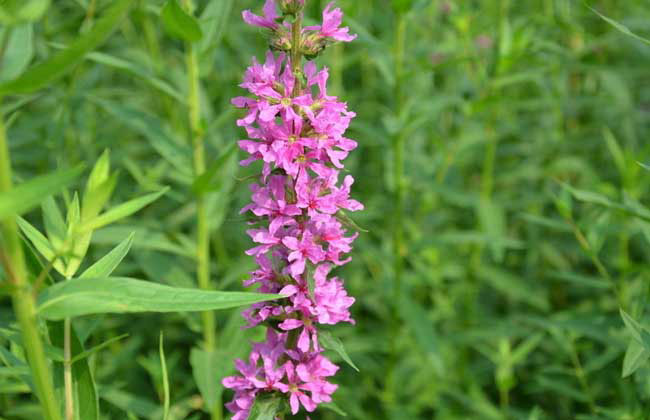
Purple loosestrife, also known as water willow, water willow, opposite-leaf lotus and so on, is a perennial herb of the genus Lythrum in the family Lythraceae. It is most suitable for mass planting along shallow-water banks or planting in ponds, and can also be used as flower border material and cut flowers, in pots or in bog gardens. As a medicinal herb it has heat-clearing, blood-cooling and other effects, and also has a blood sugar-lowering effect. Let us take a look at the cultivation techniques for purple loosestrife!
Growth habits of purple loosestrife
Purple loosestrife is produced throughout our country and is also cultivated; it is distributed in Asia, Europe, Algeria in Africa, North America and southeastern Australia, growing on riverbanks, lakesides, stream and ditch edges and moist grasslands. It likes strong light, is highly cold-tolerant, likes water and moisture, and is not strict about soil, growing better in deep, humus-rich soil.
Propagation techniques for purple loosestrife
1. Sowing: purple loosestrife is sown in spring in March to April. Before sowing, mix the seeds evenly with fine soil, then broadcast on the bed, cover with 2.5 cm of soil, and finally cover with grass and water. After sowing, seedlings emerge in 10-15 days; remove the grass immediately, and transplant when the seedlings are about 25 cm tall.
2. Cuttings: for purple loosestrife cuttings, select robust branches in spring, cut them into lengths of about 30 cm, remove the leaves, insert obliquely into the soil to a depth of 1/2 the cutting, press firm, water to keep moist, and transplant after roots and leaves have formed.
3. Division: for purple loosestrife division propagation, in spring from April to May dig up the root clumps, cut them into clumps of several buds, and plant in wet ground with sufficient base fertilizer.
Planting and management of purple loosestrife
1. Purple loosestrife has strong vitality and can be managed extensively, but choose an environment with sufficient light and good ventilation. Open-field cultivation is mostly in the shallow-water areas and wetlands of park lakeside garden waterscapes; in courtyards it can be pot-grown. The cultivation soil must be given an appropriate amount of decomposed chicken manure or cake fertilizer.
2. From planting until the rows close, cultivate and weed 3-4 times each year. Apply nitrogen fertilizer or compound fertilizer once each in spring and summer, and apply compost or barnyard manure once after autumn. Keeping the soil moist at all times is the most critical measure for growing purple loosestrife well. During the growing period, promptly remove weeds and water moss; before flowering and during the flowering period, apply monopotassium phosphate two to three times, and keeping the soil moist at all times can promote plant growth.
3. In late October the above-ground parts of purple loosestrife gradually wither; use pruning shears to cut off the above-ground clumps and let them overwinter naturally in the open field. Potted plants must be moved into a low-temperature cold shed to overwinter; throughout winter the potting soil must be kept moist, and the temperature should be controlled at 0°C to 5°C, so as to avoid sprouting early in winter. Generally divide and replant once every two to three years.
Cultivation and propagation of purple loosestrife
Purple loosestrife is a perennial emergent perennial-rooted herb of the genus Lythrum in the family Lythraceae, also called water willow, water willow and water willow. It is mostly used for mass planting by water and planting throughout ponds, and also as a flower border background in aquatic flower gardens. It is native to the warm temperate zones of Europe and Asia, likes light, likes water and moisture, and is relatively cold-tolerant; it can overwinter in the open field in both northern and southern parts of our country.
Cultivation management
Purple loosestrife has strong vitality and can be managed extensively, but choose an environment with sufficient light and good ventilation. Open-field cultivation is mostly in the shallow-water areas and wetlands of park lakeside garden waterscapes; in courtyards it can be pot-grown. The cultivation soil must be given an appropriate amount of decomposed chicken manure or cake fertilizer. During the growing period, promptly remove weeds and water moss. Before flowering and during the flowering period, apply monopotassium phosphate two to three times. Keeping the soil moist at all times can promote plant growth.
In late October the above-ground parts of purple loosestrife gradually wither; use pruning shears to cut off the above-ground clumps and let them overwinter naturally in the open field. Potted plants must be moved into a low-temperature cold shed to overwinter; throughout winter the potting soil must be kept moist, and the temperature should be controlled at 0°C to 5°C, so as to avoid sprouting early in winter. Generally divide and replant once every two to three years.
Cutting propagation
Three to five days before cutting, plow the paddy field and manually remove weeds and other debris. Leave an operation path 50 cm wide every 4 to 5 m, put in water 2 cm to 3 cm deep, and cuttings can be taken from March until before flowering.
Collect the top parts of branches that are true to variety, robust in growth and free of pests and diseases, 20 cm to 30 cm long, with the lower cut about 0.5 cm from a bud; the lower leaves need not be removed. Cutting spacing between plants and rows is 10 cm to 10 cm, depth 3 cm to 5 cm.
After inserting, irrigate with water 5 cm deep; roots form in 7 to 10 days, and water must not be lacking before rooting. Afterwards spray once with an insecticide and fungicide, mainly to control aphids. After half a month, fertilizer can be appropriately applied as a top dressing in the paddy field.