A Detailed Guide to the Cultivation and Care of Hydrocotyle vulgaris (Copper Coin Grass, South American Pennywort)
Hydrocotyle vulgaris (Copper Coin Grass, South American Pennywort)
Scientific name: hydrocotyle vulgaris
Common names: common pennywort, golden lotus, water coin, copper coin grass
Morphological features: a perennial emergent or hygrophytic herb with a trailing habit, 5-15 cm tall. It often roots at the nodes, the stem tips are brown, the leaves are alternate, with long petioles, roundly peltate, with wavy margins, grass-green, and 15-20 radiating veins. The inflorescence is an umbel, with small white flowers.
Ecological habits: highly adaptable, it prefers a location with ample light; in a shaded environment the plant grows poorly. It likes warmth and fears cold, growing well within a temperature range of 10°C to 25°C, and the overwintering temperature should not fall below 5°C. It tolerates shade and moisture, and is slightly drought-tolerant; semi-shade is best for cultivation.
Propagation methods: mostly propagated by cuttings of the creeping stems, usually carried out from March to May each year, and they root easily. It can also be propagated by seed.
Cultivation and care: it grows best in fertile soil and requires plenty of water. It can be grown in a pot without a drainage hole in the bottom to keep enough water. For a more attractive look, it can be planted in glassware or other decorative flower pots.
Flowering period: June to August.
Flower meaning: tenacity, resilience.
Landscape uses: clump planting and mass planting along water edges, water dishes, aquariums, ponds, wetlands, potted plants.
Species identification: a plant from a different family whose leaves are also peltate---Pilea peperomioides (Chinese money plant, mirror plant), a perennial of the Urticaceae family, with fleshy, entire leaves and petioles of unequal length that spread out in all directions; it is often potted as an indoor foliage plant.
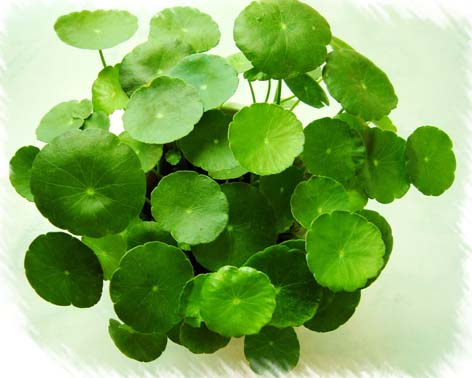
There is a plant whose leaves are round or kidney-shaped, just like the copper coins of ancient times, and so it is called copper coin grass. Copper coin grass (Hydrocotyle vulgaris) has many alternative names, such as: Centella asiatica, large-leaf money grass, beng da wan, ground line grass, lao gong gen, kui peng cai, beng kou wan, qi shi wan, di tang cao, large horse-hoof grass, tu xi xin, qian zao kou ban bian qian, di fu ping, wild winter flower vegetable, pan long cao, jie jie lian, large-leaf injury-tendon grass, hu gua cao, landing plum blossom, xiang gu cao, water coin, South American pennywort, golden lotus, and many more. Below we introduce copper coin grass:
I. Introduction to copper coin grass
Copper coin grass belongs to the Apiaceae family and the genus Hydrocotyle; it is a perennial creeping herb, 5-15 cm tall, often curling into a clump. The stems are slender and root at the nodes; the runners are well developed, with roots and leaves growing from the internodes. The leaves are round or kidney-shaped and peltate, with long petioles and wavy margins, and the underside is densely covered with appressed T-shaped hairs. The corolla is bell-shaped and yellow, and in summer and autumn it produces small yellow-green flowers. The fruiting period is July, with nearly spherical capsules. It is native to India and is now widely distributed in tropical and subtropical regions of the world; in China it is mainly distributed in the provinces south of the Yangtze River. Copper coin grass is vigorous, spreads very strongly, is easy to plant, propagates quickly, and can grow both in water and on land.
II. Care of copper coin grass
Copper coin grass likes a warm, humid climate, so a semi-shaded or shaded spot is best for cultivation; direct sunlight should be avoided. It is not demanding about the growing medium, and generally a soft, well-draining potting soil is best. Copper coin grass tolerates shade and moisture, is slightly drought-tolerant, and is highly adaptable. Therefore, care should pay attention to the following points:
1. The optimum water temperature for the growth of copper coin grass is 22-28°C. Since the plant tolerates moisture and is an emergent type, it can be grown in water basins and ponds. However, if grown in water, the water must be changed once a week and a special nutrient solution for foliage plants added.
2. Copper coin grass is a small plant and does not need a very large pot. Use ordinary garden soil, mix in an appropriate amount of river sand, and add a small amount of organic fertilizer as a base fertilizer.
3. Copper coin grass can be planted flat, with the rhizome just barely covered so that it is not visible; be sure not to plant it too deep. Keep it in semi-shade until new leaves have formed, then expose it to sunlight.
4. Copper coin grass is not cold-tolerant, so in winter the copper coin grass kept outdoors should have all the water poured off and be placed in a south-facing, sunny, sheltered spot so that it can overwinter safely; only some of the leaves will die off, but the underground root system will sprout again the following spring. If you are in a cold northern region without heating, you can make a cover to enclose the pot along with the plant, pour off the water, keep it moist, and as long as the room temperature does not fall below zero it will likewise continue to grow the following year.
5. If during cultivation you encounter yellowing leaves, you can consider whether it is due to watering that is not thorough enough or too much, freezing, a sudden change in room temperature that the copper coin grass cannot adapt to, or poor ventilation, poor photosynthesis, and other such causes.
III. Uses of copper coin grass
Copper coin grass can be used for landscaping, because its underground horizontal stems grow at an astonishing rate, spreading wherever they reach; it is one of the attractive and easy-to-grow aquatic plants. In addition, the whole plant of copper coin grass can be used as medicine and has a diuretic effect; the rhizome and leaves can be used as a vegetable dish; it can also be used as a Chinese herbal medicine to dispel wind, firm the intestines, improve eyesight and clear summer heat, and so on.
Introduction to copper coin grass
Click the image to go to the next page>>
There is a plant whose leaves are round or kidney-shaped, just like the copper coins of ancient times, and so it is called copper coin grass. Copper coin grass (Hydrocotyle vulgaris) has many alternative names, such as: Centella asiatica, large-leaf money grass, beng da wan, ground line grass, lao gong gen, kui peng cai, beng kou wan, qi shi wan, di tang cao, large horse-hoof grass, tu xi xin, qian zao kou ban bian qian, di fu ping, wild winter flower vegetable, pan long cao, jie jie lian, large-leaf injury-tendon grass, hu gua cao, landing plum blossom, xiang gu cao, water coin, South American pennywort, golden lotus, and many more. Below we introduce copper coin grass:
I. Introduction to copper coin grass
Copper coin grass belongs to the Apiaceae family and the genus Hydrocotyle; it is a perennial creeping herb, 5-15 cm tall, often curling into a clump. The stems are slender and root at the nodes; the runners are well developed, with roots and leaves growing from the internodes. The leaves are round or kidney-shaped and peltate, with long petioles and wavy margins, and the underside is densely covered with appressed T-shaped hairs. The corolla is bell-shaped and yellow, and in summer and autumn it produces small yellow-green flowers. The fruiting period is July, with nearly spherical capsules. It is native to India and is now widely distributed in tropical and subtropical regions of the world; in China it is mainly distributed in the provinces south of the Yangtze River. Copper coin grass is vigorous, spreads very strongly, is easy to plant, propagates quickly, and can grow both in water and on land.
II. Care of copper coin grass
Copper coin grass likes a warm, humid climate, so a semi-shaded or shaded spot is best for cultivation; direct sunlight should be avoided. It is not demanding about the growing medium, and generally a soft, well-draining potting soil is best. Copper coin grass tolerates shade and moisture, is slightly drought-tolerant, and is highly adaptable. Therefore, care should pay attention to the following points:
1. The optimum water temperature for the growth of copper coin grass is 22-28°C. Since the plant tolerates moisture and is an emergent type, it can be grown in water basins and ponds. However, if grown in water, the water must be changed once a week and a special nutrient solution for foliage plants added.
2. Copper coin grass is a small plant and does not need a very large pot. Use ordinary garden soil, mix in an appropriate amount of river sand, and add a small amount of organic fertilizer as a base fertilizer.
3. Copper coin grass can be planted flat, with the rhizome just barely covered so that it is not visible; be sure not to plant it too deep. Keep it in semi-shade until new leaves have formed, then expose it to sunlight.
4. Copper coin grass is not cold-tolerant, so in winter the copper coin grass kept outdoors should have all the water poured off and be placed in a south-facing, sunny, sheltered spot so that it can overwinter safely; only some of the leaves will die off, but the underground root system will sprout again the following spring. If you are in a cold northern region without heating, you can make a cover to enclose the pot along with the plant, pour off the water, keep it moist, and as long as the room temperature does not fall below zero it will likewise continue to grow the following year.
5. If during cultivation you encounter yellowing leaves, you can consider whether it is due to watering that is not thorough enough or too much, freezing, a sudden change in room temperature that the copper coin grass cannot adapt to, or poor ventilation, poor photosynthesis, and other such causes.
III. Uses of copper coin grass
Copper coin grass can be used for landscaping, because its underground horizontal stems grow at an astonishing rate, spreading wherever they reach; it is one of the attractive and easy-to-grow aquatic plants. In addition, the whole plant of copper coin grass can be used as medicine and has a diuretic effect; the rhizome and leaves can be used as a vegetable dish; it can also be used as a Chinese herbal medicine to dispel wind, firm the intestines, improve eyesight and clear summer heat, and so on.