Care and Management Methods for Dichondra repens (Yellow Gall Grass, Moneywort)
Dichondra repens (Yellow Gall Grass, Moneywort, Pouch Grass)
Scientific name: dichondra repens
Aliases: Small Moneywort, Pouch Grass, Meat Wonton Grass, Golden Key, Copper Coin Grass, Small Dichondra, Jaundice Grass
Family and genus: Convolvulaceae
Morphological characteristics: Perennial creeping herb. Leaves alternate, horseshoe-shaped, bright green. Flowers solitary in leaf axils, bell-shaped, pale yellow.
Ecological habits: It prefers warm, humid climates. It is not only highly adaptable, with strong competitiveness and invasiveness, and vigorous vitality, but also has a certain tolerance for trampling. It is not very demanding regarding soil, and can be planted in both sandy loam and clay as long as drainage conditions are moderate. Dichondra repens mostly grows under open forests, at forest edges and on hillsides, roadsides, riverbanks, river flats and shady moist grasslands, mostly growing in clusters and distributed in patches. Dichondra repens has a growth habit of both liking light and tolerating shade, and has strong disease resistance and pollution resistance.
Flowering period: April to May.
Landscape uses: Low and dense, evergreen all year round, with emerald green leaf color, strong stress resistance and spreading ability, it is an excellent foliage ground cover for shady moist areas. South of the Yangtze River basin, it is used as ornamental lawn and traffic safety lawn, as the base color of flower beds and flower borders, for soil fixation and slope protection, and mixed with oxalis to form a flower-studded lawn.
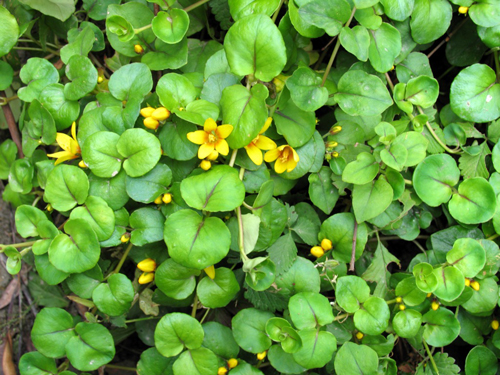
Fertilization methods for Dichondra repens, cultivation methods for Dichondra repens / care knowledge for Dichondra repens
Flower and Bonsai Network introduction: Today, Flower and Bonsai Network editors share with you an article about fertilization methods for Dichondra repens, cultivation methods for Dichondra repens / care knowledge for Dichondra repens. Let's take a look.
Dichondra repens grows creeping on the ground, and its leaves are relatively broad, making fertilization difficult. Improper methods can easily cause seedling burn. Let's take a look at the fertilization methods for Dichondra repens.
Introduction to Dichondra repens
Dichondra repens, also known as Small Moneywort, Pouch Grass, Meat Wonton Grass, Golden Key, Copper Coin Grass, Small Dichondra, Jaundice Grass, is a plant of the genus Dichondra in the family Convolvulaceae. It is distributed in areas south of the Yangtze River in China (including the Taiwan region), and is widely distributed in Guizhou, Guangxi, Fujian, Sichuan, Zhejiang, Hunan and other places. It grows in areas at altitudes of 1300 m to 1980 m, mostly on roadsides, hillside grasslands or ditch edges, and has been introduced and cultivated artificially.
Dichondra repens is a commonly used herbal medicine among the Miao people for treating hepatitis, with the Miao medicine name "Wo Bi She Liu". It is a perennial creeping herbaceous plant, harvested from April to June. Bitter and pungent in taste, slightly cold in nature, mainly entering the lung and stomach meridians, it has the effects of clearing heat and detoxifying, promoting diuresis, and activating blood circulation. It is a Miao folk medicinal material with abundant resources and good development and utilization value. The herbal medicine Dichondra repens, also called Small Moneywort, mainly treats: clearing heat; draining dampness; detoxifying. Used for jaundice; dysentery; urolithiasis; white turbidity; edema; boils and swelling toxins; traumatic injuries; venomous snake bites.
Fertilization methods for Dichondra repens
Dichondra repens likes nitrogen fertilizer. Usually, along with watering and rain, an appropriate amount of nitrogen fertilizer can be applied as a top dressing. It is best to apply about 3-5 kg per mu of urea and 5-10 kg per mu of diammonium phosphate. Generally, after 2 or 3 years of turf cultivation, the rhizomes tend to become densely packed together, often causing soil compaction, which is not conducive to aeration and water infiltration. At this time, according to the specific situation, holes can be pierced, or a knife or shovel can be used to cut lines to sever the grass roots, so as to improve soil looseness, while applying an appropriate amount of nitrogen fertilizer and watering appropriately to help it regain vitality as soon as possible.
Precautions for fertilizing Dichondra repens
Usually, before fertilizing Dichondra repens, if a fertilizer with high solubility is used, it must first be dissolved, and then sprayed for fertilization. If a fertilizer that cannot dissolve immediately is used, after fertilizing, a large amount of water should be applied to wash the fertilizer stuck on the leaves into the soil so that it dissolves as quickly as possible and reduces the degree of burning; or after fertilizing, gently sweep the fertilizer under the leaves with a broom, then combine with watering. Fertilizing should also be avoided in high-temperature weather.
Cultivation methods and precautions for Dichondra repens
Dichondra repens is a perennial creeping herbaceous plant and a commonly used folk medicine. It mostly grows on roadsides, hillside grasslands or ditch edges, and has been introduced and cultivated artificially.
Cultivation methods for Dichondra repens
Light and temperature
The growth of Dichondra repens requires sufficient light. It needs more sunlight every day so that Dichondra repens can grow vigorously and emerald green. Dichondra repens has a growth habit of both liking light and tolerating shade, and can grow in semi-shady and humid places. It has low temperature requirements, but when the temperature drops to -6°C to -7°C, it will suffer frost damage.
Water and fertilizer management
During the growth process, Dichondra repens needs regular irrigation and moderate fertilization. After the small seedlings of Dichondra repens emerge, water once or twice a week, and irrigation frequency should be increased in dry seasons. After the plants mature, watering should be controlled in early spring and early winter, and during the peak growth period around the Spring Festival, the number of waterings should be determined according to the soil quality.
Dichondra repens likes nitrogen fertilizer. Usually, in combination with rain and watering, an appropriate amount of nitrogen fertilizer should be applied as a top dressing. After fertilizing, a large amount of water should be applied to reduce the degree of leaf burn. Or fertilize first, then sweep the fertilizer under the leaves, and then combine with watering. At the same time, fertilization is not allowed during high summer temperatures.
Soil
Dichondra repens is not very demanding regarding soil. As long as drainage conditions are moderate, it can be planted in both sandy loam and clay.
It mostly grows in fertile fields or mountain areas.
Precautions for cultivating Dichondra repens
Weed removal
When Dichondra repens is used for lawn greening, because it takes a period of growth to fully cover, weeds will appear. When there are few weeds, manual pulling can be used; if there are many weeds, herbicides can be sprayed to kill them.
Propagation methods for Dichondra repens
Dichondra repens is commonly propagated by seed sowing and division.
Pest and disease control for Dichondra repens
The Dichondra repens lawn has strong disease resistance, with only southern blight and a small amount of Phyllosticta leaf spot disease occurring. Rust disease can also occur,
sclerotinia disease.
The larvae of scarab beetles, white grubs, and the larvae of noctuids, armyworms, and black cutworms are the main pests of Dichondra repens lawns. There are also other harmful insects such as snails, the meadow moth, and Atractomorpha crenulata.
How to grow Dichondra repens into a waterfall effect
When cultivating Dichondra repens, light is very important. Dichondra repens needs an environment with sufficient light. Only with sufficient light and good ventilation will Dichondra repens grow well with lush branches and leaves, and only then will hanging-basket Dichondra repens have a waterfall effect. It should be noted that Dichondra repens needs appropriate shading in summer.
Watering and fertilizing Dichondra repens
Watering is the key to good growth of Dichondra repens. Dichondra repens is a plant with relatively fine and dense roots and is not very drought-tolerant. During cultivation, the soil needs to be kept moist. How to grow Dichondra repens into a waterfall effect. How to grow Dichondra repens into a waterfall effect. Generally, when cultivating Dichondra repens, it is necessary to water reasonably and often spray water on the Dichondra repens plants. Be careful not to let it lack water, as lack of water will cause Dichondra repens to drop leaves and have sparse branches and leaves, affecting ornamentality. How to grow Dichondra repens into a waterfall effect. Article. How to grow Dichondra repens into a waterfall effect. Only with sufficient water will hanging-basket Dichondra repens have dense branches and leaves.
Fertilization is also a very important step. Dichondra repens relatively likes nitrogen fertilizer. With sufficient fertilizer, the branches and leaves will grow more luxuriantly, and it will also be easier to create a hanging-basket Dichondra repens with a waterfall effect.
When cultivating Dichondra repens, nitrogen fertilizer can be applied in combination with watering, but do not contaminate the leaves.
Pruning Dichondra repens
To grow hanging-basket Dichondra repens into a waterfall effect, another very important point is pruning. How to grow Dichondra repens into a waterfall effect. Flower Encyclopedia. The growth rate of Dichondra repens is still relatively fast, but during cultivation, proper pruning can make its branches and leaves more numerous and dense. And pruning can promptly cut off leaves that affect ornamentality and tidy up relatively messy growing branches. In this way, a beautiful waterfall can be shaped and its good form maintained.
Disease control for Dichondra repens
Disease control
The Dichondra repens lawn has strong disease resistance, with only southern blight and a small amount of Phyllosticta leaf spot disease occurring. The above diseases mostly occur in the high-temperature, high-humidity season from July to August. Using chemicals such as chlorothalonil and carbendazim, sprayed once every 7 to 10 days, can effectively prevent and control the occurrence and development of diseases.
Rust disease
The main symptom is the production of reddish-brown powdery scabs or striped spots on stems and leaves, which later turn dark brown. Generally, rust spores begin to spread in April, first appearing on the leaves, and in summer expand to the entire plant. In severe cases, it can cause the lawn to wither and die in large patches.
Control methods
First, note that nitrogen fertilizer should be avoided in summer; second, use chemical control. You can use 20% triadimefon emulsifiable concentrate at 30 to 40 ml per mu, or 40% carbendazim suspension concentrate at 75 to 100 ml per mu.
Sclerotinia disease
The main symptom of affected plants is the appearance of round brown or slightly brown spots, which become large lesions as the disease deepens. Especially in summer high temperature and high humidity, or improper nitrogen fertilizer application, the disease will be aggravated, causing large bald patches in the lawn.
Control methods
First, when the disease occurs, dig out the plants in the affected area together with 5 cm of soil and dispose of them centrally, and use 40% quintozene powder at 2 grams per square meter mixed with soil to disinfect and sterilize. Second, pay attention to drainage during the rainy season. When the disease is severe, 75% chlorothalonil wettable powder can be used for control, at 100 to 125 grams per mu.
Southern blight
Leaves, stems and roots can all be affected. Affected leaves show irregular yellow withered lesions, and in severe cases the entire leaf withers and dies. On the stem base and near the soil surface of severely affected plants, white silky mycelium and sclerotia about 1 mm in diameter can be seen. The sclerotia are initially white, then turn yellow and brown. Affected yellowing Dichondra repens lawns initially appear as circular patches several tens of centimeters in diameter, and as the disease develops, they can expand into irregular withered grass rings several meters across. Sclerotia are the main primary infection source of this disease. Sclerotium rolfsii is a soil-inhabiting fungus, and its mycelium can spread widely in the soil, becoming a secondary infection source. This disease is a high-temperature (25°C-35°C optimum), high-humidity disease. In addition, soil rich in organic matter also favors the occurrence of this disease.
Chemical control
You can choose 1% Junliting 1000-fold solution or 25% prochloraz 2000-2500-fold solution for spraying.
Pest control
The larvae of scarab beetles, white grubs, and the larvae of noctuids, armyworms, and black cutworms are the main pests of Dichondra repens lawns. The leaves of Dichondra repens lawn grass are relatively tender and high in sap content, and are very seriously damaged by armyworms. During the adult emergence period, use the phototaxis and chemotaxis of adults with black light lamps, poison bait, and poisonous grass for trapping and killing to reduce their egg-laying. For white grubs, use 50% phoxim 1000-fold solution and spray the lawn in the evening (or pour it on); for armyworms and black cutworm larvae, use 40% omethoate 1000-fold solution for spraying control. Especially repeating the spray once the next day after spraying gives the best effect. Insecticides such as phoxim and chlorpyrifos may also be considered. Another organism harmful to Dichondra repens is the snail, which can be controlled by alternating use of Mida, Miehanluo and the like.
The meadow moth
It causes serious damage to lawns. It bores into and feeds on grass roots and stems, interrupting the plant's water supply, causing stems and leaves to turn yellow and even die.
Control methods
Black light lamps can be used for trapping and killing, sugar-vinegar solution can also be used for trapping and killing, and 40% chlorpyrifos 1000-fold solution can also be sprayed.
Atractomorpha crenulata
It chews leaves and tender stems. When the infestation is severe, the stems and leaves are all eaten. The damage is heaviest from June to August.
Control methods
Use 0.5 kg of trichlorfon or dichlorvos per mu added to 500 kg of water for spraying, or concentrate manpower in the morning to catch and kill them.
Black cutworm
It specifically feeds on young tender stems and leaves, preventing the lawn from growing normally. In severe cases, it can cause plants to die in patches.
Control methods
Use 50% diazinon emulsifiable concentrate at 50 to 100 ml per mu, or 25% carbaryl wettable powder at 200 to 250 grams per mu.
Medicinal or dietary value of Dichondra repens
The medical information and health dietary information on Flower Care Network is for reference only and cannot be used as a basis for diagnosis or medical treatment. Any health issues should be consulted with professional medical personnel, and treatment of any disease should follow a doctor's advice.
Ultimate flower care mission: To love yourself, start from reality and strictly follow a doctor's advice. Regarding illness, do not be careless, do not delay, do not give up hope, face it bravely, warm the silent world with love, and care for the flower field in your heart with your heart.
Medicinal value
Functions and indications
Jaundice; dysentery; urolithiasis; white turbidity; edema; boils and swelling toxins; traumatic injuries; venomous snake bites. Clear heat and drain dampness, detoxify and reduce swelling. Used for hepatitis, cholecystitis, dysentery, nephritic edema, urinary tract infection, urinary tract stones, tonsillitis, traumatic injuries.
Usage and dosage
Internal use: decoct in water, 6-15 g; fresh product 30-60 g. External use: appropriate amount, mash and apply.
Nature and flavor
Slightly bitter, sweet, cold in nature. Enters the water and wind pagodas.
Attached formulas
1. To treat "Long Niu," "Long Meng Sha Hei": Dichondra repens 15 g, Siegesbeckia herb 10 g, plantain herb 15 g, verbena root 15 g. Decoct and take.
2. To treat "Long An Da Le": Dichondra repens 30 g, tick clover 15 g, cassia root 15 g, cogongrass rhizome 15 g, isatis root 20 g. Decoct and take.
3. To treat "Long Hai Mai Mao Ba": Dichondra repens 20 g, gourd tip 15 g, black sugarcane bud eye 20 g, Acorus gramineus 10 g. Decoct and take.
4. To treat "Long Hai Xian": Dichondra repens 30 g. Decoct in water, add a little table salt and take internally.
5. To treat "Long Sha Long Jie Huo," "Long Sha Long Jie Hou Gai Ban, O Le," "Long Sha Long Da Jie Beng Liang," "Shuo Feng Ling Lan": Dichondra repens 15 g, mash, mix with external water and take.
Medication contraindications
"Gangmu Shiyi": Avoid salt.
Care points for the ground cover plant Dichondra repens
Dichondra repens Forst, also known as Small Moneywort, Pouch Grass, Meat Wonton Grass, Golden Key, Copper Coin Grass, Small Dichondra, Jaundice Grass, is a plant of the genus Dichondra in the family Convolvulaceae. Its leaves look like horseshoes, so it is easy to remember. It is mostly planted under open forests, at roadsides or beside ponds, and can also be potted for ornamentation.Habits: It prefers warm, humid climates. It is not only highly adaptable, with strong competitiveness and invasiveness, and vigorous vitality, but also has a certain tolerance for trampling. Dichondra repens has a growth habit of both liking light and tolerating shade, and has strong disease resistance and pollution resistance.
Care points: Because Dichondra repens grows creeping on the ground and its leaves are relatively broad, fertilization is very difficult. If fertilization techniques are not strictly controlled, severe seedling burn will occur. Generally speaking, if a fertilizer with high solubility is used, it is best to dissolve it first and then spray it with a sprayer; if a fertilizer that cannot dissolve immediately is used, then after fertilizing, a large amount of water should be applied to wash the fertilizer falling on the leaves into the soil and make it dissolve as quickly as possible, which can reduce the degree of burning; or fertilize first, then sweep the fertilizer under the leaves with a broom, and then combine with watering. At the same time, avoid fertilizing at high temperatures.
Weed removal: When there are few weeds, manual pulling can be used; if there are many weeds, herbicides can be used. A single spray of the compound agent Lvjun SL-2 at 525-675 g/hm2 can control the harm of most weeds, with a residual effect lasting up to 80-90 d, and it is safe for Dichondra repens lawns. It is worth noting that herbicides are best used at the weed seedling stage for ideal results.