What are the care precautions for potted parlour palm?
The parlour palm, also known as the miniature palm, is a small evergreen dwarf shrub of the palm family. The plant is short in stature; the stem is solitary, upright and unbranched, dark green, with irregular ring-like markings on its surface; the leaves are pinnately parted, divided into lanceolate segments, dark green, leathery and glossy; the flowers are yellow and borne in small spherical clusters, opening in late spring and early summer. The fruit ripens in autumn and is orange-red.
It likes a hot, humid and semi-shaded environment and is not tolerant of drought or severe cold. Because the parlour palm has rather fine roots, a loose, fertile potting mix should be chosen for container growing. Since it prefers a more shaded environment, when grown indoors it should be placed near a north or east window or in another spot with bright, indirect light. The parlour palm fears direct strong light above all; even a short period of exposure to the sun will cause the leaves to scorch and turn yellow. If it is kept in too dark a place for a long time, the leaf colour will also fade and the gloss will diminish. The optimum growing temperature is 20-30 degrees Celsius; in winter the room temperature should be 12-14 degrees Celsius, and must never fall below 10 degrees Celsius.
The parlour palm has a strong water-absorbing capacity, so during the growing season the potting soil should be kept constantly moist, while watering should be controlled during the dormant period. In summer watering must be plentiful, and the leaves should also be sprayed frequently to raise the air humidity. To suit indoor ornamental needs, the plant height is best kept at 40-60 cm, so fertiliser should not be applied too much. Generally, during the seedling stage, applying a dilute liquid fertiliser 3-4 times in spring and autumn is enough. For the fertiliser type, a nitrogen-to-phosphorus ratio of 1.5:1.2 is best. This ratio both promotes sturdy stems and improves the gloss of the leaves. Repot once every 2-3 years in spring to encourage growth. Because the parlour palm is difficult to root from cuttings, it is mainly propagated by sowing.
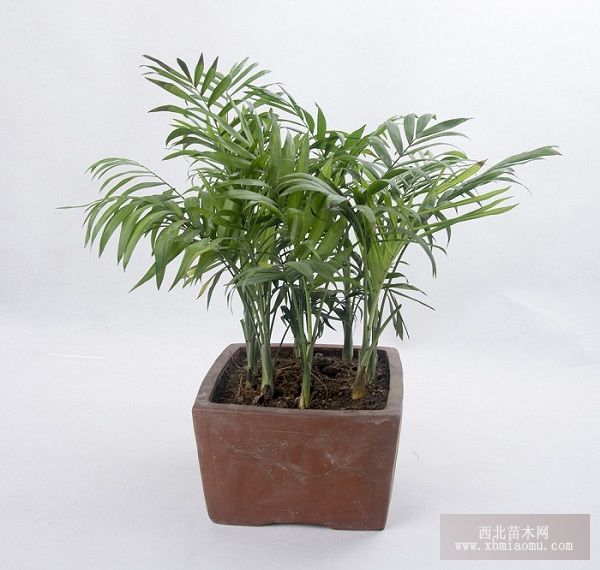
Cultivating the parlour palm as a small potted plant
When I heard the name of the small potted parlour palm, I thought it was a miniature version of a coconut palm, but when I saw it at the flower and bird market it was still slightly different from what I had imagined. Still, the tree form of the small potted parlour palm really does resemble the coconut palms of the tropics; its dainty, delicate and beautiful form is probably where the name parlour palm comes from. Among the many plants, I chose the shade-tolerant small potted parlour palm as an indoor plant, filling the room with a tropical feel; small potted plants like this are very popular these days.
Small potted parlour palm - an evergreen dwarf shrub belonging to the palm family. The planting height is around 1 m; the stem of the small potted parlour palm is slender and long, the leaf veins are irregular, and the leaves grow at the tips of the branches, dark green in colour, with the leaflets fully parted, widest below the middle and gradually narrowing towards the top, sickle-shaped and glossy. The small potted parlour palm flowers in spring, with small yellow spherical flowers, and there are male and female flowers; the male flowers are neatly arranged and upright, while male flowers with better nutritional conditions bend slightly because of their abundant blooms, and the ripe round small berries are orange-yellow. Potting medium: the roots of the small potted parlour palm are slender, so a free-draining, moist, fertile potting mix should be used as the growing medium; if heavy clay soil is used, root rot will occur.
Light: the small potted parlour palm likes shade; if it is grown indoors it can be placed in a shaded environment or where there is faint indirect light. What the small potted parlour palm dreads most is direct exposure to strong light; even a brief period of sun will likewise cause the leaves to dry out and turn yellow and lose their original colour. Conversely, if the small potted parlour palm is kept in too dark a spot for a long time, the leaf colour will likewise become paler and lose its original gloss. If the small potted parlour palm is grown outside the room, some shade netting can be used to block about 60% of the light.
Temperature: if the small potted parlour palm is kept in a hot, humid and semi-shaded environment, it grows somewhat faster; what the small potted parlour palm dreads most is direct beams of light. During the growing season a temperature of 20℃-30℃ is most suitable; in winter an indoor temperature of 12℃-14℃ is appropriate, and the lowest temperature must not fall below 10℃. At 13℃ it enters dormancy, and at an indoor temperature of around 8℃ it can safely get through the cold winter.
Water: the small potted parlour palm has a strong water-absorbing capacity, so during the growing season it can be watered frequently to keep the potting soil moist, while during the dormant period the amount of water must be controlled. In summer the small potted parlour palm must be watered plentifully, and the leaves should also be sprayed often to raise the air humidity; a little water may be left standing in the pot. From October until February of the following year is the relatively dormant period of the small potted parlour palm (night temperature 12℃-14℃); reduce watering so that the potting soil is merely kept moist, to prevent root rot, yellowing leaves and dieback caused by temperatures that are too low. If the small potted parlour palm is grown in an air-conditioned room with heating, the potting soil should be kept moist and the leaves should also be sprayed often to increase the humidity on the leaf surface.
The small potted parlour palm is propagated by sowing or by division.
Sowing method: a vigorous, sturdy small potted parlour palm plant can flower after 3-4 years, and seeds are obtained by hand pollination; its fruit takes 6-7 months to mature. Freshly harvested small potted parlour palm seeds can be sown right away; before sowing, the small potted parlour palm seeds should be soaked in warm water at 35℃-40℃ for 36 hours, and once the small potted parlour palm seeds have absorbed water and swollen they are planted, placed at a depth of 1.5 cm and covered with soil, watered thoroughly with a fine-nozzled sprinkler head, and covered with plastic film over the top of the pot to raise the temperature, kept within the range of 22℃-25℃; the small potted parlour palm seeds will germinate within 30-40 days. Once the seedlings have put out 2 or 3 true leaves they can be potted up together with their root ball.
Division propagation: the small potted parlour palm tillers fairly profusely from emergence to stem elongation, so it should be divided. This is best done before growth resumes at the end of winter and the beginning of spring.