How to care for a potted Buddhist pine (Podocarpus macrophyllus) so it grows vigorously
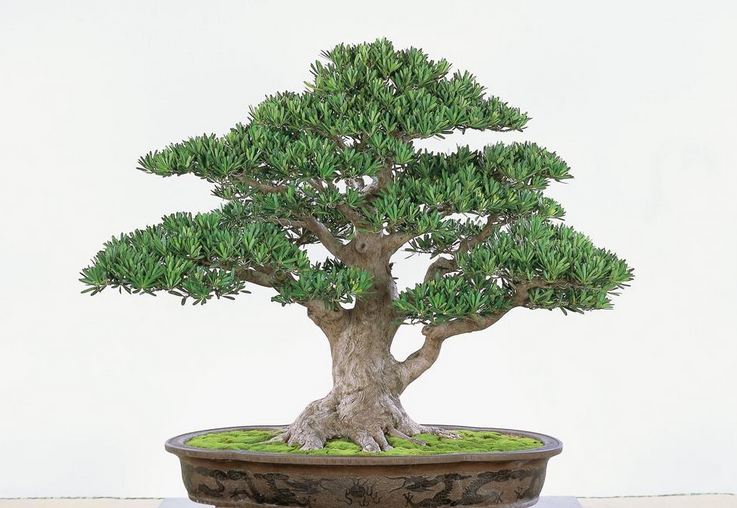
The Buddhist pine is an evergreen shrub of the family Podocarpaceae. Its stems are upright and straight. In spring and autumn it sprouts new branches and leaves once each season; the internodes are dense and it produces many branches. The leaves are linear-lanceolate, glossy and dark green, alternate, and arranged in a spiral pattern as they grow.
It likes warm, humid and semi-shaded environments, and prefers fertile, moist, well-drained soil. For potting, use a growing mix of leaf mold or peat soil with 1/5 river sand, blended with a small amount of bone meal. When the outdoor temperature is steady at around 10°C, move it outdoors to a south-facing balcony or a sheltered, sunny spot in the courtyard; after summer arrives, move it to a semi-shaded place. After rain, be sure to tip out any water accumulated in the pot promptly to avoid waterlogging.
The Buddhist pine is drought-tolerant, so during the growing season watering should keep the potting soil on the slightly dry side. If watered too much and the potting soil stays soggy for a long time, it will cause root rot and yellow leaves; in severe cases a large number of leaves drop and the plant dies. In summer, water evaporates quickly, so watering must be more generous; if the potting soil is too dry, the leaves easily scorch. The Buddhist pine does not like strong fertilizer; applying a dilute liquid fertilizer based mainly on nitrogen 2~3 times each in spring and autumn is enough for it to grow well. On the second day after fertilizing, water once, which helps the roots absorb it.
For plants that have already been shaped, pay attention to pinching and pruning to prevent excessive leggy growth of branches and leaves, so as to maintain the original form. Pinching and pruning can generally be done during the spring and autumn growing seasons. When the winter temperature drops to 5°C, move it indoors; after moving indoors, control watering and keep the room temperature at 7~8°C. Too high a room temperature is bad for the next year's growth. Generally, repot once every 1~2 years, and repotting can be done in either spring or autumn. When repotting, be careful to prune away some of the excess roots and rotten fibrous roots, and also cut out overly dense branches, adding fresh growing mix.
I. Introduction to the Buddhist pine
The Buddhist pine is one of the more common plants in gardens, and is also one of the internationally protected Class II plants. The Buddhist pine can reach a height of 18 m, its leaves are arranged in a spiral shape, and it has male and female plants; the flowering period is from April to May, and the fruiting period is from August to September. The flowers of the Buddhist pine are also edible and have a faint sweet taste. The Buddhist pines that receive special conservation are those in primeval forests, while the Buddhist pines seen in cities are basically cultivated artificially and are therefore no longer under protection. Of course, whether in primeval forests or in cities, the Buddhist pine plays an ecological role among green trees that other plants cannot replace.
II. Morphological characteristics and habits of the Buddhist pine
Evergreen tree, up to 20 m tall, with a trunk diameter at breast height of up to 60 cm. The crown is broadly ovate. The bark is grayish-brown and peels off in thin scales. The branches are relatively short, growing densely and spreading horizontally. The leaves are spirally alternate. The leaves are linear-lanceolate, 7-12 cm long and 0.7-1.0 cm wide, with a distinctly raised midrib; the upper surface is dark green and glossy, and the underside is light green or glaucous green. Male cones are borne in clusters of 3-5 in the leaf axils, female cones are solitary in the leaf axils, and the flowering period is April-May. The seeds are ovoid, green when unripe and purple when ripe, covered with a white bloom, and borne on a thick, fleshy receptacle that turns from deep red to purple. It looks just like an arhat (luohan) in red robes sitting in meditation, hence the name.
III. How to grow the Buddhist pine
1. Soil: It requires a slightly acidic growing mix rich in humus, loose and fertile, and well-drained. In alkaline soil the leaves turn yellow and growth is slow. It is long-lived, able to reach several hundred years, or even over a thousand years.
2. Watering: The Buddhist pine is not a plant of the pine family and is not drought-tolerant. On the contrary, the Buddhist pine tolerates shade and moisture, and during the growing period it should be watered frequently, but it should not become waterlogged. In the Shunde area, on sunny summer days, water frequently; generally water once each in the morning and evening, and also spray water on the leaves regularly so the foliage stays fresh green and the plant grows well. Summer usually brings a lot of rain, and the Buddhist pine does not tolerate waterlogging, so be careful to prevent prolonged standing water.
3. Sunlight: The Buddhist pine is a neutrally shade-leaning tree species; it can take relatively strong light and can also grow in fairly shady conditions. Although summer temperatures are high and the sunlight is intense, since large Buddhist pine trees benefit from high temperature and strong light for maintaining their tree form and leaf shape, there is no need to shade large Buddhist pine trees in summer. However, because young Buddhist pine seedlings have tender tissues, they should not be exposed to strong light for long periods; it is best to keep them under tree shade.
4. Temperature: For potted plants in northern regions, move them outdoors when the outdoor temperature is steady at around 10°C, and keep them in a sheltered, sunny spot outdoors; after summer arrives, move them to a semi-shaded place. In winter, when the temperature does not drop to 5°C, they should be moved indoors; after moving indoors, control watering, and they can overwinter safely as long as conditions do not freeze.
5. Fertilizing: The Buddhist pine likes fertilizer and should be given light, frequent applications, mainly nitrogen fertilizer, to which an appropriate amount of black alum can be added and fermented into alum fertilizer water. During the growing season, fertilize once every 1-2 months, and fertilizing can be done together with watering (water-to-fertilizer ratio 9:1).
6. Pests and diseases: The main diseases are leaf spot and anthracnose, sprayed with a 500-fold dilution of 50% thiophanate-methyl wettable powder. The pests include scale insects, red spider mites and large bagworm moths, which can be killed by spraying a 1500-fold dilution of 40% omethoate emulsifiable concentrate.
IV. How to grow the Buddhist pine in pots
1. Location: In summer, the Buddhist pine should be placed in a warm, humid, well-ventilated place; in winter it should be kept indoors above 5°C. But the temperature should not be too high, so as not to affect its dormancy.
2. Watering: The Buddhist pine likes moist soil; during the growing season it should be watered frequently to keep the potting soil moist, but the pot must not become waterlogged. In summer, spray water on the leaves or the ground regularly to keep the foliage bright. The Buddhist pine is not a plant of the pine family and is not drought-tolerant. On the contrary, the Buddhist pine tolerates shade and moisture, and during the growing period it should be watered frequently, but it should not become waterlogged. On sunny summer days, water frequently; generally water once each in the morning and evening, and also spray water on the leaves regularly so the foliage stays fresh green and the plant grows well. Summer usually brings a lot of rain, and the Buddhist pine does not tolerate waterlogging, so be careful to prevent prolonged standing water.
3. Fertilizing: A Buddhist pine that has already been shaped should not be fertilized much. Usually during the growing season, apply a fully rotted dilute liquid fertilizer once a month, and stop fertilizing after autumn arrives. The Buddhist pine likes fertilizer and should be given light, frequent applications, mainly nitrogen fertilizer, to which an appropriate amount of black alum can be added and fermented into alum fertilizer water. During the growing season, fertilize once every 1-2 months, and fertilizing can be done together with watering (water-to-fertilizer ratio 9:1). For large-area plantings, a semi-circular trench application can be used, applying 300-500 g of fast-dissolving compound fertilizer each time. For potted plants, spray a water-fertilizer solution containing 0.5%-1.0% compound fertilizer or a dilute cake fertilizer liquid each time.
4. Pruning: The Buddhist pine should be pruned frequently to maintain its tree shape. When it flowers, it is best to remove the flower buds promptly to avoid consuming nutrients.
5. Repotting: The Buddhist pine is usually repotted once every 2-3 years. This is generally done in March-April.
6. Pest and disease control: Pay attention to controlling pests and diseases of the Buddhist pine, especially in summer and hot seasons, and watch out for scale insects and red spider mites. Common diseases include sooty mold and leaf spot, which can be controlled with 0.5%-1% Bordeaux mixture sprayed once every 10 days for 3 consecutive times, starting one month before the plum rain season. The main pests include large bagworm moths, red wax scale insects and red spider mites, which can be killed by spraying a 1200-1500-fold dilution of dichlorvos, or a 1500-fold dilution of 40% dimethoate.
The Buddhist pine is one of the internationally protected Class II plants, so friends who like it should not casually collect it from the wild! If you like the Buddhist pine, you had better grow one yourself. The above is the content on how to care for a potted Buddhist pine. If you want to learn more about flowers, please stay tuned for more wonderful content.
What are the care methods for a potted Buddhist pine?
The Buddhist pine stays green all year round and looks great as a home ornamental. However, because the Buddhist pine also has the feng shui function of bringing in wealth and keeping you safe, there are especially many people who keep potted Buddhist pines at home. So what are the care methods for a potted Buddhist pine? Let me introduce them below.
What are the care methods for a potted Buddhist pine?
1) Preparation of growing mix. It is best to use leaf mold or peat soil with 2/5 river sand, blended with a small amount of bone meal.
2) Water requirements. Because the Buddhist pine is relatively drought-tolerant, during the growing season the potting soil should be kept slightly dry. If watered too much and the potting soil stays waterlogged for a long time, it will cause root rot, yellow leaves, and in severe cases a large number of leaves drop and the plant dies. In summer, water evaporates quickly, so watering must be ample; if the potting soil is too dry, it will also cause the leaves to turn yellow and wither.
3) Environmental requirements. When the outdoor temperature is steady at around 10 degrees, it should be moved outdoors; after summer arrives, move it to a semi-shaded place. After rain, be careful to tip out any water accumulated in the pot promptly to prevent waterlogging.
4) Fertilizer requirements. Because the Buddhist pine does not like fertilizer that is too strong, it is only necessary to apply a dilute liquid fertilizer based mainly on nitrogen 2~3 times each in spring and autumn. On the second day after fertilizing, water once, which helps the roots absorb it.