Methods and Tips for Moving Potted Flowers Indoors at the Right Time
In northern China, after the Cold Dew solar term, most flowers should be moved indoors for the winter one after another according to their cold resistance, to prevent cold and freezing damage. The specific time for moving them indoors depends on the flower species. For most flowers, do not rush to move them indoors as soon as the weather turns cold, because moving them in too early affects nutrient accumulation and is detrimental to growth and development the following year. Therefore, provided they will not suffer cold damage, it is better to move them indoors a little later.
At this time, the potted flowers can be placed in a sheltered, sunny spot so they undergo a period of low-temperature hardening, which is beneficial for most flowers. Under normal circumstances, clivia (Clivia miniata), poinsettia (Euphorbia pulcherrima), Chinese hibiscus (Hibiscus rosa-sinensis), fuchsia (Fuchsia hybrida), and cacti and other succulents are best moved indoors when the temperature drops to around 10°C; potted roses, grapes, figs, pomegranates, and the like need a period of freezing at -3 to -5°C to induce dormancy before being moved into a cold room (around 0°C) for storage. Newly moved indoor flowers need attention to ventilation.
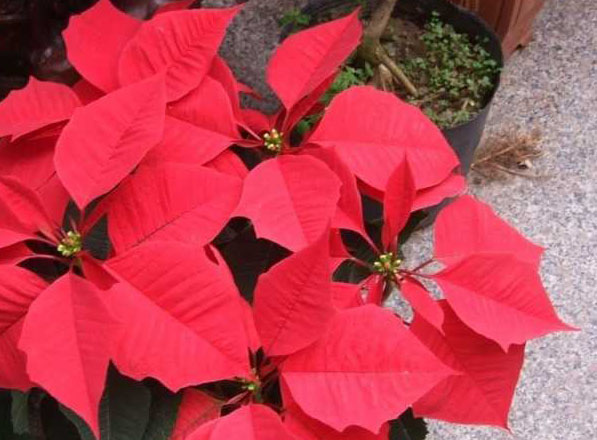
Poinsettia likes full sunlight. All year round, except for newly transplanted seedlings, it should be grown in a sunny, well-ventilated place. When the temperature is above 33°C, take care to provide appropriate shade to prevent direct strong sunlight. In the hot, muggy summer weather, and after cloudy and rainy days turn clear, also take care to avoid scorching sun, but at such times spray water on the leaves frequently to prevent leaf curling, yellowing, or leaf drop.
Poinsettia is not cold-tolerant; after frost, its leaves turn yellow and drop. Therefore, in northern China it should be moved indoors in early to mid-October. After moving indoors, place it in a sunny spot, keep the room temperature no lower than 10°C, and keep the potting soil appropriately dry so it can overwinter safely.
In addition, when growing poinsettia, avoid bruising it so that the milky sap flows out. If the stem and other parts are bruised, white latex (toxic) will flow out; if too much sap flows out, it will affect its normal growth.
How to Manage Potted Figs in Autumn
Many people often encounter the problem that the potted figs they grow are reluctant to bear fruit. What they do not realize is that, to have the branches full of fruit the following year, doing a good job of autumn management is very important. The main points to note are:Thin out young fruit: after the Start of Autumn solar term, it is best to remove all the young fruit produced by the fig. This is because the fruit set at this time is relatively difficult to ripen and will consume the plant's nutrients, affecting growth the following year.
Remove new shoots: although figs bear fruit on new shoots, if the shoots are not removed in the autumn of the previous year, it can also hinder the plant from bearing fruit later. If this operation is carried out in a planned way in autumn, it helps the branches differentiate flower buds and is very beneficial for ensuring more fruit the following year.
Move indoors at the right time: be sure to wait until the fig leaves have completely turned yellow in late autumn before moving it indoors to protect it from the cold. If it is moved indoors too early for protection, it will not only bring trouble in management but also disrupt the normal growth rhythm of the potted fig.
Twist off old roots: after the fig's leaves have completely fallen, knock it out of the pot and use a sharp knife to twist off a layer of old roots from the surface of the root ball. Then place the trimmed root ball back in the original pot and fill in new soil mixed with fertilizer. Water thoroughly once and keep it in a sheltered, sunny spot for about half a month to promote healing of the root wounds. Twisting the roots in autumn can extend the fruiting period of potted figs the following year.