How do you grow corn poppy (Flanders poppy) so it thrives?
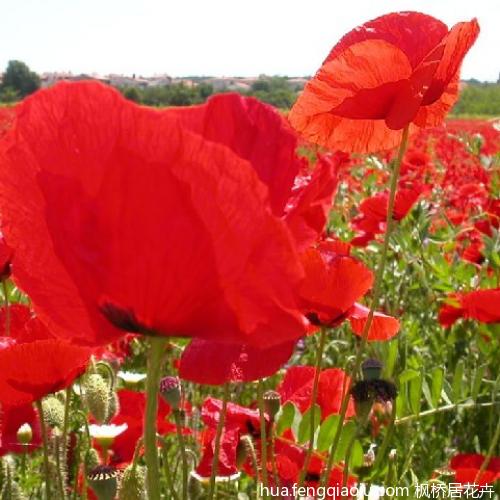
Corn poppy, also known as Flanders poppy, grows 30-80 cm tall, the whole plant sparsely hairy, leaves alternate, oblong, irregularly pinnatifid. Flowers solitary, on long stalks, drooping in bud, upright after opening, petals 4, thin and glossy, flower colors include pure white, purple-red, pink, red, rose-red, variegated, etc., flowering period May-June. Double-flowered Iceland varieties are favored.
It likes warmth, full sun and good ventilation, and is best grown in loose, fertile, well-drained sandy loam; it does not transplant well and dislikes heat and high humidity.
Sow directly in spring or early winter; the seeds are small, sow in rows 25-30 cm apart, cover with straw in winter, the optimum germination temperature is 20°C, thin the seedlings after emergence, apply topdressing 1-2 times before flowering, and remove spent flowers promptly after blooming to make the flowers larger. Avoid continuous cropping.
[Name] Scientific name/Latin name: Papaver rhoeas L.
English name: poppy
Aliases: Flanders poppy, small opium poppy, corn poppy, butterfly fills the garden with spring [1]
Folk names: Flanders poppy, brocade quilt flower
[Family and genus]
Domain: Eukaryota close-up of leaves
Kingdom: Plantae
Phylum: Magnoliophyta
Class: Magnoliopsida
Order: Ranunculales
Family: Papaveraceae
Genus: Papaver
Species: Papaver rhoeas L.
[Introduction] [2] Also called field poppy or Flanders poppy.
Scientific name Papaver rhoeas. An annual (rarely biennial) plant of the family Papaveraceae, native to Europe, North Africa and Asia, and introduced to Australia, New Zealand and North America.
The flowers are borne atop stems 25-90 cm (10-35 in) tall and are about 7-10 cm in diameter. There are 4 petals, usually bright red, sometimes with a black spot at the base. Corn poppy was formerly a widespread weed in cultivated fields, with seeds dormant in the soil for many years and germinating only when the soil was plowed. During and after World War I, corn poppies bloomed across the war-ravaged land, and so the corn poppy became a symbol of that war.
Shirley poppy is one of the most commonly cultivated garden poppies and was developed from the corn poppy. A red dye can also be extracted from corn poppy and used as a coloring agent for certain wines and medicines. In fact, the corn poppy is also a kind of poppy, because all plants in the order Ranunculales, family Papaveraceae, genus Papaver are called poppies. However, most poppies can be grown, but the fruits of the opium poppy species and the bractscale poppy species of the order Ranunculales, family Papaveraceae, genus Papaver can be used to make drugs, and their cultivation is prohibited by the state.
[Origin] Temperate continental regions of Europe and Asia; widely cultivated around the world, and Belgium uses it as its national flower. Today the corn poppy is widely cultivated in our country, most of all in the Jiangsu and Zhejiang areas. It is a fine herbaceous flower for beautifying flower beds, borders and courtyards in spring, and can also be potted or used as a cut flower.
[Flower language] Consolation, forgetting, parting in life and death, sad songs, rest red/vanity white/sleep pale red/consolation deep red/fanaticism, dreams
[Ecological habits] Annual herbaceous plant. The corn poppy grows 40-60 cm tall, with slender weak branches and short stiff hairs. The whole plant is covered with spreading coarse hairs and has milky sap. The leaves are pinnately parted or fully parted, the lobes lanceolate, with irregular serrations along the edges. Flowers solitary, on long stalks, drooping before opening, with 2 sepals, oval, covered with coarse hairs outside. The corolla has 4 petals, nearly round, with dark spots. Stamens numerous, free. Ovary obovate, style very short, stigma usually with 10 or 16 radiate branches. Flower diameter about 5-6 cm, with rich flower colors. The capsule is cup-shaped, dehiscing by pores at the top when mature; seeds kidney-shaped, numerous, 1,000-seed weight 0.33 g, viability 3-5 years.
The corn poppy is cold-hardy, fears summer heat, likes a sunny environment, and prefers well-drained, fertile sandy loam. It does not transplant well and can self-sow. Flowering period May-August.
Corn poppies include bicolor, intermediate-color, double-flowered and semi-double varieties. Related species in the same genus include the Iceland poppy (P. nudicaule) and the Oriental poppy (P. orientale). The Iceland poppy is a perennial herb, clump-forming. Leaves basal, pinnatifid or half-parted. Flowers solitary on leafless scapes, deep yellow or white. Native to polar regions. The Oriental poppy is a perennial herb, 60-90 cm tall, the whole plant covered with white hairs. Leaves pinnately parted, flowers scarlet, with purple-black spots at the base.
When the corn poppy flower has not yet opened, the egg-shaped bud is wrapped in two green sepals with white edges, hanging singly on a slender upright stalk, very much like a girl bowing her head in thought. When the corn poppy bud opens and the sepals fall, the corn poppy stands out: the bent body straightens up, and on the upward-facing flower the 4 thin petals are as thin as silk and as smooth as satin; the light corolla is like red clouds and colored silk, seeming to sway even without wind, and when the wind moves it seems about to fly away; the originally curved and delicate flower stem now also straightens up to hold the flower. It is hard to imagine that such a delicate and plain corn poppy plant could produce such richly colored and gorgeous flowers.
The corn poppy has a lush, elegant posture, graceful and slender, dancing in the wind like a colorful butterfly spreading its wings, very inspiring to the imagination. The corn poppy combines both plain elegance and rich, gorgeous beauty, the two harmoniously united in one body. Its appearance and bearing greatly resemble the charm of a beauty in classical Chinese art, and it can be called a wonderful specimen among flowers and plants.
[Cultural appreciation]
Appreciation of Li Yu's "Yu Meiren"
Yu Meiren - Li Yu
When will the spring flowers and autumn moon ever end? How much of the past do I know. Last night the east wind blew again in the little tower, and in the bright moonlight I cannot bear to look back on my homeland.
The carved railings and jade steps should still be there, only the rosy faces have changed. If you ask how much sorrow a man can have, it is just like a river of spring water flowing east.
[Appreciation 1]
This ci poem was probably written in the third year after Li Yu surrendered to Song. It reveals an undisguised longing for his homeland, and it is said to be one of the reasons that prompted Emperor Taizong of Song to order Li Yu poisoned. If so, it amounts to Li Yu's deathbed poem.
The whole poem begins with a question and ends with an answer; from asking heaven and asking others to asking himself, through a tone both sorrowful and somewhat impassioned and an artistic structure that twists and turns and flows freely, it makes the author's overwhelming sorrow run through from beginning to end, creating a refreshing aesthetic effect.
Admittedly, Li Yu's longing for his homeland may not deserve sympathy, and the past he cherished cannot be separated from the imperial life of "carved railings and jade steps" and the private palace affairs of dawn and dusk. But this widely praised famous work is indeed unique in art:
People mostly regard "spring flowers and autumn moon" as beautiful, yet the author eagerly hopes they will soon "end"; the "east wind" of the little tower brings news of spring, yet instead it draws from the author the sigh that he "cannot bear to look back," because they both stir in the author the pain of things remaining the same while people have changed, and set off his sorrow of imprisonment in a foreign land. Used to depict the state of mind of the author, who changed from a ruler of Jiangnan surrounded by pearls and jade and dining on delicacies into a prisoner singing long songs as weeping, it is both vivid and profound.
The closing line "a river of spring water flowing east" is a famous line using water as a metaphor for sorrow, implicitly showing that sorrow flows on without end, inexhaustible. Compared with it, Liu Yuxi's "Bamboo Branch Song" line "the flowing water is endless like my sorrow" is slightly too blunt, while Qin Guan's "Jiangchengzi" line "even if the whole spring river were tears, they could not flow away so much sorrow" says too much, instead weakening the moving power.
It can be said that the reason Li Yu's poem can arouse widespread resonance lies to a great extent precisely in the closing line's infectious and symbolic metaphor, which writes sorrow both vividly and abstractly: the author does not clearly state the true content of his sorrow - longing for the indulgent, luxurious pleasures of former days - but only displays its external form - "just like a river of spring water flowing east." In this way people can easily find a certain spiritual echo in it and borrow it to express similar emotions of their own. For although people's sorrows differ in content, they can all have the external form of "just like a river of spring water flowing east." Because "images are often greater than thoughts," Li Yu's poem can resonate widely and be passed down through the ages.
[Appreciation 2]
As a ruler who "loved music and women and did not care about state affairs," Li Yu was a failure; but it was precisely the fall of his country that made him the "southern king" of the ci world through the ages (words of Shen Xiong of the Qing dynasty in Gujin Cihua). As the saying goes, "The country's misfortune is the poet's fortune; only when words reach vicissitude do they begin to be skillful." "Yu Meiren" is just such a famous poem passed down endlessly through the ages.
This ci poem depicts a powerful longing for the homeland and achieves an artistic effect that moves heaven and earth and makes ghosts and gods weep. "Spring flowers and autumn moon," the things most likely to evoke beautiful associations in people, instead add to Li Yu's troubles, and he bluntly complains to heaven: spring flowers bloom every year and the autumn moon is full every year, when will it all end? Read aloud, it makes one endlessly curious. But as long as we put ourselves in the poet's situation, it is not hard to understand: for a ruler of a fallen country lying on the chopping block, these beautiful things only make him grieve at the scene and stir endless remembrance of past beautiful life; comparing past and present only produces sadness. He asks heaven and heaven does not answer, so he turns to ask himself, "How much of the past do I know." "The past" should refer to the beautiful life when he was ruler in former days, but everything has already vanished and turned to illusion. The spring of the natural world goes and comes again, so why does the spring of human life once gone never return? "Last night the east wind blew again in the little tower, and in the bright moonlight I cannot bear to look back on my homeland." The "east wind" brings news of spring, yet it draws from the poet the sigh that he "cannot bear to look back." "The music of a fallen country is sorrowful and full of thought," and probably it can only be like this. Let us imagine: in the deep quiet of night, with bright moon and morning wind, the sleepless person imprisoned in the little tower cannot help leaning on the railing and gazing far away toward the direction of his homeland and old gardens; how much sorrow surges in his heart, and who could endure such a flavor? How much helplessness and grief the single word "again" contains! The east wind enters again, showing that spring flowers and autumn moon have not ended and will continue; while he himself must still drag out his feeble existence and endure all bitter torment. "In the bright moonlight I cannot bear to look back on my homeland" is an inversion of "in the bright moonlight I cannot bear to look back on my homeland." "Cannot bear to look back," yet after all he looked back. Where he looks back, "the carved railings and jade steps should still be there, only the rosy faces have changed." In imagination, the rivers and mountains of the old country and the palaces of former days are probably still there, only things remain the same while people have changed, and the rivers and mountains have changed masters; in remembering, how much grief and resentment is contained in it. The two words "only" convey infinite regret and resentment in a tone of lament.
The above six lines are quite ingenious in structure. They repeatedly use contrast between two sides and echoes across lines, repeatedly emphasizing the cyclic replacement of the natural world and the brevity and transience of human life, rich in philosophical meaning and deep in feeling. The first two lines contrast the endlessness of spring flowers and autumn moon with the irretrievability of human affairs; the third and fourth lines contrast "the east wind blew again" with "I cannot bear to look back on my homeland"; the fifth and sixth lines contrast "should still be there" with "changed." "The east wind blew again" and "should still be there" also echo "when will it ever end"; "cannot bear to look back" and "the rosy faces have changed" also echo "the past." Such contrast and repetition vividly convey the waves and surges in the poet's soul and his unappeased sorrow.
Finally, the poet's pent-up grief and indignation can no longer be controlled and merge into the peerless famous line "If you ask how much sorrow a man can have? Just like a river of spring water flowing east." Using water as a metaphor for sorrow can be called "there were ancients before and there will be imitators after." Liu Yuxi's "Bamboo Branch Song" says "the flowing water is endless like my sorrow," and Qin Guan's "Jiangchengzi - West City Willow Teases Spring Softness" says "even if the whole spring river were tears, they could not flow away so much sorrow." These lines either fail by being too light or by being too explicit, and none is as moving as "just like a river of spring water flowing east," what is called "words of a truly heartbroken person." Comparing sorrow to "a river of spring water" makes an abstract emotion seem vivid and tangible. Sorrow is like spring water swelling and overflowing, rushing and pouring out; and again like spring water that does not pause day or night, flowing endlessly east. In form, the nine characters alternate level and oblique tones, and reading them is also like a full river of spring water rising and falling in continuous waves, fully expressing the depth and force of emotion in its surging flow. Ending with such a line, rich in both sound and feeling, greatly enhances the work's power to move; closing the book, the reader seems also to be submerged by this endless grief.
The whole poem expresses the pain of a fallen country, with profound artistic conception, sincere emotion, exquisite structure and fresh language; though the ci is short, its aftertaste is endless. No wonder Wang Guowei evaluated it thus: "The ci of the Tang and Five Dynasties had lines but no whole pieces. The ci of the famous Southern Song masters had whole pieces but no lines. To have both whole pieces and lines, only the works of Li Houzhu after his surrender to Song, and those of Yongshu, Zizhan, Shaoyou, Meicheng and Jiaxuan, a few men only." (Renjian Cihua, deleted draft no. 40) (Jiang Yayun)
[Appreciation 3]
This ci poem was written after Li Yu was captured and taken to Bianjing. It begins by saying, when will the beautiful times of spring flowers and autumn moon ever end. Because as soon as he sees spring flowers and autumn moon, countless past events surge into his mind, and thinking of the beautiful days of enjoying spring flowers and autumn moon in Southern Tang, he cannot bear to look back, so he fears seeing spring flowers and autumn moon. On a bright moonlit night when the east wind blows, the life of the old country in Jinling is unbearable to review. The carved railings and jade steps of the palaces there should still be there, only people's faces have become haggard from sorrow. If one asks how much bitterness there is, it is just like a river of spring water flowing east, endless. "A river" refers to the Yangtze River; using a river of spring water to compare to sorrow, combined with the fact that Jinling, the old capital of Southern Tang, lies by the Yangtze, it is full of longing for the homeland. Wang Jing of the Song dynasty, Mojii, volume 1: "Again, when the later ruler was in the granted residence, on Qixi he ordered old courtesans to make music, and the sound was heard outside. Taizong heard it and was furious. Again there were transmitted the lines 'last night the east wind blew again in the little tower' and 'a river of spring water flowing east,' and he was implicated for both, and so suffered disaster." Wang Guowei, Renjian Cihua: "Nietzsche said of all literature, I love that which is written in blood. The later ruler's ci is truly what is called written in blood. Emperor Daojun of Song (Huizong)'s ci "Yanshan Ting" is also somewhat similar. But Daojun merely speaks of the sorrow of his own life, while the later ruler seems to have the meaning of Buddha and Christ bearing the sins of mankind; the scale is certainly different." Li Yu was poisoned, and this was related to his writing this poem; it was truly written in blood. The so-called "meaning of Buddha and Christ bearing the sins of mankind" means that ci like Li Yu's not only writes his personal sorrow but also has great generality, encompassing the painful feelings of all people with the pain of a fallen country: such as fearing to see spring flowers and autumn moon, fearing to think of past beautiful life. Again, the beautiful scenes of the old country are already unbearable to review. The scenes of the old country, such as carved railings and jade steps, are still there, but people's faces have changed because of sorrow; here is also contained the change of human affairs, the change of master-servant relations. Again, using a river of spring water to compare to sorrow. The whole poem precisely reflects the feelings of people with the pain of a fallen country and bears the emotional pain of all these people. This precisely shows that this poem has a high degree of generality and representativeness, and this is precisely its outstanding achievement.
Chen Yu of the Song dynasty, Cangyi Huayu: "Taibai (Li Bai) said: 'Please ask the east-flowing water, whose parting feeling is longer or shorter than it.' ("Parting at a Jinling Tavern") The ruler of Jiangnan, Li, said: 'Ask you how much sorrow there still is, just like a river of spring water flowing east.' With a little blending, it already feels brilliant. As for Lord Kou Lai (Zhun), he said 'endless sorrow like spring water' ("Yeduniang"), and Shaoyou (Qin Guan) said 'ten thousand red petals falling, sorrow like the sea' ("Qianqiusui"), truly the pupil surpasses the master." Here it comments on this poem's use of "a river of spring water flowing east" to compare to sorrow. Li Bai's poetic line writes that the length of parting feeling can be compared with east-flowing water; the poem was written in Jinling, and this east-flowing water refers to the Yangtze River. Li Yu's ci was written while he was detained in Bianjing, and he could not see the Yangtze; the Yangtze became part of his longing for the old country. Therefore Li Bai's poem uses scenes before his eyes for comparison, while Li Yu's ci uses the Yangtze far away from him for comparison; in this metaphor there is longing for the old country, and the feeling is deeper. Moreover, "a river of spring water flowing east" is more vivid in image than "east-flowing water." Also, "east-flowing water" compares the "length" of "parting feeling," while "a river of spring water flowing east" compares the endlessness of sorrow. This is the difference between the two, showing that Li Yu's pain for the old country is deeper, and it is not "a little blending." Kou Zhun's ci line: "When gazing at the sandbar at dusk, tender feeling is endless like spring water." This uses spring water to compare tender feeling, and this tender feeling also refers to parting feeling, the same meaning as Li Bai's line, and can be said to imitate Li Bai's poetic meaning. "Like spring water" also cannot compare with Li Yu's line. Qin Guan's line: "Spring has gone, ten thousand red petals falling, sorrow like the sea." It writes the parting emotions of "parting loosens the clothes and belt," plus grieving over spring, plus the haggardness of "the rosy face in the mirror has changed," matched with "ten thousand red petals falling"; it is indeed a famous line. However, what Li Yu's ci writes is the pain of a fallen country, deeper than parting emotions, and it also writes "the rosy face has changed," combined with the pain of the fallen country, plus the vivid and grand image of "a river of spring water flowing east"; from feeling to image, it is not something Qin Guan's line can compare with. (Tian Deyi)
Corn poppy pictures Corn poppy
Corn poppy album[Name] Scientific name/Latin name: Papaver rhoeas L.
English name: poppy
Aliases: Flanders poppy, small opium poppy, corn poppy, butterfly fills the garden with spring [1]
Folk names: Flanders poppy, brocade quilt flower
[Family and genus]
Domain: Eukaryota close-up of leaves
Kingdom: Plantae
Phylum: Magnoliophyta
Class: Magnoliopsida
Order: Ranunculales
Family: Papaveraceae
Genus: Papaver
Species: Papaver rhoeas L.
[Introduction] [2] Also called field poppy or Flanders poppy.
Scientific name Papaver rhoeas. An annual (rarely biennial) plant of the family Papaveraceae, native to Europe, North Africa and Asia, and introduced to Australia, New Zealand and North America.
The flowers are borne atop stems 25-90 cm (10-35 in) tall and are about 7-10 cm in diameter. There are 4 petals, usually bright red, sometimes with a black spot at the base. Corn poppy was formerly a widespread weed in cultivated fields, with seeds dormant in the soil for many years and germinating only when the soil was plowed. During and after World War I, corn poppies bloomed across the war-ravaged land, and so the corn poppy became a symbol of that war.
Shirley poppy is one of the most commonly cultivated garden poppies and was developed from the corn poppy. A red dye can also be extracted from corn poppy and used as a coloring agent for certain wines and medicines. In fact, the corn poppy is also a kind of poppy, because all plants in the order Ranunculales, family Papaveraceae, genus Papaver are called poppies. However, most poppies can be grown, but the fruits of the opium poppy species and the bractscale poppy species of the order Ranunculales, family Papaveraceae, genus Papaver can be used to make drugs, and their cultivation is prohibited by the state.
[Origin] Temperate continental regions of Europe and Asia; widely cultivated around the world, and Belgium uses it as its national flower. Today the corn poppy is widely cultivated in our country, most of all in the Jiangsu and Zhejiang areas. It is a fine herbaceous flower for beautifying flower beds, borders and courtyards in spring, and can also be potted or used as a cut flower.
[Flower language] Consolation, forgetting, parting in life and death, sad songs, rest red/vanity white/sleep pale red/consolation deep red/fanaticism, dreams
[Ecological habits] Annual herbaceous plant. The corn poppy grows 40-60 cm tall, with slender weak branches and short stiff hairs. The whole plant is covered with spreading coarse hairs and has milky sap. The leaves are pinnately parted or fully parted, the lobes lanceolate, with irregular serrations along the edges. Flowers solitary, on long stalks, drooping before opening, with 2 sepals, oval, covered with coarse hairs outside. The corolla has 4 petals, nearly round, with dark spots. Stamens numerous, free. Ovary obovate, style very short, stigma usually with 10 or 16 radiate branches. Flower diameter about 5-6 cm, with rich flower colors. The capsule is cup-shaped, dehiscing by pores at the top when mature; seeds kidney-shaped, numerous, 1,000-seed weight 0.33 g, viability 3-5 years.
The corn poppy is cold-hardy, fears summer heat, likes a sunny environment, and prefers well-drained, fertile sandy loam. It does not transplant well and can self-sow. Flowering period May-August.
Corn poppies include bicolor, intermediate-color, double-flowered and semi-double varieties. Related species in the same genus include the Iceland poppy (P. nudicaule) and the Oriental poppy (P. orientale). The Iceland poppy is a perennial herb, clump-forming. Leaves basal, pinnatifid or half-parted. Flowers solitary on leafless scapes, deep yellow or white. Native to polar regions. The Oriental poppy is a perennial herb, 60-90 cm tall, the whole plant covered with white hairs. Leaves pinnately parted, flowers scarlet, with purple-black spots at the base.
When the corn poppy flower has not yet opened, the egg-shaped bud is wrapped in two green sepals with white edges, hanging singly on a slender upright stalk, very much like a girl bowing her head in thought. When the corn poppy bud opens and the sepals fall, the corn poppy stands out: the bent body straightens up, and on the upward-facing flower the 4 thin petals are as thin as silk and as smooth as satin; the light corolla is like red clouds and colored silk, seeming to sway even without wind, and when the wind moves it seems about to fly away; the originally curved and delicate flower stem now also straightens up to hold the flower. It is hard to imagine that such a delicate and plain corn poppy plant could produce such richly colored and gorgeous flowers.
The corn poppy has a lush, elegant posture, graceful and slender, dancing in the wind like a colorful butterfly spreading its wings, very inspiring to the imagination. The corn poppy combines both plain elegance and rich, gorgeous beauty, the two harmoniously united in one body. Its appearance and bearing greatly resemble the charm of a beauty in classical Chinese art, and it can be called a wonderful specimen among flowers and plants.
[Cultural appreciation]
Appreciation of Li Yu's "Yu Meiren"
Yu Meiren - Li Yu
When will the spring flowers and autumn moon ever end? How much of the past do I know. Last night the east wind blew again in the little tower, and in the bright moonlight I cannot bear to look back on my homeland.
The carved railings and jade steps should still be there, only the rosy faces have changed. If you ask how much sorrow a man can have, it is just like a river of spring water flowing east.
[Appreciation 1]
This ci poem was probably written in the third year after Li Yu surrendered to Song. It reveals an undisguised longing for his homeland, and it is said to be one of the reasons that prompted Emperor Taizong of Song to order Li Yu poisoned. If so, it amounts to Li Yu's deathbed poem.
The whole poem begins with a question and ends with an answer; from asking heaven and asking others to asking himself, through a tone both sorrowful and somewhat impassioned and an artistic structure that twists and turns and flows freely, it makes the author's overwhelming sorrow run through from beginning to end, creating a refreshing aesthetic effect.
Admittedly, Li Yu's longing for his homeland may not deserve sympathy, and the past he cherished cannot be separated from the imperial life of "carved railings and jade steps" and the private palace affairs of dawn and dusk. But this widely praised famous work is indeed unique in art:
People mostly regard "spring flowers and autumn moon" as beautiful, yet the author eagerly hopes they will soon "end"; the "east wind" of the little tower brings news of spring, yet instead it draws from the author the sigh that he "cannot bear to look back," because they both stir in the author the pain of things remaining the same while people have changed, and set off his sorrow of imprisonment in a foreign land. Used to depict the state of mind of the author, who changed from a ruler of Jiangnan surrounded by pearls and jade and dining on delicacies into a prisoner singing long songs as weeping, it is both vivid and profound.
The closing line "a river of spring water flowing east" is a famous line using water as a metaphor for sorrow, implicitly showing that sorrow flows on without end, inexhaustible. Compared with it, Liu Yuxi's "Bamboo Branch Song" line "the flowing water is endless like my sorrow" is slightly too blunt, while Qin Guan's "Jiangchengzi" line "even if the whole spring river were tears, they could not flow away so much sorrow" says too much, instead weakening the moving power.
It can be said that the reason Li Yu's poem can arouse widespread resonance lies to a great extent precisely in the closing line's infectious and symbolic metaphor, which writes sorrow both vividly and abstractly: the author does not clearly state the true content of his sorrow - longing for the indulgent, luxurious pleasures of former days - but only displays its external form - "just like a river of spring water flowing east." In this way people can easily find a certain spiritual echo in it and borrow it to express similar emotions of their own. For although people's sorrows differ in content, they can all have the external form of "just like a river of spring water flowing east." Because "images are often greater than thoughts," Li Yu's poem can resonate widely and be passed down through the ages.
[Appreciation 2]
As a ruler who "loved music and women and did not care about state affairs," Li Yu was a failure; but it was precisely the fall of his country that made him the "southern king" of the ci world through the ages (words of Shen Xiong of the Qing dynasty in Gujin Cihua). As the saying goes, "The country's misfortune is the poet's fortune; only when words reach vicissitude do they begin to be skillful." "Yu Meiren" is just such a famous poem passed down endlessly through the ages.
This ci poem depicts a powerful longing for the homeland and achieves an artistic effect that moves heaven and earth and makes ghosts and gods weep. "Spring flowers and autumn moon," the things most likely to evoke beautiful associations in people, instead add to Li Yu's troubles, and he bluntly complains to heaven: spring flowers bloom every year and the autumn moon is full every year, when will it all end? Read aloud, it makes one endlessly curious. But as long as we put ourselves in the poet's situation, it is not hard to understand: for a ruler of a fallen country lying on the chopping block, these beautiful things only make him grieve at the scene and stir endless remembrance of past beautiful life; comparing past and present only produces sadness. He asks heaven and heaven does not answer, so he turns to ask himself, "How much of the past do I know." "The past" should refer to the beautiful life when he was ruler in former days, but everything has already vanished and turned to illusion. The spring of the natural world goes and comes again, so why does the spring of human life once gone never return? "Last night the east wind blew again in the little tower, and in the bright moonlight I cannot bear to look back on my homeland." The "east wind" brings news of spring, yet it draws from the poet the sigh that he "cannot bear to look back." "The music of a fallen country is sorrowful and full of thought," and probably it can only be like this. Let us imagine: in the deep quiet of night, with bright moon and morning wind, the sleepless person imprisoned in the little tower cannot help leaning on the railing and gazing far away toward the direction of his homeland and old gardens; how much sorrow surges in his heart, and who could endure such a flavor? How much helplessness and grief the single word "again" contains! The east wind enters again, showing that spring flowers and autumn moon have not ended and will continue; while he himself must still drag out his feeble existence and endure all bitter torment. "In the bright moonlight I cannot bear to look back on my homeland" is an inversion of "in the bright moonlight I cannot bear to look back on my homeland." "Cannot bear to look back," yet after all he looked back. Where he looks back, "the carved railings and jade steps should still be there, only the rosy faces have changed." In imagination, the rivers and mountains of the old country and the palaces of former days are probably still there, only things remain the same while people have changed, and the rivers and mountains have changed masters; in remembering, how much grief and resentment is contained in it. The two words "only" convey infinite regret and resentment in a tone of lament.
The above six lines are quite ingenious in structure. They repeatedly use contrast between two sides and echoes across lines, repeatedly emphasizing the cyclic replacement of the natural world and the brevity and transience of human life, rich in philosophical meaning and deep in feeling. The first two lines contrast the endlessness of spring flowers and autumn moon with the irretrievability of human affairs; the third and fourth lines contrast "the east wind blew again" with "I cannot bear to look back on my homeland"; the fifth and sixth lines contrast "should still be there" with "changed." "The east wind blew again" and "should still be there" also echo "when will it ever end"; "cannot bear to look back" and "the rosy faces have changed" also echo "the past." Such contrast and repetition vividly convey the waves and surges in the poet's soul and his unappeased sorrow.
Finally, the poet's pent-up grief and indignation can no longer be controlled and merge into the peerless famous line "If you ask how much sorrow a man can have? Just like a river of spring water flowing east." Using water as a metaphor for sorrow can be called "there were ancients before and there will be imitators after." Liu Yuxi's "Bamboo Branch Song" says "the flowing water is endless like my sorrow," and Qin Guan's "Jiangchengzi - West City Willow Teases Spring Softness" says "even if the whole spring river were tears, they could not flow away so much sorrow." These lines either fail by being too light or by being too explicit, and none is as moving as "just like a river of spring water flowing east," what is called "words of a truly heartbroken person." Comparing sorrow to "a river of spring water" makes an abstract emotion seem vivid and tangible. Sorrow is like spring water swelling and overflowing, rushing and pouring out; and again like spring water that does not pause day or night, flowing endlessly east. In form, the nine characters alternate level and oblique tones, and reading them is also like a full river of spring water rising and falling in continuous waves, fully expressing the depth and force of emotion in its surging flow. Ending with such a line, rich in both sound and feeling, greatly enhances the work's power to move; closing the book, the reader seems also to be submerged by this endless grief.
The whole poem expresses the pain of a fallen country, with profound artistic conception, sincere emotion, exquisite structure and fresh language; though the ci is short, its aftertaste is endless. No wonder Wang Guowei evaluated it thus: "The ci of the Tang and Five Dynasties had lines but no whole pieces. The ci of the famous Southern Song masters had whole pieces but no lines. To have both whole pieces and lines, only the works of Li Houzhu after his surrender to Song, and those of Yongshu, Zizhan, Shaoyou, Meicheng and Jiaxuan, a few men only." (Renjian Cihua, deleted draft no. 40) (Jiang Yayun)
[Appreciation 3]
This ci poem was written after Li Yu was captured and taken to Bianjing. It begins by saying, when will the beautiful times of spring flowers and autumn moon ever end. Because as soon as he sees spring flowers and autumn moon, countless past events surge into his mind, and thinking of the beautiful days of enjoying spring flowers and autumn moon in Southern Tang, he cannot bear to look back, so he fears seeing spring flowers and autumn moon. On a bright moonlit night when the east wind blows, the life of the old country in Jinling is unbearable to review. The carved railings and jade steps of the palaces there should still be there, only people's faces have become haggard from sorrow. If one asks how much bitterness there is, it is just like a river of spring water flowing east, endless. "A river" refers to the Yangtze River; using a river of spring water to compare to sorrow, combined with the fact that Jinling, the old capital of Southern Tang, lies by the Yangtze, it is full of longing for the homeland. Wang Jing of the Song dynasty, Mojii, volume 1: "Again, when the later ruler was in the granted residence, on Qixi he ordered old courtesans to make music, and the sound was heard outside. Taizong heard it and was furious. Again there were transmitted the lines 'last night the east wind blew again in the little tower' and 'a river of spring water flowing east,' and he was implicated for both, and so suffered disaster." Wang Guowei, Renjian Cihua: "Nietzsche said of all literature, I love that which is written in blood. The later ruler's ci is truly what is called written in blood. Emperor Daojun of Song (Huizong)'s ci "Yanshan Ting" is also somewhat similar. But Daojun merely speaks of the sorrow of his own life, while the later ruler seems to have the meaning of Buddha and Christ bearing the sins of mankind; the scale is certainly different." Li Yu was poisoned, and this was related to his writing this poem; it was truly written in blood. The so-called "meaning of Buddha and Christ bearing the sins of mankind" means that ci like Li Yu's not only writes his personal sorrow but also has great generality, encompassing the painful feelings of all people with the pain of a fallen country: such as fearing to see spring flowers and autumn moon, fearing to think of past beautiful life. Again, the beautiful scenes of the old country are already unbearable to review. The scenes of the old country, such as carved railings and jade steps, are still there, but people's faces have changed because of sorrow; here is also contained the change of human affairs, the change of master-servant relations. Again, using a river of spring water to compare to sorrow. The whole poem precisely reflects the feelings of people with the pain of a fallen country and bears the emotional pain of all these people. This precisely shows that this poem has a high degree of generality and representativeness, and this is precisely its outstanding achievement.
Chen Yu of the Song dynasty, Cangyi Huayu: "Taibai (Li Bai) said: 'Please ask the east-flowing water, whose parting feeling is longer or shorter than it.' ("Parting at a Jinling Tavern") The ruler of Jiangnan, Li, said: 'Ask you how much sorrow there still is, just like a river of spring water flowing east.' With a little blending, it already feels brilliant. As for Lord Kou Lai (Zhun), he said 'endless sorrow like spring water' ("Yeduniang"), and Shaoyou (Qin Guan) said 'ten thousand red petals falling, sorrow like the sea' ("Qianqiusui"), truly the pupil surpasses the master." Here it comments on this poem's use of "a river of spring water flowing east" to compare to sorrow. Li Bai's poetic line writes that the length of parting feeling can be compared with east-flowing water; the poem was written in Jinling, and this east-flowing water refers to the Yangtze River. Li Yu's ci was written while he was detained in Bianjing, and he could not see the Yangtze; the Yangtze became part of his longing for the old country. Therefore Li Bai's poem uses scenes before his eyes for comparison, while Li Yu's ci uses the Yangtze far away from him for comparison; in this metaphor there is longing for the old country, and the feeling is deeper. Moreover, "a river of spring water flowing east" is more vivid in image than "east-flowing water." Also, "east-flowing water" compares the "length" of "parting feeling," while "a river of spring water flowing east" compares the endlessness of sorrow. This is the difference between the two, showing that Li Yu's pain for the old country is deeper, and it is not "a little blending." Kou Zhun's ci line: "When gazing at the sandbar at dusk, tender feeling is endless like spring water." This uses spring water to compare tender feeling, and this tender feeling also refers to parting feeling, the same meaning as Li Bai's line, and can be said to imitate Li Bai's poetic meaning. "Like spring water" also cannot compare with Li Yu's line. Qin Guan's line: "Spring has gone, ten thousand red petals falling, sorrow like the sea." It writes the parting emotions of "parting loosens the clothes and belt," plus grieving over spring, plus the haggardness of "the rosy face in the mirror has changed," matched with "ten thousand red petals falling"; it is indeed a famous line. However, what Li Yu's ci writes is the pain of a fallen country, deeper than parting emotions, and it also writes "the rosy face has changed," combined with the pain of the fallen country, plus the vivid and grand image of "a river of spring water flowing east"; from feeling to image, it is not something Qin Guan's line can compare with. (Tian Deyi)