What are the growing environment requirements for the purple magnolia?
The purple magnolia, also known as Xinyi or Mubi, is a deciduous large shrub of the Magnoliaceae family, native to central China. It prefers sunlight and a warm, humid climate; it is cold-hardy but not drought-tolerant, and dislikes waterlogging and saline-alkaline conditions. It requires loose, fertile, well-drained slightly acidic to neutral soil; its root system is well developed and it suckers readily.
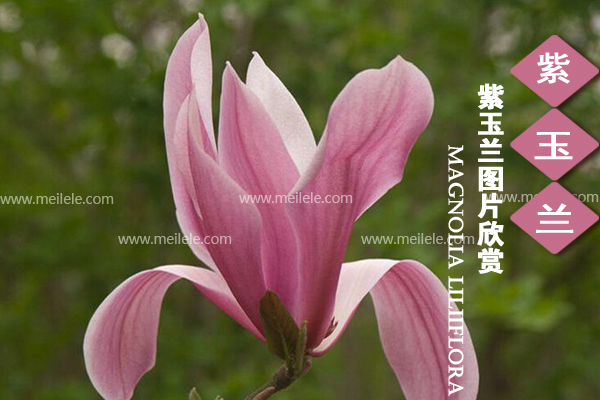 .....
In terms of form, the purple magnolia is a deciduous shrub or tree that can reach 3 m in height. Its bark is grayish brown, and the wood is fragrant. The twigs are greenish purple. The leaves are elliptical-obovate or obovate, with a pointed tip and a somewhat narrowed base, running down along the petiole to the stipule scar. The upper surface is dark green and sparsely covered with short soft hairs when young, while the lower surface is grayish green. The purple magnolia blooms every year in early spring, with the flowers opening before the leaves or rarely at the same time as the leaves. Although traces of winter still remain on the leafless twigs, the branches are covered with graceful purple blossoms. Each bloom stands elegantly, delicately carved as if from powder and jade, refined and graceful, with flowers vying in beauty and a fragrant scent. Its corolla is large, purple or purplish red, resembling a lotus but smaller, like a cup. The flower buds are large and shaped like a brush tip, hence the name “Mubi” (wood brush).
.....
.....
When it blooms in early spring, the tree is covered with bright purplish red flowers of enchanting beauty and distinctive charm. They are covered with pale yellow silky hairs and stand upright on thick, hairy pedicels. Its flowering period is March to April, and its fruiting period is between August and September. Normally it blooms once a year, but under abnormal conditions it may also bloom twice a year; such abnormal conditions are generally mainly root damage or high temperatures.
..........
As an ornamental tree, the purple magnolia also has its own special environmental requirements. It is suitable for planting in courtyards or in groups at the edges of mounds. It loves sunny places, is not cold-hardy, and grows best in fertile and relatively moist soil. In this season right now, you can see trees full of purplish red flowers on both sides of the road every day, with a unique charm. When a breeze passes, the petals flutter in the wind, lovely and touching.
..........
The purple magnolia is a relatively precious tree, so what about its price? I can only give an approximate figure, since in many people's eyes price is a rather sensitive thing, and region and other factors can all cause price differences. Generally speaking, the price of purple magnolia [by trunk diameter] is: about 15 yuan for a 3 cm diameter purple magnolia, about 30 yuan for a 4 cm diameter purple magnolia, about 50 yuan for a 5 cm diameter purple magnolia, about 100 yuan for a 6 cm diameter purple magnolia, about 150 yuan for a 7 cm diameter purple magnolia, and about 300 yuan for an 8 cm diameter purple magnolia. These are only approximate figures; for specific prices it is better to consult a nursery stock expert.
.....
.....
The beautiful purple magnolia also has quite a few varieties, each with its own characteristics. Magnolia x soulangeana is obtained by natural hybridization of the purple magnolia and the Yulan magnolia, and its flower color is lighter than that of the purple magnolia, pink with purple. The narrow-sepal Xinyi has all parts somewhat smaller and a slightly deeper color. Dutch red purple magnolia: bears solid deep red flowers and blooms somewhat later than the others. Mini Mouse purple magnolia, as its name suggests, is petite in appearance. Black purple magnolia has petals of the same color inside and out, purple tinged with red. Pointed magnolia purple magnolia is lighter in color and closes in a lotus shape. Red Lion purple magnolia has a rather grand name and is peach red in color. Randy purple magnolia was accidentally obtained by experts at the United States National Arboretum while breeding variants, and resembles a peach blossom. There are also some other varieties, which I will not list one by one. No matter which variety of purple magnolia it is, it is a noble and elegant plant.
.....
.....
With its own form, it beautifies the urban environment and makes everyone feel happier. I wonder whether you have felt the charm of the purple magnolia between the lines? For more information about flowers, you can use your little hand to open the link below!