What are the care precautions for potted scarlet sage?
For potted scarlet sage, the potting soil can be made up of 4 parts garden soil, 4 parts leaf mold, and 2 parts river sand. When potting, apply a small amount of cake fertilizer powder at the bottom of the pot as a base fertilizer. Usually water by the "dry-wet cycle" method to promote root growth. Do not water too much in the early growth stage. If watered too much, the leaves easily turn yellow and drop, affecting flowering.
Once it enters the vigorous growth period, apply a diluted cake fertilizer solution once every two weeks to promote lush plant growth and good flowering. At the bud stage and after the flowers fade, apply a compound fertilizer once each time to make the flower colors more vivid and lay a foundation for the next flowering. During growth, pinching and bud removal are needed 3~5 times to encourage more side branches. Stop pinching and bud removal about 25 days before the intended flowering date, and it will bloom right on schedule.
Plants that have been pinched several times will have a short, sturdy plant shape, dense branches, and many flowers. After flowering, heavy pruning can be done, generally cutting off half the length of the branches. After pruning, strengthen fertilizer and water management, and they can bloom again later.
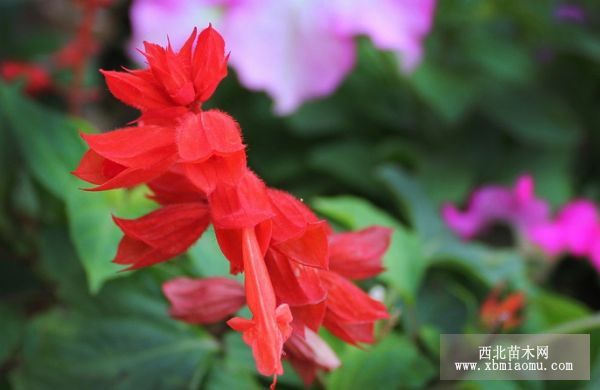
Generally, two types are cultivated in various places: large scarlet sage and small scarlet sage. Large scarlet sage is 50 cm to 90 cm tall, with long vermilion flower spikes, and is relatively heat-tolerant. Small scarlet sage is 20 cm to 30 cm tall, with dense flower spikes and bright red, vivid flower color. Its heat tolerance is poorer. From July to August, the leaves often turn yellow and growth is slow. As natural temperatures drop, it gradually becomes stronger and grows normally.
Poinsettia is mainly propagated by sowing, with a well-proportioned, full plant shape that is fresh and neat. For large potted scarlet sage for National Day, choose large scarlet sage and soak the seeds in early spring during February for pot sowing in a greenhouse. When the seedlings grow to 4 pairs of leaves, divide and transplant them with soil around the roots into No. 2 tube pots for care. When the seedlings are 15 cm tall, pinch them to encourage branching. After that, whenever the branches grow 4 pairs of leaves, pinch them at any time; pinch again as they grow, gradually expanding the crown. At the same time, watch the bottom of the pot. As soon as white roots appear, knock out the whole root ball in time and repot into a pot one size larger, so the roots do not become bound into a felt-like mass and fail to continue growing vigorously and extending. The plant will then grow vigorously and keep expanding. Repot directly into a bucket pot with an inner diameter of 50 cm. For National Day, the plant height and crown width can reach more than 1 m, and the flower spikes can reach 400 to 500. Placed in front of tall buildings, it looks spectacular.
Generally, for mass flower use in National Day flower beds and flower borders, sow large scarlet sage or small scarlet sage from April to May. When the seedlings are established, pot them into No. 2 vat tube pots. Pinch when the plants are 10 cm tall, and they can reach 20 to 30 branches, with a lively and fresh plant shape. Depending on plant growth, do the last pinching from September 1 to 5. Pinch the weaker-growing ones first and the stronger ones later, and they will bloom on schedule for the festival. During the plant growth period, always keep the potting soil and surrounding environment moist. Do not let them dry out for long periods or remain waterlogged for a long time. Add an appropriate amount of base fertilizer when potting. When autumn turns cool, apply a diluted organic liquid fertilizer once every ten days, or alternate with a mixed solution of 0.2% urea and 0.1% potassium dihydrogen phosphate.
For scarlet sage for May Day, it is best to sow small scarlet sage outdoors after mid-August, avoiding heavy rain. In early October, when the seedlings are established, lift them with the root ball and place them in a greenhouse for temporary planting. Pay attention to ventilation and water control to prevent leggy growth. In early December, plant them into No. 2 vat pots for final planting, pinch at the right time, and keep the room temperature at 20°C to 25°C, with sufficient light, fresh air, and moderate water and fertilizer. Do the last pinching in early April, gradually increase ventilation, and reduce the difference between indoor and outdoor microclimates. They should be placed outdoors for the festival, with abundant flowers and green leaves, fresh and robust.
Can scarlet sage be grown in pots? Cultivation and management tips for potted scarlet sage
When scarlet sage blooms, its flower spikes are unique, making it very suitable for planting in gardens and along roads. Moreover, its greatest feature is that it can self-sow and reproduce, so it is very suitable as a potted flower. Those who like flowers and plants can learn the cultivation and management tips for potted scarlet sage.
Scarlet sage has scarlet flower spikes and green leaves. With suitable temperatures, it can bloom year-round. It is often used for flower bed arrangements or potted ornamental display. The cultivation and management techniques for potted scarlet sage are as follows:
I. Variety selection
For potted scarlet sage, choose varieties with a compact, low plant shape, dark green leaves, bright red flower spikes, and a long flowering period, such as 'Zhanwang' and 'Taiyang Shen'.
II. Potting soil preparation
Scarlet sage likes moisture and fears waterlogging, and is not drought-tolerant. The potting soil should be loose, fertile, well-drained, rich in humus, and slightly acidic. It can be prepared by mixing decomposed spent shiitake mushroom substrate, peat soil, and decomposed pig manure at 4:4:2, and mixing in 1% carbendazim and 1% carbofuran granules to kill pests and diseases in the culture soil.
III. Temperature and light management
Scarlet sage likes light and tolerates partial shade, and dislikes direct sun exposure. The author grows scarlet sage outdoors in Beijing. Before 2005, the leaves of scarlet sage were especially green. After 2006, the leaves of scarlet sage became yellower year by year, because after 2006, Beijing's air quality became good and the light was especially strong. Without shade outdoors, the leaves turn yellow, even for the 'Zhanwang' and 'Taiyang Shen' varieties. The suitable growing temperature is 20-25°C, and the minimum temperature should not be lower than 15°C.
IV. Water and fertilizer management
Scarlet sage likes moisture and fears waterlogging, and likes fertilizer. For potted topdressing, diammonium phosphate is best. It is clean and hygienic, and convenient to apply. Just place it directly along the edge of the pot, 8-10 granules each time, once every 10-15 days. After application, the leaves become dark green and thick. During flower bud differentiation and the bud stage, spray 0.3% potassium dihydrogen phosphate, and the flower color becomes more vivid.
V. Flowering period control
From planting to flowering, scarlet sage generally needs 2-3 pinchings to make the plant shape full. It can bloom 25 days after the last pinching. The flowering period of scarlet sage is mainly controlled by pinching.
VI. Pest and disease control
In continuous cloudy days, scarlet sage may develop downy mildew and phytophthora disease, with root and stem rot and death. It can be controlled with downy mildew and phytophthora control agents. High temperature and direct sun exposure make it prone to viral disease. Control measures include killing aphids, using omethoate or aphid-whitefly control agents. Build a shade shed for shading or grow it in thinned woodland.
Scarlet sage has a simple planting method and is easy to keep alive. As long as you pay attention to variety selection, potting soil preparation, and related potted cultivation and management tips when planting, it is enough.