A Detailed Explanation of Tulip Growth Characteristics and Ecological Habits
Tulips adapt to wet and cold winters and dry, hot summers. They go dormant in summer, take root and sprout new shoots in autumn and winter, but do not emerge from the soil. After experiencing low winter temperatures, they begin to extend and grow to form stems and leaves around early February of the following year (when the temperature is above 5°C), and bloom in March to April. The optimum temperature for growth and flowering is 15 to 20°C. Flower bud differentiation takes place during the storage period when the stems and leaves turn yellow, the bulbs are dug out of the pot and placed in a cool, shaded indoor spot to pass the summer. The optimum temperature for differentiation is 20 to 25°C, and it must not exceed 28°C.
Tulips are long-day flowers, and they prefer a climate with abundant sunlight, warm and humid winters, and cool, dry summers. They are very cold-hardy; in severely cold regions, if there is thick snow cover, the bulbs can overwinter in the open ground. However, they fear intense summer heat. If summer comes early and midsummer is very hot, the bulbs have difficulty surviving the summer after dormancy. They require loose, fertile, well-drained, slightly acidic sandy loam. They dislike alkaline soil and continuous cropping.
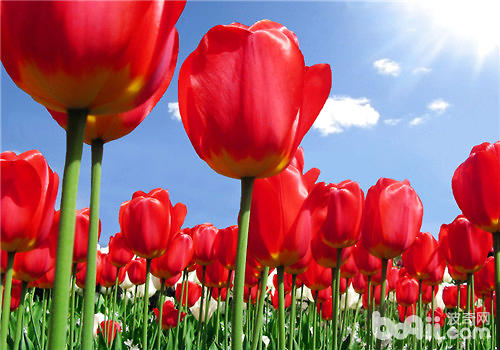
Tulip (Detailed Introduction)
Tulips are native to the high mountain regions of Iran and Turkey. Because of the Mediterranean climate, tulips have developed the characteristics of adapting to wet and cold winters and dry, hot summers. They have the traits of summer dormancy, rooting and sprouting new shoots in autumn and winter without emerging from the soil, and after experiencing low winter temperatures, beginning to extend and grow to form stems and leaves around early February of the following year (when the temperature is above 5°C), and blooming in March to April.
The optimum temperature for tulip growth and flowering is 15 to 20°C. Flower bud differentiation takes place during the storage period when the stems and leaves turn yellow, the bulbs are dug out of the pot and placed in a cool, shaded outdoor spot to pass the summer. The optimum temperature for differentiation is 20 to 25°C, and it must not exceed 28°C.
Tulips are long-day flowers, and they prefer a climate with abundant sunlight, warm and humid winters, and cool, dry summers. They are very cold-hardy; in severely cold regions, if there is thick snow cover, the bulbs can overwinter in the open ground. However, they fear intense summer heat. If summer comes early and midsummer is very hot, the bulbs have difficulty surviving the summer after dormancy. Tulips require loose, fertile, well-drained, slightly acidic sandy loam, and they dislike alkaline soil and continuous cropping.
An Introduction to Black Tulip Pictures and Growth Characteristics
Tulips are very familiar to everyone. They belong to the Liliaceae herbaceous plants and are the national flower of Turkey, Kazakhstan and the Netherlands. Although their original home is abroad, with the progress of the times and close exchanges among various countries, tulips have become a common flower in daily life. Many editors, upon seeing the title, cannot help but ask, are tulips black? What are their habits and living environment like? Today, the editor will take everyone to appreciate black tulips! And by the way, chat with everyone about knowledge concerning them!
The black tulip is one of the flower colors of the Liliaceae flower tulip. It was independently cultivated in early February 2005 by 3 students from Singapore Polytechnic. Commonly known as the "Night Queen," it is one of the rare tulip varieties. This flower color is still rarely seen on the market. The black tulip was cultivated by graduates of the Department of Biotechnology at Singapore Polytechnic using pure nutrient solution. They began cultivating this batch of tulips in August 2004, and in early February 2005, they successfully obtained the black tulip variety.
Because of the Mediterranean climate, tulips have developed the characteristics of adapting to wet and cold winters and dry, hot summers. Their special traits are summer dormancy, rooting and sprouting new shoots in autumn and winter without emerging from the soil, and after experiencing low winter temperatures, beginning to extend and grow to form stems and leaves around early February of the following year (when the temperature is above 5°C), and blooming in March to April. The optimum temperature for growth and flowering is 15 to 20°C. Flower bud differentiation takes place during the storage period when the stems and leaves turn yellow, the bulbs are dug out of the pot and placed in a cool, shaded outdoor spot to pass the summer. The optimum temperature for differentiation is 20 to 25°C, and it must not exceed 28°C. Long-day flowers, they prefer a sunny, wind-sheltered climate with warm and humid winters and cool, dry summers. They can grow normally above 8°C, and generally can tolerate a low temperature of -14°C.
They are very cold-hardy; in severely cold regions, if there is thick snow cover, the bulbs can overwinter in the open ground. However, they fear intense summer heat. If summer comes early and midsummer is very hot, the bulbs have difficulty surviving the summer after dormancy. They require humus-rich, loose, fertile, well-drained, slightly acidic sandy loam. They dislike alkaline soil and continuous cropping.
The word "enchanting and luxurious" is perfectly suited to the black tulip. Its beauty is not the same as the delicate beauty of a rose; it belongs to the poisonous beauty of the poppy, and it also has the gentlemanly air of the lotus that emerges from the mud unsoiled. One glance intoxicates you. It represents the spirit of the knight and melancholic love. Seeing it is like arriving at the memory of the beauty who stole your heart. Well, the above is the editor's complete introduction to the black tulip. I hope such exquisite pictures can bring everyone visual enjoyment!