What are the common cultivated varieties of Paphiopedilum?
Paphiopedilum is also known as the slipper orchid. Its flower shape is unusual: every petal has stripes or spots, and the lip is modified into a rounded pouch that closely resembles the front of a slipper, which is how it got its name. Most Paphiopedilum species are terrestrial orchids, while a few are epiphytic. Paphiopedilum flowers come in rich colors, the blooms are long-lasting, and some species flower in all four seasons. There are more than 10 species native to China. The commonly cultivated ones are:
(1) Paphiopedilum hirsutissimum. Flowers are borne singly, about 10 cm in diameter, richly colored, with a base color of dark green-yellow marked with purple spots or patterns; each flower can last 1 month. Flowering period is spring.
(2) Paphiopedilum bellatulum. Flowers are usually borne singly, large, 13 cm in diameter. The pouch is large, yellow-green, with purplish-red blotches or markings; each flower can stay open for 4-6 weeks. Flowering period is winter and spring.
(3) Paphiopedilum parishii. The flower stalk is thick and arching, 60 cm long, bearing 4-6 flowers; the petals are linear, 10-12 cm long, yellow-green with purple-brown markings. Flowering period is summer.
(4) Paphiopedilum villosum. Flowers are borne singly, large, yellow-purple, with purple-brown stripes on the surface. Flowering period is winter and spring.
(5) Paphiopedilum purpuratum. Flowers are solitary, deep purplish-red. Flowering period is autumn and winter.
(6) Paphiopedilum appletonianum. The flower stalk is upright, 50 cm long. Flowers are solitary, purple-brown. Both the inner and outer surfaces of the petals have several black warty dots, and the lip is a deep pouch; each flower can stay open for more than two months. Flowering period is March to May.
(7) Paphiopedilum armeniacum. Flowers are borne singly, apricot-yellow. The lip is an elliptical-ovoid pouch. Flowering period is spring.
(8) Paphiopedilum concolor. Each flower stalk bears 1-3 flowers, pale yellow, with the outer surface densely covered in purple-brown spots; the lip is an ovoid pouch, and each flower can stay open for 6-8 weeks. Flowering period is April to June.
(9) Paphiopedilum godefroyae. Each flower stalk bears 1-2 flowers, occasionally 3. Flowers are pale yellow, with the outer surface densely covered in purplish-red or brown spots; each flower can stay open for 4 weeks. Flowering period is spring and autumn.
(10) Paphiopedilum micranthum. Flowers are borne singly; the lip is a pocket-shaped pouch, pink or nearly white; each flower can stay open for 2-3 weeks. Flowering period is February to March.
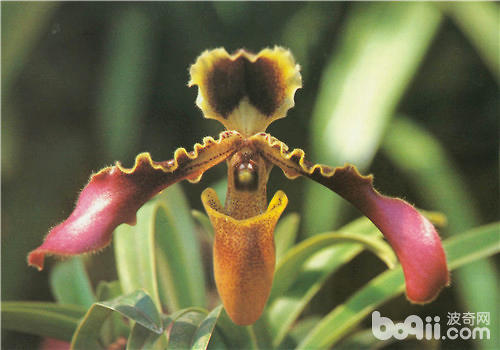
Paphiopedilum hirsutissimum
Paphiopedilum hirsutissimum prefers a warm, semi-shaded and humid environment. It likes fertile, humus-rich, well-drained sandy soil. In summer, cultivate it under a shade frame; in winter, place it in a bright spot in the greenhouse. To maintain high air humidity, spray water on the plant and the surrounding ground every day. About 40 days after planting, apply dilute liquid fertilizer as a top dressing; repot once every 2-3 years. During the growing period, provide plenty of water; during the dormant period and when new shoots first emerge, control watering.
The suitable growing temperature for Paphiopedilum hirsutissimum is 18-25°C; the suitable overwintering temperature is about 12°C, and it should not be lower than 5°C. If kept at 1-2°C, the leaves wither and the plant dies; if kept above 20°C for a long time, flower bud differentiation cannot proceed normally, making it difficult to flower, and rot is likely to occur. In summer, provide appropriate shading; in winter, provide full light. It requires a fertile growing medium with good drainage and aeration.