What are the daily care essentials for native Paphiopedilum orchids?
For potted Paphiopedilum orchids, if they are terrestrial orchids, it is best to use leaf mold, peat soil, moss, bark chunks, etc. as the growing medium. The bottom of the pot needs to be lined with granular material such as crushed brick and charcoal chunks amounting to about 1/4 of the pot's volume, to facilitate drainage and aeration. If they are epiphytic orchids, it is best to use moss and fern roots as the growing medium; before use, soak them thoroughly with water and squeeze out the excess water before using. If the growing medium used is dry, it will be very difficult to moisten thoroughly after planting, which will affect the growth of new shoots.
Paphiopedilum orchids can be kept year-round in a bright spot indoors. In winter, it is best to place them about 80 cm from a sunny windowsill, avoiding direct sunlight. If exposed to strong light in summer, they are prone to sunscald, with leaves turning yellow and withering, and even the whole plant dying; however, excessive shading also affects flowering. When kept indoors in summer, be sure to pay attention to ventilation, otherwise soft rot is likely to occur. Because Paphiopedilum orchids have no pseudobulbs, their drought resistance is relatively weak. During cultivation, it is necessary to keep the growing medium constantly moist and maintain high indoor humidity. For this reason, in dry seasons it is necessary to frequently sprinkle water around the flower pot and also mist the leaf surfaces to increase air humidity.
In spring, summer, and autumn, watering should be moderate, and it is best to keep the growing medium in the pot slightly moist at all times; avoid waterlogging at all costs. Two to three months before flowering, the plant is mostly in a semi-dormant state. At this time, watering should be appropriately controlled so that the growing medium in the pot is in a half-dry, half-slightly-moist state, which is beneficial for flower bud differentiation. During the growing season, after new shoots sprout, apply a dilute cake fertilizer solution once every 3-4 weeks, or apply a small amount of granular flower fertilizer around the edge of the pot once every 2 months. Stop fertilizing during the dormant period. Most Paphiopedilum orchids have relatively poor cold tolerance, so the minimum wintering temperature must not be lower than 10°C; generally, it needs to be kept at 12-15°C for normal bud formation and flowering. If the wintering temperature is higher than 20°C, the plant will grow too vigorously, with large, drooping leaves, which will also affect normal flowering.
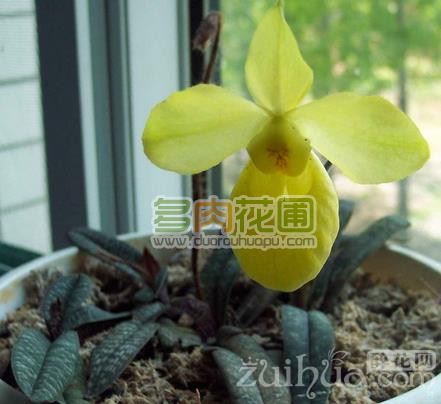
Paphiopedilum armeniacum is named for its apricot-yellow flower color and is commonly known as "golden slipper." It originates from Bijiang, Yunnan, China, growing on cliff faces, and was discovered not long ago. It was first collected in 1979 by Chinese botanist Zhang Aoluo and named in 1982 by Liu Xinqi and Liu Fangyuan. The plant has an extremely short stem, with leathery leaves that are nearly basal, elongated, dark green to grayish-green on the surface, light purple on the underside, with light green spots on both sides. The flower is apricot-yellow without a trace of other colors, looking very pure. The lip is an oval-shaped pouch, and the inward-rolled portion at the tip edge of the pouch is very narrow. The flowering period is in spring, and a single flower can remain open for 20-30 days.
Paphiopedilum micranthum is named for its relatively hard leaf texture, and is also called "silver slipper" because its flower color is light pink or white. It is distributed in southern Yunnan. Paphiopedilum micranthum is a new species discovered by Chinese botanists Tang Jin and Wang Fazan in 1951. Because the type specimen on which it was based at the time was a plant that had not yet flowered, it was named "small-flowered Paphiopedilum," though in fact its flowers are not small. In 1982, Liu Xinqi and Liu Fangyuan gave it the name "hard-leaved Paphiopedilum." The plant is similar to Paphiopedilum armeniacum but slightly smaller with hard leaves. The flower is solitary, with a relatively long and firm flower stalk; the flower is very large when open, pink or nearly white. The flowering period is in early spring, and each flower can remain open for 2-3 weeks.
Home care
Paphiopedilum armeniacum and Paphiopedilum micranthum are both perennial herbaceous plants of the genus Paphiopedilum in the orchid family, with similar habits. They prefer a warm, humid, semi-shaded environment. In northern regions, loose, breathable, well-drained leaf mold or grass peat soil is commonly used for planting, with 1/4 of the bottom of the pot filled with granular material such as tile fragments, brick chunks, and clay pellets to facilitate drainage and aeration. In southern regions, materials such as moss, fern roots, and bark chunks are used for cultivation. Normally, place them in a bright spot without direct sunlight for care. If the light is too strong, it will cause slow growth and stunted plants, sunscald on the leaves, and in severe cases even the death of the whole plant; while if too shaded, although the leaves grow well, flowering will be reduced or absent. During cultivation, in addition to keeping the potting medium moist, also mist the plant to increase air humidity. Two to three months before flowering, pay attention to controlling watering to facilitate flower bud formation.
Except during winter and the dormant period after flowering, apply a decomposed dilute liquid fertilizer once every 10 days, and be careful not to splash the fertilizer solution onto the leaves, as this may cause rot. In summer, place in a cool, ventilated spot to prevent plant rot caused by stuffy, humid conditions. In winter, maintain a nighttime temperature above 10°C, and daytime temperatures should be 5°C-10°C higher than at night.
The above is the introduction to orchid family plant care knowledge provided by Succulent Garden for everyone. I hope you have gained something after reading this article!