What conditions must be met for fuchsia to bloom more
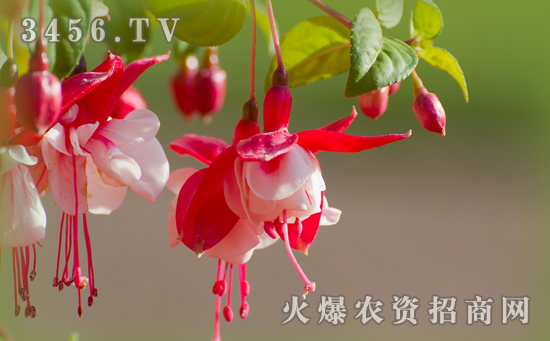
Fuchsia is also known as lady's eardrops. It is a perennial evergreen subshrub. Racemes or panicles, flowers pendulous, sepals red, corolla purple, rose red or white, stamens and pistils protruding beyond the flower. Commonly cultivated flowers of the same genus include Fuchsia corymbiflora, Fuchsia albiflora, Fuchsia magellanica var. gracilis, Fuchsia boliviana, Fuchsia procumbens, etc.
To make fuchsia bloom more, you need to do a good job with fertilizer, water supply and pruning. Fuchsia prefers fertilizer. The potting soil should be a culture soil made of 5 parts leaf mold, 4 parts sandy loam, and 1 part decomposed cake fertilizer. No additional base fertilizer is needed, to prevent root rot. Because it grows relatively fast, it is best to repot once every early spring. To promote lush leaves and abundant flowers, during the growing period it is best to apply a dilute liquid fertilizer combining nitrogen and phosphorus once every 10~14 days. If nutrients are insufficient, it will be difficult to bloom again after flowering once. Usually, watering should follow the principle of “see dry see wet”. During the flowering period, if the potting soil is too dry or too wet, it will cause bud drop, flower drop, and leaf drop, affecting normal flowering.
Pinching at the right time is a key measure to make fuchsia bloom more. Because fuchsia has the habit of bearing flower buds in the leaf axils of new shoots, pinching can stimulate the sprouting of new branches, produce more branches, and bloom more. Pinching should start from the seedling stage. Generally, when the seedlings grow to about 10 cm tall, carry out the first pinching to promote new branches; about 1 month after the first pinching, when the new branches grow 6~8 leaves, carry out the second pinching, keeping 5~7 branches per plant. After the weather turns cool in autumn, cut the overly long branches shorter, and thin out the overly dense branches, to facilitate the sprouting of robust new branches. After each pinching, watering should be controlled, and normal watering should be resumed after new branches grow from the leaf axils. Generally, 15~20 days after pinching, the new shoots produced can bloom bright flowers again, so multiple pinching has the effect of extending the flowering period.
How long does it take for fuchsia to bloom
Fuchsia is mainly propagated by cuttings, generally cuttings in January, February and October. The suitable temperature for cuttings is 15-20°C, and roots form after about 20 days. For species of fuchsia that easily set fruit, propagation by sowing can be used, sowing in pots in a greenhouse in spring and autumn. They germinate in about 15 days and bloom the following year.
How to make fuchsia bloom
To make its flowers abundant and colorful and extend the flowering period, the following measures should be taken in care:
1. Timely pinching and pruning of fuchsia
The flower buds of fuchsia grow in the leaf axils of new shoots. Pinching at the right time will promote the sprouting of new branches, making it branch more and bloom abundantly. Pinching should start from the seedling stage. The first pinching is when the seedlings grow to about 6~8 leaves, then carry out the second pinching, keeping about 5~7 branches per plant. During the growing season, after the flowers fade, pinching can be carried out again. Usually 20 days after pinching, new shoots can grow again, form flower buds, and bloom bright flowers. After autumn, thin out overly dense branches and shorten overly long branches. This is conducive to sprouting strong new branches and promoting more flowering.
2. Fuchsia should be fertilized in time
Because fuchsia grows fast and blooms continuously, attention should be paid to fertilizing during the growing period. Otherwise, after blooming once, it will be difficult to bloom again due to insufficient nutrients. Usually, apply a dilute decomposed cake fertilizer water or compound fertilizer once about every 10 days. After fertilizing, spray water once, to prevent the liquid fertilizer from sticking to the leaves and causing rot.
3. Fuchsia should be watered reasonably
The potting soil should not be too dry or too wet, otherwise it will cause leaf drop, bud drop, and flower drop. Watering should be done by watering thoroughly as soon as the soil is dry. After pinching and heavy pruning, watering should be controlled, and normal watering should be resumed after new branches sprout from the leaf axils. After each fertilization and watering, pay attention to loosening the soil to facilitate aeration.
How long it takes for fuchsia to bloom and how to make fuchsia bloom are briefly introduced here. Fuchsia likes a cool environment. Cultivation should ensure good ventilation and soil with good drainage. Fuchsia is afraid of high temperatures and is not cold-tolerant, so temperature regulation is also very important. In summer, avoid high temperatures, and in winter it must not be exposed to frost.
How to grow fuchsia? Tips for fuchsia to bloom in all four seasons
Fuchsia is also called lady's eardrops and lantern flower. Its flower language is believing in love, having a passionate heart. The flower shape is very special, unique and beautiful, a lush and abundantly flowering potted plant. The more you look at it, the prettier it is. It can bloom for more than half a year, and with suitable temperature, it can even bloom all year round. How do you grow fuchsia?
1. To plant fuchsia, one branch is enough. Around April in spring, choose a healthy section of branch, about three stem nodes and two leaves, soak it in water for two days, then insert it into sandy soil, and it can grow roots and sprout in a little over a week.
2. The planting time for fuchsia can be spring or autumn. For the soil for growing fuchsia, it is best to use sandy soil plus leaf mold and farmyard manure or animal manure. After planting, place it in a ventilated place with scattered light, and it must not be exposed to rain.
3. Its growth speed and reproduction speed are especially fast. Usually it should not be placed in places prone to sun exposure with strong light. Although it needs frequent watering and spraying, the potting soil must not have standing water.
4. In summer, when the temperature is high, it needs to be placed in a relatively ventilated and shady place, not exceeding 30 degrees, and must not have high temperature and strong light. In winter, place it indoors in a warm place, not lower than 5 degrees.
5. The temperature suitable for its growth is about 20 degrees. During the growing period, apply a thin fertilizer once every half month. Cake fertilizer, urea or monopotassium phosphate. Then it will bloom especially abundantly, hanging all over the branches like little lanterns.
6. It generally blooms in April and continues blooming until December. After flowering, pinch in time, cut off the faded flowers, and prune the branches, and it will continue to produce new flower buds and leaves, especially beautiful.
7. In winter, when the temperature is below five degrees, move it indoors in time. If the temperature is suitable in a relatively warm place, it can also bloom in winter.
The above are a few suggestions shared by the editor, hoping they can be of some help to you. After all, the article is limited, and many detailed issues in the planting process still require you to continuously accumulate experience in the planting process and gradually master the cultivation techniques for growing fuchsia.