How to care for fuchsia to get through summer safely
Fuchsia prefers a cool, airy, semi-shaded environment, with an optimum growing temperature of 15-25°C. When the temperature exceeds 30°C it enters a semi-dormant state, at which point leaf drop and root rot very easily occur; if effective measures are not taken in time, the whole plant can die. In care, pay attention to the following points:
(1) Lower the temperature and raise the humidity. After summer arrives, move the pot to a cool, airy, rain-sheltered spot, such as a shaded place on a north-facing balcony, or a spot indoors with bright scattered light. At the same time, spray water on the leaves 2-3 times a day, and in the hot summer season also splash water on the ground around the pot 1-2 times to lower the temperature and raise the humidity.
(2) Control fertilizer and water. In the high-temperature months of July and August, stop fertilizing and control watering; at this time the potting soil should preferably be on the dry side. If the potting soil is constantly too wet or muggy, the branches and leaves will turn yellow and wither, and in serious cases the roots will rot and the plant will die.
(3) Grow new seedlings. Old perennial fuchsia plants are sensitive to high temperatures. However, seedlings have a stronger heat resistance and generally do not drop their leaves during the dog days, so taking cuttings and raising new seedlings every year helps them get through summer safely.
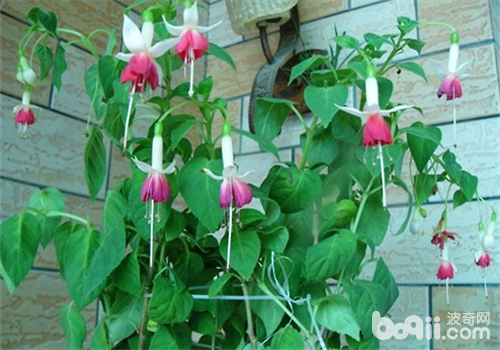
Fuchsia
Although the fuchsia has a rather odd appearance, it is grown quite widely in China, which shows just how popular it is with Chinese gardeners. However, the vast majority of flowering plants like a warm, humid environment, and the fuchsia is one of them, so the key to growing fuchsia well is how to get it through summer safely.
I. Environmental management for getting fuchsia through summer safely
1. Lower the temperature and improve ventilation. In summer, fuchsia should be placed in a shaded, cool, airy spot. For home growing, it can be placed in a cool, airy spot facing north or with a little sunlight; for greenhouse growing, open the windows for ventilation and shade with shade netting. Spray water on the leaves and the ground several times a day to lower the temperature and increase air humidity.
2. Stop fertilizing and control watering. In the hot summer, because fuchsia is in a semi-dormant state, stop fertilizing and control watering, and keep the potting soil slightly on the dry side. If the potting soil is too wet, the leaves will turn yellow and scorch, and the plant may even die.
3. Avoid rain. After being rained on, fuchsia is prone to root rot, yellowing leaves and leaf drop. Therefore, when it rains, shelter it from the rain or move it indoors.
4. Plant new seedlings. Although fuchsia is a perennial plant, in places where summers are hot, it is best to grow new potted seedlings each year in order to get through summer safely, because old perennial plants are less resistant to high temperatures than seedlings of the current year.
II. Pest and disease control for getting fuchsia through summer safely
1. Gray mold
Gray mold occurs during continuous rainy weather, or when too much nitrogen fertilizer is applied, or when light is insufficient. It mainly damages stems, leaves and flowers, causing water-soaked spots on the affected parts; if not controlled in time, these gradually enlarge and become rotten, covered with gray fuzzy mycelium, and in serious cases the plant dies.
Solution: In the early stage of the disease, promptly spray 65% zineb at 500 times dilution or 50% carbendazim or other new pesticides, spraying once every 7-10 days for 3-4 times in a row. Usually pay attention to ventilation and light so the plants grow well and their disease resistance improves. After the disease appears, promptly cut off and dispose of the diseased branches and leaves to reduce the source of infection.
2. Powdery mildew
Powdery mildew mainly damages stems, leaves and flower buds. After infection, there is a layer of white powder on the surface, and in serious cases the leaves shrivel and the flowers become smaller.
Solution: Pay attention to ventilation and light, and apply more phosphorus and potassium fertilizer to improve the plant's disease resistance. After the disease appears, promptly spray 70% thiophanate at 800 times dilution or 2500 times dilution of triadimefon or other suitable pesticides, spraying once every 10 days for 2-3 times in a row.
Fuchsia
3. Root rot
Root rot is a physiological disease, often occurring when watering is excessive, or during continuous rainy days and hot summer weather, causing oxygen deficiency; the roots turn black and rot, with mild cases showing yellowing and wilting of branches and leaves, and severe cases killing the whole plant.
Solution: After the disease appears, promptly drench the soil around the roots with 50% amobam at 300 times dilution. At the same time, in summer pay attention to ventilation and cooling, and do not water the potting soil too much.
4. Fusarium wilt
Solution: Apply 10% antibacterial agent 401 at 1000 times dilution to the soil for control.
5. Rust
Solution: Spray 20% rust-removing emulsifiable concentrate at 400 times dilution for control.
6. Aphids, red spider mites
Pests such as aphids and red spider mites mainly suck the sap of leaves, buds and flowers, affecting normal growth and development, and in serious cases the whole plant withers and dies.
Solution:Spray with dimethoate solution at 1:1000 dilution, 10% deltamethrin solution, or 50% menazon at 2000 times dilution.
The fuchsia may seem more fragile and delicate than other flowering plants, but as long as you understand its growth habits and do the daily care work well, you can still grow fuchsia with plump leaves and beautiful flowers.