What are the care methods for the red-backed prayer plant?
The red-backed prayer plant, also known as the red-backed calathea. The leaves are long-elliptic, ovate or broadly lanceolate, leathery, dark green, glossy, with a lighter midrib and blood-red undersides. The flower stalks, bracts and calyx are all bright red, with small white flowers inside. Many small flowers form a panicle. The flowering period is from winter to spring. Because the flowers are numerous and dense, and the colors are vivid, it is highly ornamental.
It likes a warm, humid and fairly shady environment. The optimum growth temperature is 20-30°C, and the minimum wintering temperature must not be lower than 15°C. Placed in a bright room, it can be enjoyed all year round. The potting soil is generally prepared with peat soil and leaf mold plus about 1/4 perlite or sandy soil, with a small amount of base fertilizer added. The watering, misting, fertilizing and other care methods are basically the same as those for the red-line prayer plant.
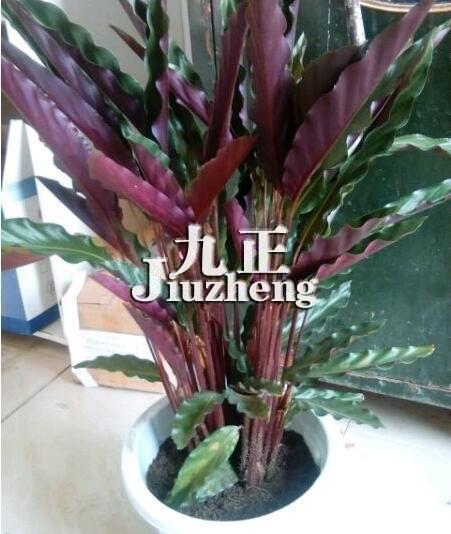
How to grow the red-backed prayer plant:
1. Soil: The red-backed prayer plant likes loose, fertile, moist and well-drained acidic soil. For pot culture, leaf mold, garden soil and river sand can be mixed in equal amounts and a small amount of base fertilizer added as the growing medium; the soil should be nutrient-rich, loose and breathable.
2. Watering: The red-backed prayer plant is not drought-tolerant. During the growing season it must be given sufficient water to keep the potting soil moist at all times, and attention should be paid to misting the leaves; especially in summer and autumn when the temperature is higher and the air is dry, it is also necessary to frequently spray water on the leaves and around them to maintain high air humidity. However, care should be taken not to let the potting soil become waterlogged, so as not to affect root aeration and cause poor growth or root rot; after late autumn, when the temperature is lower, watering should be controlled and the potting soil kept only slightly moist.
3. Light: The red-backed prayer plant likes shade and avoids direct sunlight, and must not be placed in the sun, otherwise the leaves will lose their green color and gloss, and in severe cases sunscald will occur; however, it should also not be placed in a dark and poorly ventilated place for a long time, so as to avoid the leaves turning yellow and falling off.
4. Fertilizing: During the growing season, apply liquid fertilizer 1-2 times a month to ensure robust growth and lush branches and leaves.
5. Pests and diseases: The common diseases of the red-backed prayer plant are mainly leaf spot and leaf blight. In the early stage of the disease, spray with 200-times Bordeaux mixture 2-3 times every half month. It can also be controlled by spraying with 65% zineb wettable powder diluted 600 times. The common pest is mainly scale insects, which are prone to occur when ventilation is poor. During the nymph stage, spray with 50% fenitrothion emulsifiable concentrate diluted 1000 times.
How to grow the red-backed prayer plant (basic knowledge):
Best propagation time: Division of the red-backed prayer plant is best done in spring after the temperature warms up.
Best growing soil: The red-backed prayer plant likes loose, fertile, moist and well-drained acidic soil.
Humidity requirements for growth: The most suitable relative air humidity for the growth of the red-backed prayer plant is 75%-85%; high air humidity is beneficial for leaf unfurling.
Best growing temperature: The optimum growth temperature for the red-backed prayer plant is 20-30°C.
Best growing light: The red-backed prayer plant likes shade and avoids direct sunlight, and must not be placed in the sun, otherwise the leaves will lose their green color and gloss, and in severe cases sunscald will occur; however, it should also not be placed in a dark and poorly ventilated place for a long time, so as to avoid the leaves turning yellow and falling off.
How the red-backed prayer plant propagates - division propagation
As the red-backed prayer plant grows, the plant becomes larger and larger. If it grows vigorously, it needs to be repotted every 1-2 years. Therefore, division propagation can be carried out in conjunction with repotting. Division is carried out in spring when the temperature rises; if the temperature and humidity are suitable, it can also be done throughout the year.
Remove the red-backed prayer plant from its pot and soil, and use a small knife to cut the clustered plant along the growth direction of the underground rhizome; it is best if each section has stems and leaves or leaf buds. It can be divided into several clumps and then potted separately. Place the planted red-backed prayer plant in a fairly shady place for care, control water, and only water normally after it has resumed normal growth.
How the red-backed prayer plant propagates - cutting propagation
The red-backed prayer plant is also often propagated by cuttings. Generally, cutting propagation of the red-backed prayer plant can be carried out at any time when the temperature is not lower than 20°C.
Cutting propagation of the red-backed prayer plant generally uses the tender tips at the top. Select tender tips 10-15 cm long and cut them off. Observe the size of the leaves; generally retain one-third or one-half of the leaves, treat the cuttings, and place them in a cool place to let the wounds heal, or use a little rooting powder to speed up rooting of the cuttings.
After treating the cuttings of the red-backed prayer plant, insert them into the seedbed, preferably at a spacing of 5 x 10 cm. The seedbed can use a breathable soil mixed from substrates low in organic matter such as river sand, vermiculite or perlite, and the soil should be sterilized before insertion. After cutting, the red-backed prayer plant should be covered with a 60% shade net, and suitable temperature and air humidity should be maintained; its management method is the same as that for division propagation.
After cutting, the red-backed prayer plant generally roots in 30-50 days, but the survival rate of cuttings is not as high as that of division propagation, generally around 50%.
Is the red-backed prayer plant toxic? How to grow the red-backed prayer plant, the flowering period of the red-backed prayer plant
The red-backed prayer plant is a perennial herbaceous plant of the genus Calathea in the family Marantaceae, and is an indoor shade-loving foliage plant. So what exactly is the red-backed prayer plant? What gives it such charm, and how should it be grown? Today the editor will explain this knowledge in detail for everyone.
.....
.....
Introduction to the red-backed prayer plant
The whole red-backed prayer plant is about 1 m tall and upright. The leaves are long-ovate or lanceolate. Its branches and leaves grow densely and the plant shape is full; the leaves are thickly leathery, the upper surface dark green and glossy, the midrib light-colored, and the undersides blood-red, forming a sharp contrast with the leaves and looking very beautiful. The spike is a spicate inflorescence, with bright red bracts and calyx and white petals. The back is purplish-red.
.....
.....
The growing environment of the red-backed prayer plant
The red-backed prayer plant is native to Central America and Brazil, and is cultivated in many provinces and regions in southern China. It likes a warm and humid climate and grows in a shady environment; the optimum growth temperature is 20-30°C, it needs more water and is not drought-tolerant. It is relatively heat-tolerant and slightly cold-tolerant, and can overwinter safely above 5°C.
.....
.....
How to grow the red-backed prayer plant
The red-backed prayer plant is mainly propagated by division. During cultivation, several points must be ensured. Soil: The red-backed prayer plant likes fertile, loose, moist and well-drained acidic soil. For pot culture, leaf mold and river sand can be evenly mixed, with a small amount of base fertilizer added as the growing medium. Ensure the nutrition and breathability of the growing medium. During the growing season, apply liquid fertilizer 1-2 times a month to ensure its growth needs and promote lush branches and leaves. In addition, repot once every 1-2 years.
.....
.....
Key care points for the red-backed prayer plant
Light: The red-backed prayer plant is an excellent indoor shade-loving foliage plant. In the hot summer, exposure to the sun must be prevented, and 70%-80% of the light should be shaded, otherwise damage is likely to occur; the leaves will lose their green color and become lusterless; but it also must not be placed in a dark and poorly ventilated place for a long time, so as to avoid the leaves turning yellow and falling off.
.....
.....
Watering: The red-backed prayer plant is not drought-tolerant, so during the growing period sufficient water must be ensured, the potting soil kept moist, and the leaves misted frequently; especially in the high-temperature seasons of summer and autumn, when the air is dry, it is also necessary to frequently spray water on the leaves and around them to maintain high air humidity. Be careful not to let the potting soil become waterlogged, so as not to affect root aeration and cause poor growth or root rot; after late autumn, when the temperature is lower, watering should be controlled, and keeping the potting soil slightly moist is enough.
Pest and disease control: The common diseases of the red-backed prayer plant are mainly leaf spot and leaf blight. In the early stage of the disease, spray with Bordeaux mixture about 2-3 times every 15 days. It can also be controlled by spraying with zineb wettable powder liquid. The common pest is mainly scale insects, which are prone to occur when ventilation is poor.
.....
.....
Introduction to the flowering period of the red-backed prayer plant
The red-backed prayer plant is mainly a foliage plant. Basically, if the temperature is kept above 25°C for about a year, it will bloom, but its flowers are somewhat inferior to its colorful leaves, which is also why many people are unclear about whether the red-backed prayer plant will bloom.
.....
.....
Introduction to the toxicity of the red-backed prayer plant
The red-backed prayer plant is non-toxic. It is mainly made into potted plants for indoor decoration and is an excellent indoor shade-loving foliage plant that can be enjoyed for a long time. It not only adds a touch of vitality but also brings a good mood.
.....
.....
Editor's summary
That is all the editor has to introduce about the red-backed prayer plant. This plant is especially suitable for pot culture. Friends who like it can grow a pot themselves and place it at home or in the office; it is all good! To learn more about flowers, you can click the link below!