Why does a potted kumquat only bloom but not bear fruit?
When a potted kumquat only blooms but does not bear fruit, or sets fruit that drops early, the cause, besides changes in conditions such as environment, water and light, lies mainly in insufficient fertilizer, especially insufficient phosphorus during the fruit-retention period after fruit set. For home potted kumquats, fertilizing can be done as follows: after Qingming, use nitrogen and phosphorus fertilizer combined with fermented, fully rotted concentrated organic fertilizer as a base fertilizer; in May to June, before flowering, apply nitrogen and phosphorus fertilizer again; apply a phosphorus-based top dressing 2~3 times, once every 10~15 days, and for larger plants the fertilizer can be slightly more concentrated; after flowering, when fruit sets, apply 1~2 more light top dressings of combined nitrogen and phosphorus, and in this way the fruit generally will not drop in autumn.
In addition, note the following: when the first fruit is forming, the potting soil must not be too wet or waterlogged, otherwise fruit drop will also occur; if too many fruits have set, thin the fruit to reduce nutrient consumption, and do not be greedy for quantity; when applying the combined nitrogen and phosphorus top dressing after flowering, the fertilizer should be dilute and not too concentrated, generally in September 1 part fertilizer to 1 part water; if the top dressing is too concentrated, the fruit cannot absorb it and will also drop early; apart from soybean cake crumbs or fish bone meal, any organic fertilizer applied must be fully fermented and rotted, and raw fertilizer that has not been fermented and rotted must not be applied.
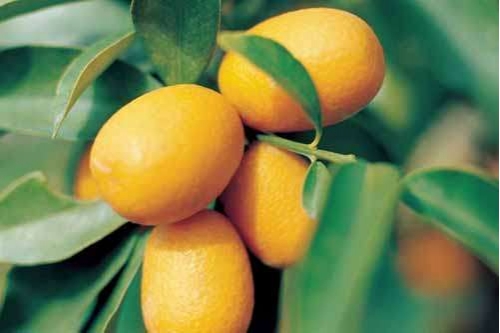 Kumquat
(1) Kumquat. The kumquat is the most cold-tolerant variety among potted citrus, so it is also the most widely cultivated. The kumquat's crown is round and spherical, with small, entire, lanceolate or oblong leaves and inconspicuous netted veins. On either side of the leaf stalk there are narrow wings, called phyllodes. The kumquat's phyllodes are especially narrow and small. The fruit is as large as a thumb, oval, and when ripe orange-yellow, sweet with a tart taste, and the peel and flesh are edible. After winter sets in, the fruit still does not drop, making it an excellent fruit-viewing plant for the Spring Festival. It has the characteristics of a small plant, small leaves, small flowers and small fruit, and is very suitable for a narrow balcony environment. Fruiting is not difficult, and it bears rather many fruits, so many people cultivate it.
Mandarin orange
(2) Mandarin orange. The mandarin orange grows vigorously, fruits early, has good fruit flavor, is seedless, and is also ornamental, so it is often grown in pots on balconies. Although the mandarin orange is cold-tolerant, it is less so than the kumquat. The leaves are large, long oval or prismatic, thick and fleshy, with long leaf stalks and small phyllodes. The fruit is large and oblate, reaching 8 cm in diameter, sweet and juicy. Citrus fruits mostly grow on the current year's new shoots, but mandarin orange fruits grow on last year's autumn shoots, and the fruit-setting rate is low. If the potting soil is too wet, there is too much rain, drainage is poor, or the plant is battered by storms, the young fruits already set will also drop. When balcony light is insufficient, it only grows leaves and does not bloom, and fruiting is even harder.
Potted citron
(3) Citron. The citron is also called xiangyuan; its branches and leaves grow densely, and the stems have sharp, pointed thorns. The leaves are alternate, oval, with small serrations along the edges. In May to June, flowers cluster in the leaf axils, white with purple outside, and have a strong fragrance. The fruit is like a goose egg, with a nipple-like protrusion at the tip and a rounded, pointed base; the rind is rough, yellow, glossy and delicately fragrant. The fruit ripens in October to November; although it is not edible, it hangs for a long time and can remain on the branch until the next year's new fruit ripens, providing fairly long-term viewing. A potted citron with a crown diameter of 70-80 cm, about 5-6 years old, if well cared for, can bear dozens of fruits. When ripe, green branches and leaves set off abundant orange fruits, making it very appealing.
Daedai bitter orange
(4) Daedai. Daedai is a variety of bitter orange. The branches are slender and sparse, mostly triangular; the bark of the trunk is green, with scattered thorns. The leaves are leathery and alternate, ovate-oblong or oval, with wavy notches along the edges; the leaf stalk has a broad, inverted heart-shaped phyllode, and the phyllode reaches 1/3 of the leaf blade, larger than the phyllodes of other citrus types, and is an important marker distinguishing Daedai from other citrus species. The flowers are white and strongly fragrant. Fruit set comes mainly from spring flowers, borne on the current year's new branches. It does not bear many fruits, 5-8 per pot; the fruit is oblate, 7-8 cm in diameter, rough-surfaced and strongly fragrant. In autumn and winter of that year it turns from green to orange-red or orange-yellow; if not picked, the following summer it turns from orange-red back to green and continues to grow, lasting 5 years without rotting, so that several generations can hang on one plant at the same time, which is why it is called daedai or huichun orange.
Finger citron
(5) Finger citron. The finger citron is a variety of citron. Among potted citrus, it is the least cold-tolerant. Its branches and leaves are dense; old branches are brown-green, young branches slightly purplish-red, with short hard thorns. The leaves are alternate, leathery, oval, bluntly rounded at the tip, with wavy serrations; the leaf stalk is short, with no phyllode. Between the leaf stalk and the leaf blade there is a distinct joint, while in the citron the joint is almost invisible. It can bloom several times a year; the flowers are white with purplish-red at the base of the petals and a delicate fragrance. The fruit is elongated, wrinkled and glossy; those whose tips split open like fingers are called open finger citron, and those not completely split are called fist finger citron. The flesh is almost completely degenerate; the fruit is bright yellow with a rich, unusual fragrance, and when fully ripe it turns bronze-colored, hard as wood, and can be kept a long time without losing its scent. With a pot of finger citron at home, a subtle fragrance fills the air, creating a distinctive charm.
Four-season mandarin
(6) Four-season mandarin. The four-season mandarin is also a common potted citrus on balconies, especially in the Guangdong area, where more people cultivate it. It is a hybrid of kumquat and mandarin; the fruit is oblate, about 3 cm in diameter, orange-yellow when ripe, sour and inedible. From ripening to natural dropping, the four-season mandarin's fruit lasts as long as half a year; for example, fruit hung in autumn of that year can be enjoyed until May of the following year, whereas kumquat fruit, once ripe, can only be viewed for another 1~2 months. A four-season mandarin with a crown diameter of 50-60 cm can bear around a hundred fruits. The four-season mandarin is loved for its abundant fruit and long viewing period.