Is Amaryllis Poisonous? Learn About Its Toxicity Before You Grow It for Peace of Mind
Recently, quite a few readers have emailed us asking: is amaryllis poisonous? Is amaryllis also called "Hedinghong" (red arsenic), and is it toxic? I say amaryllis is basically not poisonous. Yes, some people do call it Hedinghong. In fact, its other names are: baizhilian, huazhoulan, gutinghua, also called baiquilian, zhudinglan, and also zhudinghong, among others.
Amaryllis (Hippeastrum) is a perennial herbaceous bulbous flowering plant. The bulb is thick and fleshy, nearly spherical, with a pale green or yellowish-brown outer skin. The leaves grow opposite on both sides, strap-shaped, with tapering tips, and the leaves usually emerge after the flowers. It likes warmth and moisture, and dislikes intense direct sunlight. It does not like high temperatures, nor is it cold-tolerant. It thrives in fertile, loose,
well-drained sandy loam soil.
Amaryllis is widely grown in pots by plant lovers and has excellent ornamental value. However, the pot should not be too large (generally start with a pot of 16-20 cm in diameter), to avoid the potting soil staying wet for too long and causing the bulb to rot. So why do some people suspect that amaryllis is poisonous and unsuitable for placing indoors? I looked up the relevant materials: in real life, there is a natural mineral called Hedinghong, which is actually red realgar. Red realgar is a natural mineral form of arsenic trioxide, and after processing it becomes the well-known white arsenic. It may be because red realgar is red that the name Hedinghong was used. But this Hedinghong is not that Hedinghong; the two things are fundamentally different, so there is no need to worry at all. Amaryllis is a non-toxic plant, so plant lovers who enjoy growing amaryllis can grow it with peace of mind.
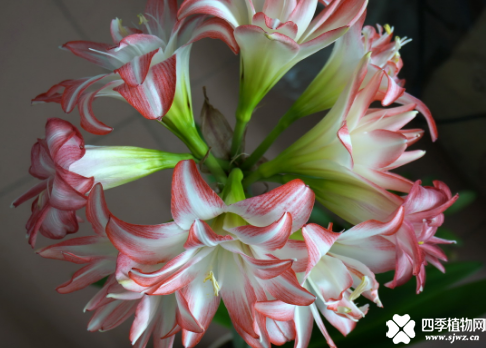
Is Amaryllis Poisonous?
Amaryllis itself is slightly toxic, but like some other toxic plants, its toxicity exists only in its sap, that is, in its bulb. So as long as we are careful not to touch its sap, it is fine; if you accidentally touch it, washing your hands promptly is usually no big problem. The scent produced by amaryllis is also non-toxic, so there is no need to worry. However, when amaryllis respires it absorbs oxygen and releases carbon dioxide, so amaryllis should not be placed in the bedroom.