What is the difference between amaryllis and belladonna lily? A quick guide to tell them apart
Amaryllis (scientific name: hippeastrum rutilum) is a perennial herbaceous plant of the genus Hippeastrum in the Amaryllidaceae family. Its bulb is plump and nearly spherical, 5 - 10 cm in diameter, with a pale green or yellowish-brown outer skin. The leaves grow opposite on both sides, are strap-shaped with tapering tips, and number 2 - 8; the leaves mostly appear after the flowers, and are 15 - 60 cm long. Because amaryllis has many divergent varieties, it is widely grown in pots and has very high ornamental value.
The amaryllis flower scape is hollow and covered with white powder, bearing 2-6 flowers at the top; the flowers are trumpet-shaped. The flowering period includes late autumn and spring to early summer, and some varieties even bloom from early autumn to the Spring Festival (white-striped amaryllis). Most modern cultivated forms are hybrids, with very large blooms and brilliant colors, including bright red, rose red, orange red, light red, white, blue-purple, green, pink with white, and red with yellow; apart from pure blue, pure black, and pure green, their flower colors can cover virtually every other color in the spectrum. The largest flowers can reach more than 20 cm across, and there are also double-flowered varieties. The variety of amaryllis is no less than that of hyacinths; the perfection of its flower colors surpasses that of hyacinths; its flower forms are so unusual that even lilies are outshone; and flowers and foliage both being ornamental makes it a rarity among bulb plants. It is clear that its overall qualities make it foremost among bulb flowers and plants.
In fact, many netizens have not figured out the difference between amaryllis and belladonna lily. The editor has also checked a lot of professional materials, which clearly state that amaryllis and belladonna lily are the same plant, both being plants with the same alias.
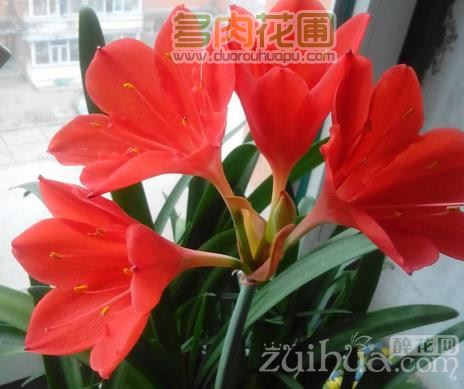
Purple-root lily, also known as George lily. It belongs to the genus Cyrtanthus in the Amaryllidaceae family, and is a perennial bulbous herb.
The purple-root lily has a plump, nearly spherical bulb, 5-7 cm in diameter, with a pale green, yellowish-brown, or purple outer skin. The leaves grow opposite on both sides, are strap-shaped with tapering tips, and number 6-8; some leaves appear after the flowers. The flower scape is hollow and covered with white powder, bearing 2-4 flowers at the top; the flowers are trumpet-shaped and mostly red. The flowering period runs from winter to spring, and even later. In the middle and lower reaches of the Yangtze River, it can overwinter safely in the open ground. Its growing environment requires cool summers and warm winters. The soil needs to be sandy loam rich in organic matter. It likes sunlight, but the light should not be too intense. It likes moisture, but is afraid of waterlogging.
What amaryllis and purple-root lily have in common: both belong to the Amaryllidaceae family, have spherical bulbs, strap-shaped leaves growing opposite on both sides, hollow flower scapes covered with white powder, flowers borne at the top, and trumpet-shaped flowers.
The parts where amaryllis and purple-root lily differ are the size of the bulb, the number of leaves, and the number of flowers.
From the above information, the purple-root lily is a variety of amaryllis. I hope readers can gain something after reading this article. You are welcome to continue following Succulent Garden to learn more about bulb flowers!
How to tell amaryllis and purple-root lily apart
Many people are not particularly familiar with amaryllis and purple-root lily, so when they see them, they think they are the same plant, but the two are indeed two different plants. How do you tell amaryllis and purple-root lily apart? Let's take a look with the editor below.
Amaryllis, also known as hundred-branch lotus, column-top red, amaryllis lily, belladonna lily, huazhou lily, African lily, hundred-branch lotus, pair red, pair-head lotus, and belladonna lily. It is a perennial plant of the genus Hippeastrum in the Amaryllidaceae family. Its bulb is plump and nearly spherical, 5-10 cm in diameter, with a pale green or yellowish-brown outer skin. The leaves grow opposite on both sides, are strap-shaped with tapering tips, and number 2-8; the leaves mostly appear after the flowers, and are 15-60 cm long. The flower scape is hollow and covered with white powder, bearing 2-6 flowers at the top; the flowers are trumpet-shaped. Because amaryllis has many different varieties, it is widely potted in homes and office environments, greening and accenting spaces, and is a flower with very high ornamental value.
Purple-root lily, also known as George lily. It belongs to the genus Cyrtanthus in the Amaryllidaceae family, and is a perennial bulbous herb.
The purple-root lily has a plump, nearly spherical bulb, 5-7 cm in diameter, with a pale green, yellowish-brown, or purple outer skin. The leaves grow opposite on both sides, are strap-shaped with tapering tips, and number 6-8; some leaves appear after the flowers. The flower scape is hollow and covered with white powder, bearing 2-4 flowers at the top; the flowers are trumpet-shaped and mostly red. The flowering period runs from winter to spring, and even later. In the middle and lower reaches of the Yangtze River, it can overwinter safely in the open ground. Its growing environment requires cool summers and warm winters. The soil needs to be sandy loam rich in organic matter. It likes sunlight, but the light should not be too intense. It likes moisture, but is afraid of waterlogging.
What amaryllis and purple-root lily have in common: both belong to the Amaryllidaceae family, have spherical bulbs, strap-shaped leaves growing opposite on both sides, hollow flower scapes covered with white powder, flowers borne at the top, and trumpet-shaped flowers.
The parts where amaryllis and purple-root lily differ are the size of the bulb, the number of leaves, and the number of flowers.
As for how to tell amaryllis and purple-root lily apart and where they differ, that is all the editor has to introduce here. I hope it helps everyone distinguish between these two flowers.