How to Water Azaleas? The Correct Method Explained Clearly in One Article
Because the root system of azaleas is a shallow, fine root mass, they fear both drought and waterlogging; improper watering can cause leaf drop in mild cases and death in severe cases. Therefore, whether watering is done properly becomes one of the keys to growing azaleas well. Watering azaleas should be determined according to the plant's growth condition and weather changes.
During the spring bud formation and flowering period, water consumption is relatively high, so watering must be timely; otherwise the pot will dry out, the flowers will wither, and the flowering period will be shortened. At this time, it is best to keep the potting soil moist. In summer, azalea branches and leaves grow vigorously, the temperature is high, and water evaporates quickly; in addition to watering thoroughly once a day, water must also be replenished at any time. A slight negligence in forgetting to water will cause the leaves to turn yellow, the leaf centers to curl, and even dry up and die. In autumn, the flower buds have already formed, the temperature gradually drops, and the weather turns cool; at this time, it is enough to keep the potting soil from drying out. In winter, the temperature is low, azaleas are in a dormant or semi-dormant state, metabolism slows down, and water consumption is low, so watering must be strictly controlled; otherwise root rot is likely. However, note that at this time the branches and leaves should be sprayed and washed once about every week with clean water close to room temperature, to help keep the plant fresh and reduce the occurrence of sooty mold.
When watering azaleas, attention should be paid to water quality; using rainwater is very beneficial to their growth. In Northeast China, watering azaleas with snow water also has a very good effect, but note that the ice and snow should be melted and left to stand until close to room temperature before use. If tap water is used, it needs to be placed in a basin and stored for one to two days before use.
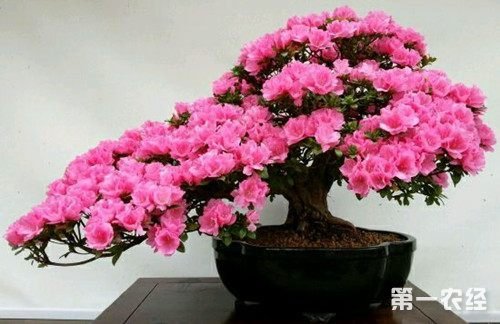
Azalea bonsai
If you want azaleas to grow well, the important thing is to take proper measures in management and to meet as much as possible the requirements of this flower in terms of growth habits, among which the three important conditions of water, soil, and fertilizer are the most important. Below, let's talk about the issue of watering.
In terms of watering, first of all, water supply must be timely and appropriate; second, better water quality is required. The root system of azaleas is relatively fine and weak; it is neither tolerant of drought nor of waterlogging; it likes moisture but also fears water accumulation. This requires the grower to grasp carefully. Because if water is lacking during the leaf-expansion period, the leaves on the azalea plant will turn yellow and the heart leaves will curl; if it dries out severely, it may even wither and die.
If water is lacking while it is blooming, the petals will become soft and shrunken, the flowers will droop, the flower color will not be bright, and the flowers may even wither and die. Therefore, watering must be done as appropriate according to sunny or rainy weather, air dryness, and the water content of the potting soil.
Under ordinary circumstances, in spring and autumn, water once every 2 to 3 days; in summer, when the temperature is high and the air is dry, water every morning and evening. Of course, on rainy days you can water less or not at all, depending on the moisture condition of the potting soil. In the hot summer climate, if it has not rained for several days and the air is very dry, you should also use a fine-nozzle watering can to spray clean water on the flowers and leaves, and you can also spray some water on the ground around the flowerpot to increase air humidity. After the Start of Autumn, the weather has turned cool, so watering frequency and amount should gradually decrease as the temperature drops; in winter, when the flowerpot has been moved indoors, water even less, only keeping the potting soil slightly moist.
The water used to irrigate azaleas should be particular about water quality. The water used to irrigate azaleas is best natural rainwater, because natural rainwater does not contain bleaching powder and other chemicals and impurities; next is river water and pond water; tap water comes after that. Tap water has been purified and belongs to soft water, and it contains chemical agents such as bleaching powder, liquid chlorine, and alum. If this kind of water is used for a long time, the alkalinity in the potting soil will gradually increase, which is not conducive to the growth of azaleas.
If in a big city only tap water is available, you can put the tap water into a water vat or bucket and let it stand for 1 to 2 days; after the impurities settle, add 0.15% ferrous sulfate, let it dissolve into a dilute ferrous sulfate solution, and then use it for irrigation. If it can be used together with liquid manure water for irrigation, it will be even more beneficial. Because regularly watering with these two kinds of water can both keep the potting soil at a certain acidity and supply certain nutrients, suitable for the needs of azalea growth.