Reasons for Anthurium Leaves Turning Yellow and Dropping, and How to Fix It
When anthurium shows symptoms of leaves turning yellow, drying up, and rotting, it is caused by bacteria. Spraying chili water cannot cure it; chili water is for pest control, not for bacterial diseases. To eliminate bacteria, you can spray a 0.3% solution of garlic juice, a 0.2% solution of vinegar, or fungicides such as carbendazim or chlorothalonil at 800-1000 times dilution.
But this cannot solve the root problem, because these symptoms in anthurium occur when the care environment is unsuitable. Anthurium should be managed in a semi-shaded, moist, warm environment, with the best temperature between 20-25°C and never above 33°C, otherwise symptoms of discomfort easily appear; air humidity must be between 75-90%, and below 50% the leaves easily develop scorched edges and drying.
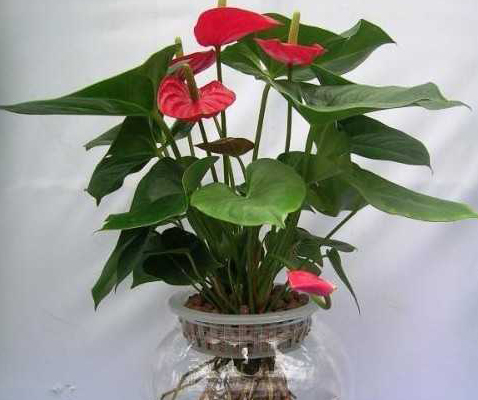
Fertilizing should not be too concentrated either; the potting soil should be watered with fully water-soluble fertilizer, not general chemical fertilizers, because anthurium cannot absorb them and fertilizer burn will occur.
What Causes Anthurium Leaves to Turn Yellow, and What to Do About It
Anthurium has excellent ornamental value; its spathe goes from creamy yellow to milky white, and finally even turns green, and before it withers it turns yellow again. The flower language of anthurium: great prospects and passion. But today the editor will bring you the reasons why anthurium leaves turn yellow and how to deal with them.
[Growth Habits]
Anthurium is a perennial evergreen herbaceous flower. It likes warm, hot and humid environments but also needs good drainage; it fears both drought and strong direct sunlight. The most suitable growing temperature is between 26-32°C, and the nighttime temperature should also be between 21-32°C; it can tolerate a maximum temperature of 35°C and a minimum temperature of 14°C.
[Care Methods]
Temperature: Anthurium is quite sensitive to temperature, and the most suitable growing temperature is 14-35°C, with the optimum at 19-25°C and a day-night temperature difference of 3-6°C, meaning it is best at 21-25°C during the day. If it stays below about 13°C for a long time, although the plant will not die, it will be difficult for it to recover growth for a long time; when the temperature is above 35°C and light is fairly strong, leaf surfaces are prone to scorching, and because damaged leaves do not reverse, this affects the overall quality of the anthurium and also creates difficulties for subsequent care.
Water: During the seedling stage, because the root system is very weak, it is distributed relatively shallowly in the substrate and is not drought-tolerant. After planting, water should be sprayed 2-3 times a day, and the substrate should often be kept moist to encourage early development and more new roots, while paying attention to the dryness and moisture of the substrate on the pot surface; during the medium and large seedling stages, the plants grow quickly and need more water, so the water supply must be sufficient; during the flowering period, watering should be appropriately reduced and phosphorus and potassium fertilizer increased to promote flowering. However, the key to successful large-scale anthurium cultivation is maintaining relatively high air humidity. Especially in hot seasons, the relative air humidity in the greenhouse can be increased through sprinkler systems and misting systems. But be careful not to mist the leaf surfaces in the evening, and be sure to ensure there are no water droplets on the anthurium leaf surfaces at night; this avoids high-temperature scorching of leaves, scorched leaves, deformed flower buds, and fading. During watering, always alternate between dry and wet; never water when the plant is severely short of water, as this will affect its normal growth and development. In hot seasons, water usually once every 2-3 days, and at noon also use a sprinkler system to spray water on the leaf surfaces to increase indoor relative humidity. In cold seasons, watering should be done between 9 a.m. and before 4 p.m. to avoid freezing the root system.
Fertilizer: Liquid fertilizer application should follow the principle of regular and measured amounts. Fertilization time varies with climate and environment; under normal circumstances, apply between 8 a.m. and before 5 p.m.; in winter or early spring, do it between 9 a.m. and before 4 p.m. Each fertilization must be carried out by a dedicated person, and the dilution concentration and application amount of the liquid fertilizer (stock solution) must be strictly controlled. Adjust the pH of the diluted liquid fertilizer to about 5.7, and apply when the EC value is 1.2 ms/cm. In addition, two hours after liquid fertilizer application, use a sprinkler system to spray water on the plant leaf surfaces to wash off fertilizer remaining on the leaves, keep the leaf surfaces clean, and avoid algae growth.
[Causes of Yellowing Leaves and How to Handle Them]
Cause: Generally, the most likely cause of anthurium leaves turning yellow is temperature, though of course it may also be watering and light.
Method: Move the anthurium outdoors to get some sunlight. A lack of light can also make leaves turn yellow, and the flower color becomes paler and paler and loses its luster. First remove the yellowed leaves.
What to Do When Anthurium Leaves Turn Yellow: Causes and Solutions for Anthurium Leaves Turning Yellow
Flower lovers who have grown anthurium will encounter the situation of anthurium leaves turning yellow. Below, we introduce the causes and solutions for anthurium leaves turning yellow.
Cause 1 of Anthurium Leaves Turning Yellow: Metabolism
If you find that anthurium leaves are turning yellow, pay attention to observing the condition of the other leaves. If the leaves are fresh tender yellow-green while the flowers are growing well, it means new leaves are growing, and old leaves turning yellow and dropping is normal.
Cause 2 of Anthurium Leaves Turning Yellow: Unsuitable Soil
In most northern regions, the medium and water contain more salt and alkali. Because the medium lacks the soluble iron that the plant needs to absorb, the leaves gradually lose green and turn yellow.
Solution: Treat the medium and watering water with oxalic acid, etc.
Cause 3 of Anthurium Leaves Turning Yellow: Overwatering
When anthurium's new leaves turn yellow while the old leaves remain normal, this is generally because watering too much and too frequently keeps the medium in the pot wet for a long time, or even waterlogged, causing some fibrous roots to rot, hindering normal respiration and nutrient absorption, and causing leaves to gradually turn yellow and drop.
Solution: Water normally.
Cause 4 of Anthurium Leaves Turning Yellow: Dry Air
When the air indoors is too dry in winter when growing flowers, leaf tips often dry up and turn yellow, or leaf edges scorch, or leaves develop scorched spots and curled edges.
Solution: According to the growth characteristics of anthurium, appropriately increase air humidity.
Cause 5 of Anthurium Leaves Turning Yellow: Excessive Shading
If anthurium is kept for a long time in a shaded place or a place with insufficient light, growth will weaken, leaves will be thin and yellow, and it will not bloom or bloom very little.
Solution: According to the growth characteristics of anthurium, appropriately increase light intensity.
Cause 6 of Anthurium Leaves Turning Yellow: Unsuitable Temperature
If the indoor temperature is too low in winter, the leaves will turn yellow; if the room temperature is too high, the plant transpires excessively, and the roots cannot supply enough water and nutrients, which will also make the leaves turn yellow.
Solution: Keep the temperature in the greenhouse relatively stable.
Cause 7 of Anthurium Leaves Turning Yellow: Uneven Fertilization
Too little fertilization, or not changing the pot or soil for a long time, leads to a lack of nitrogen and other nutrients in the soil, causing weak branches and leaves and thin, yellow leaves. In addition, excessive fertilization can also cause new leaves to be thick and uneven, while old leaves dry at the tips and turn scorched yellow and drop. At this point, fertilization should be stopped immediately, watering increased, and some of the old soil removed and replaced with new culture soil for normal management.