How to Grow the Goldfish Plant: A Detailed Guide to the Key Cultivation Techniques
A reader asked about goldfish plant cultivation techniques and how to grow the goldfish plant. Based on my years of experience growing flowers, I will now explain in detail how to grow the goldfish plant.
The goldfish plant originates from tropical regions and prefers a warm, humid, shade-loving environment. For home care, it can be placed in a spot with bright, indirect light. During the hot summer months, take care to protect it from the sun, and it is best to move it to a cool, well-ventilated spot for care; otherwise, intense sunlight can easily cause soft rot in the goldfish plant's stems, leading to death. Winter and spring are the flowering season for the goldfish plant. At this time, it needs ample sunlight so that the flower colors can be vivid.
During its vigorous growing season, the goldfish plant has a high water requirement. In spring, summer, and autumn, keep the potting soil moist, following the principle of "“water when dry, stop when wet”." Normally, maintain environmental humidity, and it is best to frequently spray water around the flower pot, but avoid wetting the leaves. If you have no time to care for it, you can place the pot in a shallow basin filled with clean water, which can effectively ensure humidity in a small area. After winter arrives, the goldfish plant enters its dormant period and grows slowly. At this time, correspondingly reduce watering and keep it appropriately dry until the flower buds first appear. Once the buds appear, you can appropriately increase watering to prepare for flowering.
The goldfish plant has low requirements for fertilizer and water. Applying a dilute organic fertilizer solution about once every half month is sufficient. If you can appropriately add some phosphorus fertilizer before bud formation, it will produce more flowers with vivid colors.
After the flowering period, necessary pruning should also be carried out: remove spent flowers and dead branches, and shorten the stems. This encourages the plant to branch more and keeps the whole plant compact, so that next year it will have even more flowers and lush foliage. However, if you want to grow it as a hanging basket, then simply shortening the stems appropriately is enough.
Introduction to the Goldfish Plant
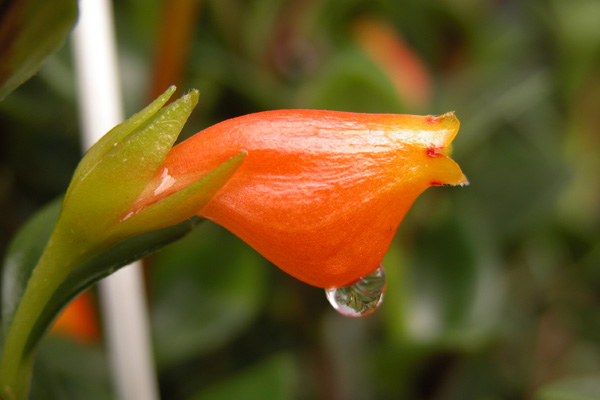
The goldfish plant is a perennial evergreen herbaceous vine in the family Gesneriaceae, genus Columnea (goldfish plant). Its stems are slender, climbing and trailing, with branches drooping downward, bearing roots and leaves. The leaves are opposite or unequal in size left and right, 2.5-3 cm long and 2 cm wide, broadly heart-shaped or ovate, mostly fleshy, deep green, with red hairs on the surface. The flowers are borne in the leaf axils, solitary, large, growing horizontally or upright. The flower is gamopetalous and tubular, with deep lobes at the tip, yellow spots in the throat, petals in 2 lips, arched and curved, fiery red, and shaped much like a red goldfish.
[Scientific Name] Columnea gloriosa
[Common Names] Kelun flower, string of goldfish, small-leaf goldfish plant, whale flower, button whale flower, small-leaf goldfish plant, goldfish hanging plant, kangaroo hanging plant, kangaroo flower
[Classification] Spermatophyta, Angiospermae, Dicotyledoneae, Scrophulariales, Gesneriaceae, Columnea. The goldfish plant is a plant of the genus Columnea in the family Convolvulaceae, also known as Yu Hua Niao Luo, Kelun flower, string of goldfish, small-leaf goldfish plant, whale flower, button whale flower, small-leaf goldfish plant, goldfish hanging plant, kangaroo hanging plant, kangaroo flower, goldfish vine, and feather flower vine. It is distributed in Central America, Mexico, South America, and Yunnan and other places in mainland China. In the goldfish plant, the leaf surface is deep green, and the underside is red near the main vein; the fruit is 6-8 mm long and contains 4 seeds or fewer. It originates from tropical regions of the Americas and is a perennial herbaceous twining plant that twines to the left. If kept in a sunny place for a long time, or if it is too dry or the winter temperature is too low, it will drop its leaves. Perennial left-twining herbaceous plant, hairless, stems 2-5 m long. Leaves 3-lobed or entire. Dichasial scorpioid cymes, up to 35 cm long, with each flower oriented to one side; sepals 5-6 mm long; corolla tubular, slightly curved, ribbed, the mouth slightly swollen and jar-shaped, 1.7-2 cm long, initially red, gradually turning pale yellow to white; stamens and style extend beyond the corolla. It mostly blooms in spring, with a flowering period of more than 20 days.
The goldfish plant has dense branches and leaves, with stems and vines hanging naturally. During peak flowering, a larger plant can bear more than a hundred flowers at the same time, and the flowers are large and brightly colored, quite spectacular, making it a very ideal shade-loving trailing foliage and flowering plant. It is very suitable as an epiphytic potted plant in greenhouses and indoor gardens, and can also be used as a hanging plant for home appreciation.
Cultivation Methods for the Goldfish Plant
I. Propagation Methods
The goldfish plant, also known as kangaroo flower, is a perennial evergreen herbaceous plant in the family Gesneriaceae. The leaves are leathery, deep green and glossy, and arranged neatly and compactly. The flowers are orange-yellow with a peculiar shape, swollen in the middle, small at both ends, with a small opening at the front. It is suitable for small and medium-sized potted plants or for indoor hanging and corridor greenery. Its cultivation characteristics are described below:
1. For cultivation, use a substrate soil mixed with leaf mold, manure, and sand in a 3:1:1 ratio, with a pH of 6 to 6.5. Apply a dilute compound fertilizer solution monthly, and in the two months before the flowering period, apply a phosphorus-potassium fertilizer solution once every half month. Repot once every other year.
2. The suitable growth temperature is 16°C to 28°C. Above 30°C, strengthen shading and ventilation, otherwise leaf drop may occur. Keep it at at least 10°C or above through the winter.
3. It is shade-tolerant and suitable for places with indirect light, avoiding direct strong light. When the soil surface is dry, water thoroughly. You can frequently spray water on the leaves and around the plant to increase air humidity, and reduce watering in winter.
4. After flowering, prune all weak branches, top branches, and excessively long drooping branches. In winter, cut off withered flower stems from the base and keep them dry, which helps new flower branches sprout and grow the following spring.
5. Propagation is mainly by cuttings. You can cut nodal branches, each about 8 cm long, cut off half of the upper leaves and remove all the lower ones, and keep them in a semi-shaded, moist environment. They can take root and be potted in about 30 days. They can also be propagated by division, carried out in early spring or late autumn, with each clump necessarily having 1 to 2 terminal buds, and planting 2 to 3 plants per pot.
II. Cultivation Techniques
1. Light: The goldfish plant originates from tropical regions and prefers a warm, humid, shade-loving environment. For care, it can be placed in a spot with bright, indirect light. During the hot summer months, take care to protect it from the sun, and it is best to move it to a cool, well-ventilated spot for care; otherwise, intense sunlight can easily cause soft rot in the goldfish plant's stems, leading to death. Winter and spring are the flowering season for the goldfish plant. At this time, it needs ample sunlight so that the flower colors can be vivid.
2. Temperature: The suitable growth temperature for the goldfish plant is 18-22°C, and it dislikes low temperatures. If the temperature is below 10°C, the leaves begin to turn yellow and dry out, to the point that even a very slight vibration will cause leaf drop. In addition to low temperatures, continuous temperatures above 30°C will also cause leaf drop. In high summer temperatures, the goldfish plant grows very slowly or almost stops growing. At this time, appropriate shading measures should be taken so that it can grow vigorously and not lose leaves.
3. Watering: During its vigorous growing season, the goldfish plant has a high water requirement. In spring, summer, and autumn, keep the potting soil moist, following the principle of "“water when dry, stop when wet”“." Normally, maintain environmental humidity, and it is best to frequently spray water around the flower pot, but avoid wetting the leaves. If you have no time to care for it, you can place the pot in a shallow basin filled with clean water, which can effectively ensure humidity in a small area. After winter arrives, the goldfish plant enters its dormant period and grows slowly. At this time, correspondingly reduce watering and keep it appropriately dry until the flower buds first appear. Once the buds appear, you can appropriately increase watering to prepare for flowering.
4. Fertilizing: The goldfish plant has low requirements for fertilizer and water. Applying a dilute organic fertilizer solution about once every half month is sufficient. If you can appropriately add some phosphorus fertilizer before bud formation, it will produce more flowers with vivid colors. Fertilizing is mainly done in spring and autumn, applying a dilute liquid fertilizer once every 10-14 days. In autumn, apply a liquid fertilizer mainly based on nitrogen fertilizer to promote lush branches and leaves, while after spring, more fertilizers containing phosphorus and potassium should be applied to promote vivid flower colors.
5. Propagation: The goldfish plant is mainly propagated by cuttings, primarily by terminal branch cuttings or stem segment cuttings. It can be done throughout the year, and is best done indoors after flowering. Cut 10-15 cm of one-year-old branches, retain 3-4 pairs of leaves at the top, remove several pairs of small leaves at the base, insert them into a sand bed or sand pot, cover well with plastic film, control the temperature at 20-22°C, and maintain relatively high air humidity; roots will develop in 3-4 weeks. After surviving, begin pinching 2 months later to encourage more branching and more flowers, and then it can be planted into pots. Seedlings do not bloom in the first year, and with proper care they can bloom after 2-3 years.
How to Grow the Goldfish Plant
How to Grow the Goldfish Plant
Goldfish Plant - Cultivation Methods
[Scientific Name] Columnea gloriosa
[Common Names] Kelun flower, string of goldfish, small-leaf goldfish plant, whale flower, button whale flower, small-leaf goldfish plant, goldfish hanging plant, kangaroo hanging plant, kangaroo flower
[Classification] Spermatophyta, Angiospermae, Dicotyledoneae, Scrophulariales, Gesneriaceae, Columnea. The goldfish plant is in the family Convolvulaceae
Goldfish Plant
Propagation can use terminal branch cuttings or stem segment cuttings. It can be done throughout the year, and is best done indoors after flowering. Cut about 10-15 cm of one-year-old branches, retain 3-4 leaves, remove several pairs of small leaves at the base, and insert them into sandy soil. Cover well with glass or plastic film, control the temperature at 20°C, and maintain relatively high air humidity; roots can develop in about 3-4 weeks. After surviving, begin pinching two months later to encourage more branching and more flowers, and then it can be planted into pots. Seedlings do not bloom in the first year, and only after two or three years do red flowers emerge from the leaf axils at the tips of the drooping branches.
The goldfish plant can be propagated by sowing, division, and cuttings. Because seeds are not easily obtained, sowing is mostly not used, and cutting propagation is generally common. In spring and autumn, cut branches about 10 cm long (3-4 nodes), insert them into a cutting bed made of river sand or vermiculite, and maintain relatively high humidity. At a temperature of 20-25°C, they can take root in about one month; after rooting and surviving, strengthen management, promote the growth of new shoots, and pinch to encourage branching. After 1-2 months, they can be potted.
For potted goldfish plants, the substrate should be rich in humus, loose, and well-drained. Generally, peat soil, perlite, and vermiculite are mixed in equal amounts, and the soil should be kept slightly acidic to favor growth. During the growing period, apply a liquid fertilizer once every 1-2 weeks, and during the peak growth and flowering period, additional phosphorus and potassium fertilizers must be applied. In winter there is a short dormant period, during which watering can be reduced and the potting soil kept appropriately dry; in winter (that is, the flowering period), watering can be appropriately increased; during the growing period there must be sufficient moisture, the potting soil must be kept constantly moist, and efforts should be made to increase air humidity. High temperature and high humidity can easily cause stem and branch soft rot and death. If this happens, promptly cut off the soft rot parts. The goldfish plant prefers a bright, non-direct-light environment, so when summer light is too strong, shade it (50% shading); to promote flower bud formation, give it sunlight in autumn and keep the potting soil slightly dry; during winter dormancy, it is best to keep it in a dry, cool environment to promote flower bud differentiation; before winter flowering, appropriately increase light, and indoors it must be moved to the brightest window to ensure vigorous growth and flowering.
The goldfish plant has dense branches and leaves, with stems and vines hanging naturally; during peak flowering, a larger plant can bear more than a hundred flowers at the same time, and the flowers are large and brightly colored, quite spectacular, making it a very ideal shade-loving trailing foliage and flowering plant. It is very suitable as an epiphytic potted plant in greenhouses and indoor gardens, and can also be used as a hanging plant for home appreciation.
Goldfish Plant - Cultivation Techniques
Goldfish Plant
It is suitable for small and medium-sized potted plants or for indoor hanging and corridor greenery. Its cultivation characteristics are described below:
1. For cultivation, use a substrate soil mixed with leaf mold, manure, and sand in a 3:1:1 ratio, with a pH of 6 to 6.5. Apply a dilute compound fertilizer solution monthly, and in the two months before the flowering period, apply a phosphorus-potassium fertilizer solution once every half month. Repot once every other year.
2. The suitable growth temperature is 16°C to 28°C. Above 30°C, strengthen shading and ventilation, otherwise leaf drop may occur. Keep it at at least 10°C or above through the winter.
3. It is shade-tolerant and suitable for places with indirect light, avoiding direct strong light. When the soil surface is dry, water thoroughly. You can frequently spray water on the leaves and around the plant to increase air humidity, and reduce watering in winter.
4. After flowering, prune all weak branches, top branches, and excessively long drooping branches. In winter, cut off withered flower stems from the base and keep them dry, which helps new flower branches sprout and grow the following spring.
5. Propagation is mainly by cuttings. You can cut nodal branches, each about 8 cm long, cut off half of the upper leaves and remove all the lower ones, and keep them in a semi-shaded, moist environment. They can take root and be potted in about 30 days. They can also be propagated by division, carried out in early spring or late autumn, with each clump necessarily having 1 to 2 terminal buds, and planting 2 to 3 plants per pot.
Goldfish Plant - Cultivation Management
Goldfish Plant
The goldfish plant is an epiphytic plant. The growing medium can be an equal mixture of peat soil, perlite, and vermiculite; or materials such as sphagnum moss, fern roots, and bark chunks can be used, cultivated in porous pots to facilitate ventilation and good drainage. For indoor cultivation, place the potted plant in a place without direct sunlight all day, and it can be moved to a sunny place before flowering. The goldfish plant is relatively sensitive to low temperatures. When the temperature drops below 10°C, the leaf color turns yellow, becomes mottled, and falls off. It dislikes summer heat, so in summer it should still be kept indoors, with attention to ventilation and shading, and kept constantly moist. Watering should follow the principle of "prefer wet over dry." In dry spring and autumn seasons, leaf water evaporation is vigorous, so increase the frequency of watering, but be careful not to overwater. From December to January of the following year, the plant enters its dormant period. To make it bloom abundantly the next year, the room temperature should be controlled between 14-16°C, and water supply should be controlled, keeping it appropriately dry. During the growing season, pay attention to maintaining a high-humidity environment. You can use misting to increase humidity, or frequently spray clean water on the potted plant and the surrounding ground. But when the buds color up or the flowering period begins, misting should stop, otherwise yellow spots will appear on the leaves. During the vigorous growth period, fertilize once every 1-2 weeks, with more phosphorus fertilizer to favor flower bud formation. The goldfish plant tolerates pruning relatively well. If not pruned for a long time, the flowering position moves upward. After flowering, lightly shorten its main and side branches to form more branches.
The goldfish plant can be propagated by cuttings: cut about 5-6 cm of new branches and insert them into a river sand seedbed. The surviving cuttings are planted in culture soil mainly composed of humus, with 3-4 plants per pot, laying the foundation for future shaping. To encourage branching, pinch during the growing period.
In spring, summer, and autumn, the goldfish plant should be watered more, and the surrounding ground should often be sprayed with clean water. Never sprinkle water on the leaves. In high summer temperatures, it is best to place the flower pot in a shallow dish filled with water. These measures can all avoid leaf drop caused by dry air. Before flowering in winter and spring, the goldfish plant should also be appropriately watered more, so that the flowers can open fully and the flower colors are bright.
Apart from needing relatively ample sunlight in winter, the goldfish plant needs more shading in the other seasons. In spring, summer, and autumn, 60%-70% of sunlight should be blocked, or it should be hung in an outdoor shade shed, or in a cool, ventilated place under the shade of a large tree, receiving more indirect light and no direct sunlight. Such an environment is very suitable for its growth.
Before the goldfish plant blooms in winter, light should be appropriately increased so that it can have abundant flowers and vivid colors. When grown as a hanging basket at home, it can be placed in a bright, ventilated room and can be displayed and appreciated year-round.
Do not fertilize the goldfish plant while it is flowering. After the flowers fade, prune and shape it, and apply more nitrogen-containing fertilizer. During the growing period, apply a thin organic fertilizer solution once every 1-2 weeks to make it grow vigorously; before flowering, increase phosphorus fertilizer to make it produce more buds and flowers and enhance its ornamental effect.
In autumn, mainly apply nitrogen fertilizer to promote abundant stems and leaves. After spring begins, appropriately apply more phosphorus and potassium fertilizers to favor abundant, vividly colored flowers. After the flowers fade, pay attention to timely pruning. Pruning not only helps promote branching and make the plant shape fuller, but also places the flowers at a moderate position, thereby improving ornamental value. Otherwise, the stems and vines become slender and long; only the top of the trailing stems bears flowers, which is unsightly. Generally, repot once every 1 year after flowering. The potting soil is preferably prepared by mixing equal amounts of peat soil, garden soil, and river sand, with a small amount of bone meal or cake fertilizer powder added as a base fertilizer. To propagate the small-leaf goldfish plant, cuttings are mostly used. It can be done throughout the year, but is best done after flowering.