Cultivation and Care Methods and Management Techniques for Zinnia
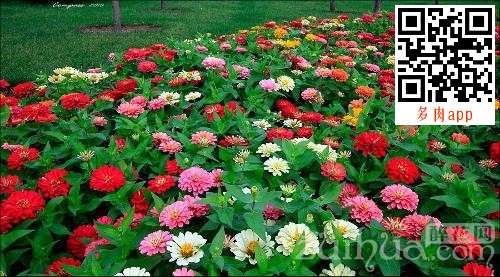
Zinnia belongs to the genus Zinnia, an annual herbaceous plant. It is robust, fond of warmth, not cold-tolerant, fond of light, and relatively drought-tolerant. The optimum germination temperature is 22-25°C. When sowing, a little soil should be covered, and it should be placed in a dark place. Once true leaves appear, it must be transplanted immediately.
Zinnia grows extremely fast and is prone to leggy growth, so timely pinching is necessary to promote the growth of axillary buds, making the flowering plants sturdy with a high flower-setting rate. Zinnia is a 1-2 year herbaceous plant, with opposite, sessile leaves, and its flowers are composed of ray florets and tubular florets. Since zinnia is a relatively short-day plant, the flowering period can be regulated by controlling day length.
When day length exceeds 14 hours, flowering will be delayed, taking about 70 days from sowing to flowering, and at this time the ray florets will increase noticeably; when day length is less than 12 hours, flowering can be advanced, taking only 60 days from sowing to flowering, and at this time there will be more tubular florets. In addition, the flowering period can also be controlled by adjusting the sowing date and pinching time.
During sowing, zinnia requires a well-drained, loose, fertile soil environment. The usual germination temperature is 21-22°C, and soil cover is needed for germination, with germination occurring in 2-5 days. During growth, the day temperature should be maintained at 18°C, and the night temperature should reach 21°C. From sowing to flowering, the time required is generally 9-10 weeks.
It is also worth noting that zinnia should not be continuously cropped and should be rotated in a timely manner. Because zinnia is prone to leggy growth in the later growth stage, growers usually take the following measures to control it: first, appropriately lower the temperature and increase ventilation; second, ensure sufficient nutritional area and increase plant and row spacing; third, pinch in a timely manner to promote axillary bud growth. The specific operation method is generally carried out when the plant height is about 10 cm, pinching after leaving 2 to 4 pairs of true leaves. To make plants short and flowering, a dwarfing agent is often sprayed when the axillary buds grow to about 3 cm after pinching. Seedlings that have not grown leggy can be cultivated in open ground, and if the growth height is to be limited, pinching should also be carried out.
Stage One:
Three days after sowing, the radicle emerges, and the medium moisture level should be relatively dry; being too moist easily causes the seeds to rot. However, at this stage it is very important to keep the area around the seeds moist and with sufficient oxygen, so covering with a thin layer of coarse vermiculite or loose rice husk ash after sowing is very helpful for seed germination, with the covering depth such that the seeds are not visible. For open seedling cultivation, a shade net must be added to ensure humidity and lower temperature (if sowing is carried out in a germination room environment, appropriate supplemental lighting can be given). No fertilization is needed at this stage.
Stage Two:
Keep the soil relatively moist, neither too wet nor too dry; too wet easily causes disease, and too dry causes the seedlings to wilt. At this time the main root grows to 1-2 cm, the cotyledons unfold, the first pair of true leaves begins to grow, and the seedlings can gradually be exposed to light. Fertilization can begin, generally using 0.05% urea or 50 ppm 20-10-20 water-soluble fertilizer; N promotes vegetative growth.
Stage Three:
The seedlings enter a rapid growth period, and water management should be strengthened, carrying out a cycle from dry to wet and then to dry, which is beneficial to the root growth of the seedlings and can also avoid leggy growth. At this stage, attention should be paid to pest and disease control, and 0.1% urea or compound fertilizer can be appropriately applied as a top dressing. For the compound fertilizer type, an N-P-K ratio of 15-15-15 can be used (or according to market supply, the N and K content can be slightly higher, and the P content can be lower). If conditions permit, the medium and ambient temperature should be appropriately lowered to about 20°C, but when sowing is carried out under protected bed conditions, temperature control is very difficult. This stage also requires a full-light environment, otherwise it easily causes seedling leggy growth. According to the seedling growth vigor, appropriately control moisture. Pay attention to ventilation in the broader environment to prevent disease occurrence. Spray chlorothalonil or thiophanate-methyl about once a week. If leggy growth appears at this stage, B9 should be sprayed immediately to control height.
Stage Four:
The root system has already formed well. When there are 3-4 pairs of true leaves, if leggy growth appears, B9 should be sprayed immediately to control height. The temperature and humidity requirements are the same as Stage Three. After the hardening-off stage, prepare for transplanting and potting.
Transplanting/Potting: For plug tray seedlings, transplanting and potting can be done when there are 2-3 pairs of true leaves; for tray-sown or bed-sown seedlings, they can also be directly potted when there are 3-4 pairs of true leaves. According to plant height and plant diameter requirements, 12×13 nutrient pots are generally used for potting, which can be done in one step without further repotting. Plug tray seedlings have less root damage and are easy to transplant and survive; for open seedling cultivation, as much soil as possible should be kept when lifting the seedlings, and transplanting should be chosen in the evening or on cloudy days to increase the survival rate.
Light regulation: Zinnia is a sun-loving plant, and both growth and flowering require sufficient sunlight. Insufficient sunlight easily causes stem node leggy growth and affects the ornamental effect. After potting, the entire growth period does not require shading.
Temperature regulation: Although zinnia likes warmth, under hot summer conditions its growth vigor is somewhat weaker and the flowering effect is not ideal. The optimum temperature for growth and flowering is 15-20°C. The sowing date of zinnia is controlled in summer to prepare flowers for National Day. If high temperatures above 35°C are encountered during the growth period, growth is generally not affected.
Cultivation management: In the plum rain season, when there is too much rain, it easily causes excessive internode elongation, so attention should be paid to draining accumulated water and spraying B9 at an appropriate time; in summer, when there is long clear weather and little rain and it is too dry, it easily causes weakened growth vigor and affects flower color, so attention should be paid to water and fertilizer management at this time. Throughout the growth period, appropriately control water; alternating dry and wet in the pot soil is beneficial to root development and height control. For potted plants, fertilization is generally once every 7-10 days. Depending on growth conditions, top dressing can be carried out, using 0.2% urea and compound fertilizer alternately, and stopping urea after one month. After flowering, depending on growth conditions, the interval for top dressing with compound fertilizer can be appropriately extended. Because the side branches of zinnia have the habit of terminal budding and flowering, if natural growth is not controlled, the flowering position will become higher and higher, affecting the beauty of the plant shape. Pinch in a timely manner before and after transplanting to control plant shape. Pinching generally retains 2-3 pairs of true leaves. Zinnia can be pruned, but after pruning the growth vigor is poor, so this method is generally not used.
Pests and Diseases: The main diseases of zinnia are: damping-off at the seedling stage, bacterial wilt during the growth period, stem rot, and leaf spot; the main pests are: noctuid moths, red spider mites, cabbage caterpillars, etc.