Key Field Management Techniques for Zinnia
Plant shaping management: If zinnia is not pinched, the plant will have too few side branches and too few flowers. Proper pinching can promote dwarfing of the plant and increase the number of flowers. When the seedlings grow to 4 leaves, transplant and pinch to encourage lower branches to grow and form a better plant shape. Begin pinching one week after transplanting, keeping 4 pairs of true leaves, and decide whether to pinch again based on plant growth and branching. During the flowering period, continue applying phosphorus and potassium fertilizers such as potassium dihydrogen phosphate to encourage continuous production of flower heads. After flowers fade, promptly remove withered flower heads to reduce nutrient loss.
Water and fertilizer management: At transplanting, apply 2-3 grams of compound fertilizer to the bottom of the pot, and after transplanting, drench the roots with 800 times diluted Dexon for disinfection. Within 1 week after transplanting, keep the potting soil moist to promote surface root growth. Once the roots reach the bottom of the pot, begin topdressing, fertilizing 2-3 times per week (apply water-soluble fertilizer on sunny days at a concentration kept within 200 mg/kg; apply granular fertilizer 2-3 grams per pot on rainy days), and also apply 1 supplemental calcium fertilizer. Begin pinching 1 week after transplanting; after pinching, spray 1 fungicide and apply 1 heavy fertilizer. About two weeks after the last pinching, the plant enters the reproductive stage. Gradually increase phosphorus and potassium fertilizers, such as spraying 1000 times diluted potassium dihydrogen phosphate, to promote abundant flowering and vivid flower colors, and correspondingly reduce the amount of nitrogen fertilizer. During this period, ensure sufficient watering, and watering in the morning is better than in the afternoon; rapid drying of leaves can prevent disease occurrence and prevent leggy growth.
Temperature: Zinnia prefers warmth and sunlight, and is not tolerant of intense summer heat or severe cold. The suitable growing temperature is 18-20°C during the day and 15-16°C at night. Growth is especially rapid in summer.
Sunlight: Full sun exposure with direct sunlight can be used. If sunlight is insufficient, the plant tends to grow leggy and has weaker resistance; in addition, flowering will also be affected.
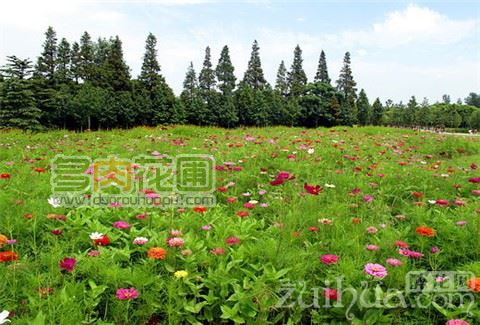
Time
Late April to early August. Sown in late April, it flowers from early June to August; sown in early August, it flowers from mid-September to October in northern regions.
Land selection and preparation
Choose a sunny plot (flowering is later and fewer in shaded areas) with loose soil. Clear away debris and trash, and apply compound fertilizer appropriately according to soil fertility. Loosen the topsoil to 15 to 20 cm.
Sowing
Broadcast the seeds at 3 g/sq m. Use a rake or similar tool to rake once so the seeds are covered with soil. Spray water daily to keep the soil moist, paying attention to water amount; it must not be too wet or too dry. (Do not flood irrigate.)
Management
Seedlings emerge 3-5 days after sowing. Around 20 days later, thin and weed, with a plant spacing of about 25 cm. Flowering occurs 45-50 days after emergence. Pests and diseases of zinnia are not very serious; spray a broad-spectrum insecticide and fungicide once every half month. If the soil is dry, water promptly, which helps flowering and prolongs the flowering period. With proper management, the flowering period can generally reach 70-90 days.
The above is the content I have introduced about zinnia. To learn more information, please continue to follow Duorou Huapu, and we will provide you with more information.
Zinnia Planting Methods and Cultivation Management Techniques
Zinnia is a famous ornamental plant, also known as zinnia, Bubugao, fireball flower, opposite-leaf chrysanthemum, etc. It is an annual herbaceous plant of the genus Zinnia in the Asteraceae family, native to Mexico. There are single-petaled, double-petaled, curled-leaf, wrinkled-leaf, and various differently colored horticultural varieties. It is widely cultivated throughout China and sometimes becomes wild. Now let us take a look at the planting methods of zinnia!
Propagation Methods of Zinnia
1. Seed propagation: Before sowing, the soil and seeds must undergo strict disinfection treatment to prevent pests and diseases during the growing period. Sowing can be done from early April to late June. For seed disinfection, soak the seeds in 1% potassium permanganate solution for 30 minutes. The substrate is prepared by mixing 2 parts leaf mold, 1 part river sand, 2 parts peat, and 2 parts perlite. Before sowing, moisten the substrate and sow by dibbling. After sowing, cover with a layer of vermiculite. At 21-23°C, germination occurs in 3-5 days.
2. Cutting propagation: Zinnia can also be propagated by cuttings, but cutting-raised seedlings are less uniform than seed-raised seedlings. Side shoots 10 cm long can be selected for cuttings, generally rooting in 5-7 days. Subsequent cultivation management is the same as for sowing, and the plants can leave the nursery after 30-45 days.
Planting Methods of Zinnia
1. Plant shaping: If zinnia is not pinched, the plant will have too few side branches and too few flowers. Proper pinching can promote dwarfing of the plant and increase the number of flowers. When the seedlings grow to 4 leaves, transplant and pinch to encourage lower branches to grow and form a better plant shape. Begin pinching one week after transplanting, keeping 4 pairs of true leaves, and decide whether to pinch again based on plant growth and branching.
2. Water and fertilizer management: At transplanting, apply 2-3 grams of compound fertilizer to the bottom of the pot, and after transplanting, drench the roots with 800 times diluted Dexon for disinfection. Within 1 week after transplanting, keep the potting soil moist to promote surface root growth. Once the roots reach the bottom of the pot, begin topdressing, fertilizing 2-3 times per week, and also apply 1 supplemental calcium fertilizer.
3. Timely pinching: Begin pinching 1 week after transplanting; after pinching, spray 1 fungicide and apply 1 heavy fertilizer. About two weeks after the last pinching, the plant enters the reproductive stage. Gradually increase phosphorus and potassium fertilizers, such as spraying 1000 times diluted potassium dihydrogen phosphate, to promote abundant flowering and vivid flower colors, and correspondingly reduce the amount of nitrogen fertilizer.
4. Temperature and light: Zinnia prefers warmth and sunlight, and is not tolerant of intense summer heat or severe cold. The suitable growing temperature is 18-20°C during the day and 15-16°C at night. Growth is especially rapid in summer, and full sun exposure can be used directly. If sunlight is insufficient, the plant tends to grow leggy and has weaker resistance; in addition, flowering will also be affected.
Pest and Disease Control of Zinnia
1. White star disease
[Symptoms] On zinnia leaves, small dark brown spots appear initially, later becoming lesions with dark brown edges and grayish-white centers, 2-4 mm in diameter. They mostly occur on lower leaves. In severe cases, the leaves curl and wither, and the lesion surface has dark green mold-like growth.
[Control] Strengthen management, apply sufficient fertilizer, cultivate strong seedlings, protect from rain and shade, strengthen ventilation in greenhouses and sheds, reduce humidity, and promptly remove diseased residues. In the early stage of disease, promptly remove diseased leaves, then immediately spray for control. Bordeaux mixture at 1:0.5:200 plus 0.1% sulfur powder can be used, or 65% zineb wettable powder at 500 times, or 75% chlorothalonil wettable powder at 500-800 times, or 50% amobam at 800-1000 times.
2. Black spot disease
[Symptoms] Small dark brown spots first appear on the leaves, soon expanding into large irregularly shaped spots, 2-10 mm in diameter, reddish-brown. As the spots expand and increase, the entire leaf turns brown and withers. On stems, the disease starts from the base of the petiole and develops longitudinally, becoming dark brown elongated streaks. Symptoms on flowers are similar to those on leaves, and soon the petals shrink and wither.
[Control] Choose well-drained sites for planting. Planting density should be appropriate. Avoid continuous cropping. Seeds must be disinfected before sowing. After autumn, diseased leaves, stems, and other parts should be collected and destroyed to eliminate the infection source for the next year. Keep seeds from healthy, disease-free mother plants. Spray with 50% zineb or mancozeb at 5000 times. When spraying, pay special attention to evenly covering the undersides of leaves.
3. Mosaic disease
[Symptoms] It occurs throughout the country and often causes stunted, degenerate plants. In the early stage of disease, leaves show slight mottling, later becoming light and dark green mottled symptoms. Symptoms are more obvious on new leaves.
[Control] Eliminating aphids to prevent disease has a certain controlling effect on zinnia mosaic disease. Attention should also be paid to field sanitation management, and diseased plants should be eradicated to reduce infection sources.