Some Practical Tips for Growing Tulips
Tulips have beautiful flower shapes and graceful plant forms, making them common ornamental plants. In recent years, they have become quite popular in the cut flower market, and the long, elegant flower stems of tulips make them excellent material for flower arranging. Tulips have broad market prospects, and the following points should be noted when cultivating them.
1. They require well-drained sandy loam soil rich in humus, and a small amount of decomposed farmyard manure and bone meal can be mixed in as a base fertilizer.
2. They prefer cool conditions but are highly adaptable, able to cope with wet cold in winter and dry heat in summer, but summer temperatures should not exceed 27°C; if the temperature is too high, leaves will grow leggy, the leaf-to-flower ratio will be thrown off, and flowering will be poor. The optimal growing temperature is 15-20°C, and they can grow normally above 8°C, but they can also tolerate low temperatures of -14°C.
3. During the growing period, generally keeping the soil moist is sufficient. Apart from moderate watering during droughts, large amounts of watering are generally unnecessary. In winter, the main growth is in the roots and growth is slow, so watering can be omitted or kept to a minimum. Spring is the vigorous growth period for flower buds and leaves, so moderate watering is appropriate. After the flowers fade, the main focus is bulb growth, and watering should again be appropriately controlled.
4. With sufficient light, flowers will bloom well and the ornamental period will be extended; with insufficient light, they will open poorly or even fail to open at all.
5. After seedlings emerge, during flower bud formation, after flowering, and at other important growth stages, supplementary fertilizing should be carried out. Diluted solutions of sesame paste residue, horse hoof water, ferrous sulfate, etc. can all promote their growth. Do not use urea for supplementary fertilizing.
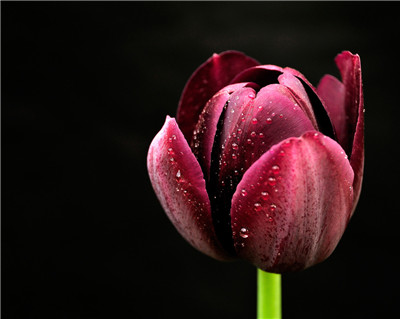
6. For those growing tulips for bulb production, the flower buds should be removed as soon as they show color to avoid wasting nutrients. For those producing cut flowers, the buds can be cut off only when they have fully changed color.
7. If flowers develop streaks or mottling, this is caused by a viral infection, and they should be immediately dug up and burned to prevent the infection from spreading.
8. Propagation: Seed propagation is generally used only in breeding and mass propagation. However, it takes 4-5 years to bloom, so propagation is generally done mainly by separating small bulblets, as follows: a one-year-old mother bulb, after flowering, will sprout 1-3 new bulbs at the base of the bulb that can flower the following year, along with 2-6 small bulblets, while the mother bulb gradually dries up. The bulbs can be dug out, cleaned of soil, dried, and the young bulblets separated from the bulb, then stored in a ventilated place at 5-10°C. In autumn, in September, the young bulblets can be planted in soil rich in leaf mold with an appropriate amount of phosphorus and potassium fertilizer, with a spacing of 14-16 cm between plants and rows, a trench depth of 15-20 cm, and a covering soil depth of 4 cm. Note, however, that round bulblets will flower even if small, while flat bulblets generally will not flower. After planting, water the bulblets thoroughly, then keep the soil merely moist. The following spring, begin normal fertilizer and water management for the seedlings, and they will bloom in 2-3 years.
9. Forcing cultivation: To have them available for the Spring Festival, choose early-flowering varieties, plant them in early October on the sunny side of a hotbed or greenhouse, move them into a heated greenhouse in early December, and water once daily. Buds will appear in about 20 days. If an earlier bloom is desired, the greenhouse temperature should be maintained at 16-18°C, and the surroundings should be covered to keep out sunlight. After two weeks, place them in a sunny spot and lower the temperature appropriately, and they will bloom after six weeks.
Tulip Growing Techniques
Click the image to go to the next page>>
Below, let us explore together how to care for the “Queen of Flowers of the World.”
To understand the essence from the phenomenon: to care well for a plant, one must start from its essence. Tulips originate from the high mountain regions of Iran and Turkey. Due to the Mediterranean climate, tulips have developed the characteristic of adapting to wet cold in winter and dry heat in summer. >>More
1. Propagation is done by separating small bulblets. A one-year-old mother bulb, after flowering, sprouts 1 to 3 new bulbs at the base of the bulb that can flower the following year, along with 2 to 6 small bulblets. >>More
(1) Bulb rot often occurs when cultivating tulips. The main reasons for this phenomenon are as follows. >>More
(2) Pest and disease control for tulips.
The main pests and diseases of tulips include rot, sclerotinia disease, viral disease, thrips, foxglove aphid, and root lice. >>More
Prevention and treatment of brown spot disease:
Cause:
a. The pathogen overwinters in the soil as sclerotia or mycelial cords in diseased plant debris. When conditions are suitable the following year, the sclerotia or mycelial cords produce hyphae for primary infection.
b. The silky mycelium produced by the plant extends to contact neighboring plants, or the sclerotia spread through water flow for secondary infection, causing the disease to spread. The disease is severe in years or seasons with continuous cropping, heavy clay soil, low-lying terrain, or high temperature and humidity. >>More
Symptoms: Infected leaf buds develop poorly, becoming deformed and curled. After young buds are affected, the leaves that grow from them become curled. If the environment is humid, large numbers of gray mold-like conidia are produced on the diseased tissue, affecting nearby healthy plants and causing leaf infection, so bulb growth is greatly affected. >>More
Cause: The pathogen can produce conidia at 5°C and 90%-100% humidity. The disease is severe in spring with low temperatures and rainy, humid conditions. >>More
Prevention and treatment of tulip black rot:
Symptoms: The bulb becomes diseased. On the stem plate and stem surface, and sometimes on the 2nd and 3rd bulb scales, lesions appear that are initially yellow-brown and later black and irregular in shape, with a rough surface.
Cause: Infected bulbs and diseased plant debris in the soil are the sources of infection. >>More
Tulip Growing Techniques
Below, let us explore together how to care for the "Queen of Flowers of the World."
To understand the essence from the phenomenon: to care well for a plant, one must start from its essence. Tulips originate from the high mountain regions of Iran and Turkey. Due to the Mediterranean climate, tulips have developed the characteristic of adapting to wet cold in winter and dry heat in summer. >>More
1. Propagation is done by separating small bulblets. A one-year-old mother bulb, after flowering, sprouts 1 to 3 new bulbs at the base of the bulb that can flower the following year, along with 2 to 6 small bulblets. >>More
(1) Bulb rot often occurs when cultivating tulips. The main reasons for this phenomenon are as follows. >>More
(2) Pest and disease control for tulips.
The main pests and diseases of tulips include rot, sclerotinia disease, viral disease, thrips, foxglove aphid, and root lice. >>More
Prevention and treatment of brown spot disease:
Cause:
a. The pathogen overwinters in the soil as sclerotia or mycelial cords in diseased plant debris. When conditions are suitable the following year, the sclerotia or mycelial cords produce hyphae for primary infection.
b. The silky mycelium produced by the plant extends to contact neighboring plants, or the sclerotia spread through water flow for secondary infection, causing the disease to spread. The disease is severe in years or seasons with continuous cropping, heavy clay soil, low-lying terrain, or high temperature and humidity. >>More
Symptoms: Infected leaf buds develop poorly, becoming deformed and curled. After young buds are affected, the leaves that grow from them become curled. If the environment is humid, large numbers of gray mold-like conidia are produced on the diseased tissue, affecting nearby healthy plants and causing leaf infection, so bulb growth is greatly affected. >>More
Cause: The pathogen can produce conidia at 5°C and 90%-100% humidity. The disease is severe in spring with low temperatures and rainy, humid conditions. >>More
Prevention and treatment of tulip black rot:
Symptoms: The bulb becomes diseased. On the stem plate and stem surface, and sometimes on the 2nd and 3rd bulb scales, lesions appear that are initially yellow-brown and later black and irregular in shape, with a rough surface.
Cause: Infected bulbs and diseased plant debris in the soil are the sources of infection. >>More