Cultivation and Management Methods and Key Technical Points for Cyclamen
Cyclamen is a rather delicate flower species, prone to disease and requiring meticulous care. However, because of its bright and rich flower colors, long blooming period, and thick, fleshy leaves, it has high ornamental value. It is an excellent gift for relatives and friends and a way to convey blessings, as well as a fine potted flower for placement in living rooms, conference venues, hotels, and other settings. It is still loved by many consumers. When cultivating cyclamen, pay attention to the following:
1. Growing medium. Use special cyclamen peat, perlite, and vermiculite as the growing medium, mixed in the prescribed proportions.
2. Seedlings for planting. In mid-to-late April, when the small seedlings in the plug tray have grown to 6 to 7 leaves and the roots have filled the plug tray, select healthy seedlings free of pests and diseases and plant them into pots. Take them and plant them immediately, without damaging the root system. Leave the corm exposed by 1/3 to 1/2, keep the growing medium 3 cm to 4 cm below the pot rim, and water after planting.
3. Water and fertilizer management. Water according to the principle of watering when dry and letting it dry between waterings, watering once every 1 to 2 days, and apply special cyclamen fertilizer once every 5 to 7 days, applying light fertilizer frequently. After autumn begins, due to changes in the natural environment, cyclamen enters a period of vigorous growth, and its demand for water and nutrients increases. Water and fertilizer management directly affects the cyclamen's crown width, crown shape, flower bud differentiation, flower shape, flower color, and so on. Therefore, pay attention to watering and fertilizing. Water promptly after the potting soil dries. Fertilize according to growth conditions. Generally use special cyclamen fertilizer 15-15-30 at a concentration of 700 ppm to 1000 ppm, generally applying fertilizer once a week. In November, it gradually enters the flowering period, so nitrogen fertilizer should be reduced and phosphorus and potassium fertilizers increased. At the early stage of flower bud differentiation, use 1 part urea and 2 parts monopotassium phosphate to make a 0.1% solution and water it once a week, and about every 10 days use 1 part potassium chloride and 2 parts monopotassium phosphate to make a 0.1% solution and spray it on the leaves.
1. Propagation methods: mainly by sowing, and also by the method of dividing the corm. Sowing is usually best from early September to mid-October. Sowing too early affects growth, and the corm flowers before it is large; sowing too late means the temperature is too low, affecting germination. Because its seeds are relatively large, before sowing it is best to soak them in clean water for 24 hours to promote germination. Before sowing, the sowing soil and sowing pots should be disinfected. After sowing, soak the pot, and place it in a dark place at 20°C to germinate. Generally, roots can form in two weeks, and one cotyledon can emerge in 6 weeks.
2. Cultivation and management: generally thin the seedlings when there are 3 leaves, transplant and repot when there are 6 leaves, and establish them in their final pots in September. When transplanting, keep the entire root system and do not shake off the original soil. The planting depth should leave 1/3 or 1/2 of the corm exposed above the soil. After planting, water appropriately and pay attention to shading. Cyclamen seedlings grow relatively slowly, and June of the following year is the peak growth period. During this period, strengthen water and fertilizer management, applying liquid fertilizer twice a month. When the surface soil is dry, water thoroughly, but when watering and fertilizing, do not pour onto the leaves or the top of the corm, to prevent rot. The growing period temperature is best around 18°C; too high will induce the small corm to go dormant and hinder flowering that year. After October, as the temperature drops, move it indoors and place it in a sunny spot, keep the room temperature at 18°C, and pay attention to keeping the potting soil moist, but avoid excessive humidity. Do not fertilize during the flowering period, to avoid affecting flower longevity.
3. Safely passing the summer: Cyclamen likes a cool, humid climate, and enters dormancy when the temperature is above 30°C. Summer is hot, and if ventilation is poor, the corm easily rots. Therefore, one-year-old cyclamen seedlings should be placed in a cool, ventilated, rain-sheltered place, and water should be sprayed and sprinkled frequently, with shading to lower the temperature, creating a cool environment to promote growth. For old corms more than two years old, in summer they should be placed in a shaded place, keeping the potting soil moist and the environment ventilated. In this way, after repotting and replanting, they can quickly sprout and produce leaves, bloom early and bloom abundantly.
Cultivation and Management Techniques for Cyclamen
Cyclamen, also known as rabbit ear flower, rabbit flower, radish begonia, and so on, is a perennial bulbous flower of the primrose family. Cyclamen flowers open downward, with petals curling upward, resembling rabbit ears, hence the name rabbit ear flower. Its corm is fleshy, flat and round like a radish, hence it is also called radish begonia.
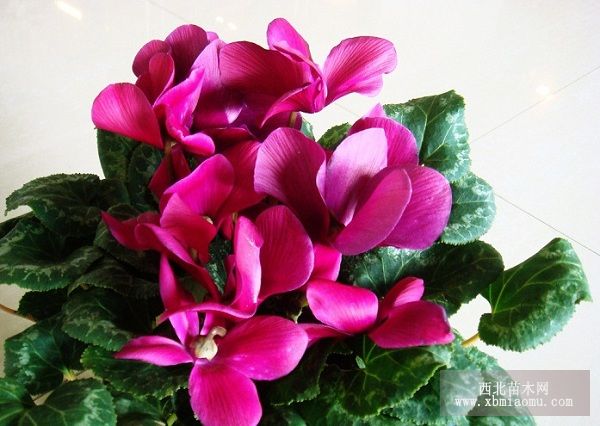
The corm of cyclamen is a flattened sphere, mostly buried in the soil, with only the top part exposed above the soil surface, and dense fibrous roots growing at the bottom. Leaves grow in a rosette above the corm, with long petioles, heart-shaped or kidney-shaped, dark green, with obvious white markings and finely serrated edges. The flowers are large and solitary, with slender, fleshy pedicels. The petals have five deep lobes and are connected at the base into a tube shape. According to differences in flower color, it can be divided into many varieties such as peach red, carmine, rose red, purple red, pink, orange yellow, light purple, red edge with white center, deep red with spots, and white. Some flowers are fragrant. Depending on the variety, the petal shapes vary: some are recurved, resembling a monk's hat; some are narrow and long, extending outward in all directions; some have slightly notched edges, or are edged with ruffles.
Cyclamen has a relatively long flowering period, blooming successively from the 1st of the first year until March of the following year, with the peak flowering period from late November to late January of the following year. A single flower often lasts a month without fading. A one-year-old plant can produce 10-30 flowers; a two-year-old plant can produce 50-80 flowers; a three-year-old plant can produce up to 200 flowers; plants more than four years old no longer flower normally.
After flowering, cyclamen forms spherical capsules, and when mature, the seeds mature 2-3 months after flowering. When the fruit turns yellow, softens, and the top slightly splits, it can be picked. Each flower can produce 30-40 seeds, and the seeds are dark brown. If stored well, the seeds can retain germination capacity for 3 years.
Cyclamen is native to southern Europe and the Mediterranean region, including Greece, Tunisia, and Syria. It is a semi-hardy bulbous flower that likes a warm, humid climate and fears both severe heat and severe cold. Autumn, winter, and spring are its growing seasons, while it is dormant in summer. It should be placed in a ventilated, cool place, and water should often be sprayed around it to lower the temperature so that the small corm does not go dormant, which is beneficial for winter and spring flowering. The most suitable growing temperature for cyclamen is 15-20°C, and in winter it needs to be maintained in a greenhouse.
Cyclamen is suited to growing in humus-rich, acidic, sandy soil. In daily management, pay attention not to water too much; keeping the potting soil moist is enough. When spraying water on the leaves, do not spray it onto the flowers. If it is too dry, the plant will become wilted and listless. Cyclamen likes fertilizer relatively well, but light, diluted fertilizer should be applied frequently, generally once a week, and the fertilizer solution must not touch the leaves. When the pedicels emerge, apply an additional dose of bone meal or superphosphate. Stop fertilizing during the flowering period and control watering.
Doing a good job in managing the summer dormancy period of cyclamen is an important key to growing cyclamen well.
One-year-old cyclamen is in the seedling stage during the hot summer. When the temperature reaches 30°C, it stops growing or grows very slowly. After June, the plant should be moved to a cool, ventilated, rain-sheltered place, and at noon water should be sprinkled on the shading material and the ground to lower the ambient temperature. During this period, stop fertilizing and limit watering.
For old plants more than two years old, it is best to move them indoors to a ventilated, cool place to pass the summer. Starting in late May, gradually reduce watering and stop fertilizing. When the weather is hot, often sprinkle water on the ground to increase environmental humidity, but do not make the potting soil too wet; keeping it slightly moist is enough. After the weather turns cool in September, slightly increase the amount of watering; at this time, new buds gradually sprout on the tuber. When the new buds are 3 cm tall, tip out the old corm, remove the old soil, repot it, strengthen water and fertilizer management, and increase light, so as to promote sprouting and leaf growth. By Spring Festival it can bloom successively.
Cyclamen is mostly propagated by sowing. The best sowing time is from late August to mid-October, so that cyclamen seedlings can avoid the hot summer and cold winter periods. To increase seed germination speed, soak the seeds in warm water for 2-3 hours, then wrap them in gauze, keep them at 25°C for two days to promote germination, and thus they can sprout half a month after entering the soil. Sow the seeds in a pot and cover with soil not too thick; half a centimeter to 1 centimeter is enough. Cover the pot mouth with glass or plastic film, but do not cover it too tightly, then place it in a cool indoor place and use the soaking method to keep the potting soil moist. At a temperature of 18-20°C, seedlings can emerge after about 1 month. When the seedlings grow 2-3 true leaves, thin them promptly. If transplanting is delayed, the plants will be weak and thin and cannot form a corm. After the seedlings are potted, they need to be placed in a cool place to recover, gradually exposing them to sunlight. After half a month, fertilize once a week. During the growing period, the potting soil should not be too dry, and severe sun and high temperatures should be avoided.
In recent years, some people have successfully tested propagation of cyclamen by leaf cuttings and by dividing the corm. Leaf cuttings are done in March-April or September-October. When cutting off the leaf, the petiole must carry a part of the corm; the larger the piece of corm carried, the faster roots form and seedlings develop. The cutting bed must be both air-permeable and moisture-retentive, and vermiculite is generally used as the cutting bed medium. For propagation by the corm division method, it can be done in May after flowering. After cutting off the upper 1/3 of the corm as leaf-cutting material, the lower corm is still kept in the soil, and then the cut surface is scored with a knife into a 1 cm square grid, with a depth of 1 cm. Before long, adventitious buds will grow on the cut surface. After 3-4 months, divide and transplant the corm bearing the new buds. It is said that using these two methods to raise seedlings is faster than sowing, blooms earlier, and can maintain the excellent characteristics of the variety.
The main diseases of cyclamen include gray mold, anthracnose, and bacterial soft rot; the pests include root-knot nematode, cyst nematode, and so on.。
Gray mold:It occurs on cyclamen leaves, petioles, and flowers. At the beginning of the disease, small dark green spots with white inside appear on the leaves, showing water-soaked markings, and later gradually spread to the entire leaf, causing the leaf to dry up and die. After the petioles and pedicels are affected, water-soaked rot occurs, and gray mold spots form. During the onset period, 70% thiophanate-methyl 1000-1500 times solution or 1% Bordeaux mixture of equal parts can be sprayed once every half a month for control.
Anthracnose:It mostly occurs on the underside of cyclamen leaves. At first it is a small brown spot, and the lesion expands outward in concentric rings, nearly circular or irregular. In the later stage, black-gray granular substances appear on the lesion. After discovering that this disease has infected leaves, the diseased leaves should be cut off promptly and destroyed. You can also use 60% anthracnose fumet 800-1000 times solution, or 50% carbendazim wettable powder 500-600 times solution, spraying once a week for control; generally 2-3 times will show effect.
Bacterial soft rot:It mostly occurs on cyclamen petioles and corms. In the early stage, water-soaked softening appears, green color fades, and white or dark gray-green lesions appear. After expansion, the diseased tissue becomes soft-rotted, swollen, ruptured, and the epidermis falls off, with a foul odor. After the corm is infected, it turns black, soft-rotted, and mushy. The control method is to strengthen ventilation and pay attention to drainage and rain avoidance. You can also use 200-1000 ppm streptomycin, oxytetracycline, or penicillin solution to spray and smear diseased plants. Water the soil around the diseased roots with 700 times dexon solution.
Root-knot nematode disease:It is caused by root-knot nematodes parasitizing cyclamen roots. The stimulation by nematode secretions causes the root tissue to enlarge and proliferate, forming many tumor-like structures, thereby destroying the normal function of the roots, leading to weakened growth and even death. You can use undiluted dichlorvos mixture to fumigate the soil and disinfect the soil, and then sow or transplant after 2 weeks. You can also bury 15-50 grams of 3% carbofuran granules in the pot for control.
Cyst nematode:After invading the root system of seedlings, it forms many galls of varying sizes. In severe cases, the fine roots rot and the leaves turn yellow and die. The methods for controlling root-knot nematodes can be used for control.