How are tulips produced using the water culture method?
Tulips are perennial herbaceous plants of the lily family; their flowers are large and brightly colored, making them very popular. They are widely used in the fresh cut flower market, and now water culture cut flower production is gradually gaining popularity among professional growers. China began introducing and experimentally cultivating them in the 1990s. When producing tulips by water culture, pay attention to the following points:
1. Selecting suitable and disease-free bulbs is the key to water culture production of tulip cut flowers.
2. After the bulbs are transported back, they must be stored in a well-adjusted cold storage room, at a temperature of 5°C and a humidity within 80%. Check in time and pick out bulbs seriously affected by penicillium rot.
3. According to the required flowering time, choose and determine the cultivation time and planting method. For water culture cut flower cultivation, the bulbs should be planted in disinfected and watertight needle trays, keeping the rooting temperature stable at 8°C and the humidity between 60% and 70%.
4. About two weeks after rooting, once the roots are ensured to be more than 3 cm long, move the needle trays to the greenhouse. Keep the temperature at 15-20°C and the humidity at 60%-70%, and add nutrient solution so that the EC value of the water is 1.5 ms to 2.0 ms, to facilitate the rapid growth of tulips.
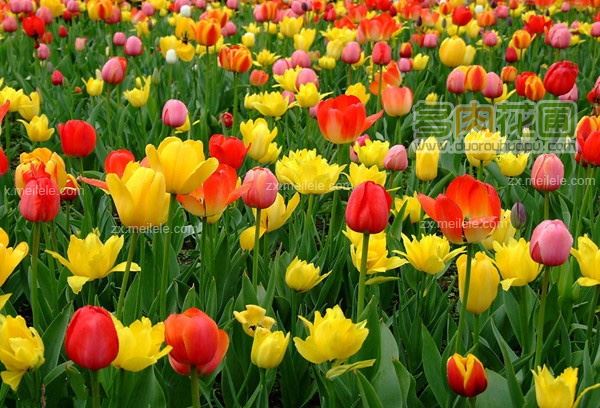
Through the above understanding, we all know that tulips are perennial herbaceous plants of the lily family and are loved by many people. Because they sell very well on the market, various countries have devoted themselves to researching their cultivation techniques, and water culture cut flower production is gradually gaining popularity among professional growers. China began introducing and experimentally cultivating them in the 1990s. At present, domestic water culture experience is mainly as follows:
1. Select bulbs; this is the key to water culture production of tulip cut flowers, so the bulbs should be suitable and disease-free.
2. After the bulbs are transported back to the water culture site, store them in a cold storage room at a temperature of 5°C and a humidity within 80%, and check in time and pick out bulbs seriously affected by penicillium rot.
3. According to the required flowering time, choose and determine the cultivation time and planting method. For water culture cut flower cultivation, the bulbs should be planted in disinfected and watertight needle trays, keeping the rooting temperature stable at 8°C and the humidity between 60% and 70%.
4. About two weeks after rooting, once the roots are ensured to be more than 3 cm long, move the needle trays to the greenhouse. The relevant conditions of the greenhouse are: humidity at 60%-70%, adding nutrient solution so that the EC value of the water is 1.5 ms to 2.0 ms, and temperature controlled at 15-20°C; such values facilitate the rapid growth of tulips.
5. The early stage of growth is very prone to disease, so in the early stage of growth, to prevent diseases caused by filamentous fungi, spray 2 to 3 times. Choose low-toxicity agents such as thiophanate-methyl, highly effective chlorothalonil, and thiram, at a concentration of 750-1000 times dilution.
6. According to the growth situation, spray foliar fertilizer at the appropriate time to coordinate vegetative growth and reproductive growth.
7. During the growth process, due to root secretions and other environmental conditions, an oily film will form on the water surface of the needle trays, which will cause the root system to lack nutrient supply and turn brown. Therefore, change the water 2 to 3 times as appropriate.
8. When harvested finished cut flowers cannot be sent out in time, they must be placed in a cool, ventilated place to avoid strong light, high temperature, and low temperature affecting cut flower quality.
Summary: With the continuous development of the times, there are more and more plant cultivation techniques, and some are gradually moving from soil cultivation to water culture. This is also true for tulips; every cultivation method is a witness to the progress of the times. The above tulip water culture production methods can be used for reference!
More information
|What does a white rose represent|What plants protect against computer radiation|Pelargonium|How to grow rhododendrons and points to note|Golden-heart spider plant|
|Lavender flowering period|Indoor foliage plants|Boston ivy|How to fold a lily|Effects and uses of mint|How to grow sensitive plant|
|How to grow succulents|Osmanthus|Effects and uses of jiaogulan|Handmade roses|Effects and uses of honeysuckle|Kumquat|
Can tulips be grown in water? Tulip water culture methods
Some people may know something about hydroponic flowers, but do you know whether tulips can be grown in water? Below we will explain tulip water culture methods.
Can tulips be grown in water?
Tulip water culture methods:
1. Bulb selection: Selecting suitable and disease-free bulbs is the key to water culture production of tulip cut flowers. Water culture tulips require cold treatment of the bulbs: before the end of October, control the temperature at 9°C, then gradually lower it, and from December to January keep the temperature at about 2°C and the humidity at 85-95%.
2. Planting method:
① According to the required flowering time, choose and determine the cultivation time and planting method. For water culture cut flower cultivation, the bulbs should be planted in disinfected and watertight needle trays, keeping the rooting temperature stable at 8°C and the humidity between 60% and 70%.
② About two weeks after rooting, once the roots are ensured to be more than 3 cm long, move the needle trays to the greenhouse. The relevant conditions of the greenhouse are: humidity at 60%-70%, adding nutrient solution so that the EC value of the water is 1.5 ms to 2.0 ms, and temperature controlled at 15-20°C; such values facilitate the rapid growth of tulips.
③ The early stage of growth is very prone to disease, so in the early stage of growth, to prevent diseases caused by filamentous fungi, spray 2 to 3 times. Choose low-toxicity agents such as thiophanate-methyl, highly effective chlorothalonil, and thiram, at a concentration of 750-1000 times dilution.
④ According to the growth situation, spray foliar fertilizer at the appropriate time to coordinate vegetative growth and reproductive growth. During the growth process, due to root secretions and other environmental conditions, an oily film will form on the water surface of the needle trays, which will cause the root system to lack nutrient supply and turn brown. Therefore, change the water 2 to 3 times as appropriate.
3. Culture solution: Place the planting trays in a rooting room at a temperature of 5°C with a small amount of air circulation, and replenish water at the appropriate time. Tap water or rainwater with a conductivity value of 1.5 ms/cm can be used. For varieties prone to leaf cracking, water with a conductivity value of 2 ms/cm should be used during the rooting stage.
4. Care: When tulip roots grow to 100px, place the planting trays on a relatively flat ground in the greenhouse and remove diseased bulbs or bulbs that have not sprouted. At this stage, ensure the water level reaches the overflow outlet, keep the temperature at 16-18°C, and maintain the humidity at 60-80%. At the end of planting, the number of waterings can be reduced to half of the previous amount. Before harvest, sufficient water should be provided to the plants, which can extend the tulip flowering period.
More information