How to grow commercial tulips? A detailed guide to care essentials
The commercial applications of tulips are becoming increasingly widespread, and the number of flower growers planting tulips is gradually increasing. Tulips are a rather delicate flower species. To grow tulips well, you must pay attention to scientific planting methods.
Substrate preparation. Prepare a high-quality substrate that is both water-retentive and breathable, with salinity that is not too high and not too acidic; the pH value should be no less than 6, and it should be free of pests, diseases and harmful substances. The bulbs should be planted very firmly in a sufficiently deep cultivation bed (at least 5 cm deep). In recent years, we have used a 1:1:1 mixture of peat, decomposed soil and sand as the cultivation substrate, with good results. About half a month before planting, apply decomposed farmyard manure to the bed soil as a base fertilizer, and add an appropriate amount of carbofuran and carbendazim (or drench with 1% formalin and cover for disinfection), water thoroughly, and carefully plow and harrow before planting to ensure the soil is loose.
Planting. Because the ground temperature inside the greenhouse is high, tulips will undergo late vernalization, and the low-temperature treatment effect of forcing cultivation will be reduced. Therefore, early planting is not as good as late planting; generally, plant about two months before the Spring Festival, around mid-to-late November. Before planting, remove the brown tunic of the bulbs and soak them in a 500-fold dilution of 50% carbendazim for about two hours. The plant-to-row spacing is 9×10 cm. When planting, the top of the bulb should be level with or slightly below the soil surface; appropriately shallow planting can advance flowering, and sometimes when about 1/3 of the tulip bulb is exposed above the soil, flowering can be advanced by more than 5 days. After planting, water thoroughly to promote rooting.
Cultivation management temperature. Generally after one week, the bulbs begin to sprout. Before and during the seedling stage, keep the indoor temperature at 12-15 degrees Celsius during the day; if the temperature is too high, ventilate and cool it promptly, and at night it should not be lower than 6 degrees Celsius, to encourage the bulbs to root early and grow strong roots and cultivate strong seedlings. If the temperature is too high at this time, the plant stems will be weak and flower quality poor. After more than 20 days, when the plant has grown two leaves, increase the temperature promptly to encourage the flower buds to separate from the bracts in time. Keep the indoor temperature at 18-25 degrees Celsius during the day, and above 10 degrees Celsius at night. Generally after another 20-plus days, the corolla begins to color; the first flower opens from late December to early January, and full bloom takes 10-15 days. At this time, the plants should be placed in batches according to the different times flowers are needed; the higher the temperature, the earlier the flowering. Generally, once the corolla is fully colored, the plants should be placed in a 10 degrees Celsius environment to await sale.
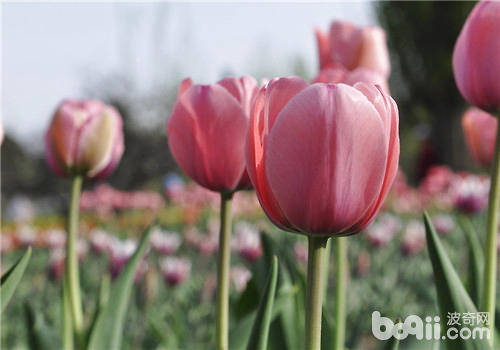
Tulip
Choose a flowerpot with a diameter of 10 cm to 20 cm, line it with about 3 cm of charcoal cinders, brick and stone granules, ceramsite, etc. as a drainage layer, and add loose, fertile neutral soil. Note that new soil must be used; old soil in which liliaceae plants and bulbous flowers have been planted cannot be used, to prevent infection by viruses, nematodes, etc. The top of the bulb should be level with the soil surface. Place in a shaded spot for 3 to 5 days, then water thoroughly and place in a cool spot outdoors. When the potting soil is dry below 1 cm of the surface, water it.
December to February of the following year: in the severe cold season, wrap the flowerpot with foam plastic, etc., and place it outdoors in a wind-sheltered, sunny spot; roots grow above 5 degrees C. Do not water if the potting soil is not dry; when watering, water thoroughly.
March to April: sprouts emerge in March; 15 degrees C to 18 degrees C is the vigorous growth period for stems and leaves, and it should be placed in sunlight for care. Water once a week with a 1 permille full-element compound fertilizer. Spray the leaf surface with warm water 1 to 2 times a day. After the flower buds appear, often sprinkle water on the ground around the potted plant to increase air humidity.
What is the method for growing tulips? An introduction to tulip growing essentials
Many families like to keep some flowers and plants at home, not only to decorate the home space and make the mood better, but more importantly to purify indoor air, such as spider plants and tulips. So, how do you grow tulips? What is the method for growing tulips? Today the editor of Shengduoduo Decoration Network will introduce the essentials of tulip growing, hoping to help everyone.Tulip growing method 1. Soil
Tulips require planting soil that is both water-retentive and breathable, with salinity that is not too high and not too acidic; the pH value should be no less than 6. Using a 1:1:1 mixture of peat, decomposed soil and sand as the cultivation substrate gives better results.
Tulip growing method 2. Sunlight
Sufficient sunlight exposure is essential for the growth of tulips. Insufficient light will cause poor plant growth, causing bud drop, weakened plants, lighter leaf color and a shortened flowering period. However, within more than half a month after tulips are potted, they should be appropriately shaded to help the bulbs grow new roots. In addition, during sprouting, the elongation of flower buds is inhibited by light; after shading, the elongation of flower buds can be promoted, preventing excessive vegetative growth and legginess in the early stage. After emergence, light should be increased to promote stem elongation, the formation of flower buds and coloring. After the flower buds are fully colored in the later stage, direct sunlight should be prevented to extend the flowering time.
Tulip growing method 3. Temperature
Tulips prefer a climate that is warm in winter and cool in summer, with an optimum growth temperature of 9-13 degrees C. They are highly cold-tolerant and can withstand low temperatures of -35 degrees C in winter.
Tulip growing method 4. WateringAfter planting, water thoroughly so that the soil and bulbs can fully and tightly combine, which helps rooting. After sprouting, water should be appropriately controlled. When the leaves gradually extend, water can be sprayed on the leaf surface to increase air humidity. During the flower stem extraction stage and bud stage, a sufficient water supply must be ensured to promote full development of the flowers. After flowering, appropriately control water.
Tulip growing method 5. Fertilizing
Tulips do not have high fertilizer requirements. If growth vigor is weak, some nitrogen fertilizer can be applied. After the root system develops well, apply 2 kg of calcium nitrate per 100 sq m, broadcast in three applications, with an interval of more than one week between each.
Tulip growing method 6. Pests
The pathogens of tulip pests and diseases can be carried by the bulbs, or the bulbs can be infected by soil-borne pathogens. They mostly occur in high-temperature and high-humidity environments. The main diseases include stem rot, soft rot, color-breaking disease, damping-off, blind buds, etc., and the pests are mostly aphids. Fully disinfect the soil before planting, use virus-free bulbs for cultivation as much as possible, promptly dig out and destroy diseased plants when found, and apply fungicide 1-2 times during greenhouse growth for better results; maintain good ventilation to prevent high temperature and high humidity; when aphids occur, spray with an 800-fold dilution of 3% natural pyrethrin to kill them.
Related articles