Care Methods and Precautions for Anisodontea capensis
The care of Anisodontea capensis is very important. It grows very fast, is afraid of drying out, needs a large pot, and once its leaves turn yellow there is no turning back. From my observations, it loves full sun except in summer, and it leans heavily toward the light, so you must keep turning the direction to keep it from growing lopsided. In summer when the weather is hot you can put it in a bright spot. Mine has safely made it through a summer placed in a scattered-light spot on the balcony at 37/40 degrees Celsius. Of course, a south-facing balcony or window is even better.
In winter during dormancy you can water a bit less. Once the weather turns hot, you need to water once a day. If you forget, large patches of yellow leaves will appear. Here the weather is now between 26/33 degrees Celsius, and in direct sunlight the temperature is a little higher, so you have to water once a day, and you must water thoroughly. Anisodontea capensis has a fairly high chance of dying from water loss.
For Anisodontea capensis, try to use soil with good drainage. In fact, if the soil drains well, even watering a lot will not cause major problems. You can try mixing 50% garden soil + 50% of the nutrient soil sold at flower markets; the effect is quite good too. That kind of nutrient soil costs just a few tens of yuan for a huge gunny sack.
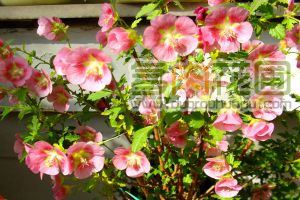
Sunlight exposure for potted Anisodontea capensis
The care of Anisodontea capensis is extremely important. It grows very fast, so growing it requires a relatively large flower pot. If management during the care process is improper, it will cause the leaves of Anisodontea capensis to turn yellow with no way to recover.
Anisodontea capensis is a flower that loves sunlight and warmth, so it has high requirements for sunlight. During care you must keep moving it around to prevent it from being restricted to one direction for a long time and growing lopsided. In summer when the weather is too hot, you need to place it in a spot on the balcony with sufficient scattered light and keep it ventilated, and it will safely make it through the hot summer.
Watering amount for potted Anisodontea capensis
In summer, when caring for Anisodontea capensis you must pay attention to watering, because water is the key to getting it through the summer. When the weather is too hot and the temperature rises, you need to water once a day. If you forget to water, large patches of withered yellow fallen leaves will appear.
When direct sunlight makes the temperature too high, you must water once a day, and water thoroughly. If Anisodontea capensis lacks water it will easily wither and die. During the winter dormancy period, stop watering it.
Choosing potting soil for potted Anisodontea capensis
For the potting soil of Anisodontea capensis you should choose soil with good air permeability. When the soil has good air permeability, even watering a little too much will not cause root rot in Anisodontea capensis. For the soil choice, use 50% garden soil mixed with 50% nutrient soil; the effect is very good.
Anisodontea capensis grows very fast, so flower lovers need to buy a slightly larger flower pot, such as a clay tile pot with good air permeability. In late autumn, Anisodontea capensis needs timely pruning: shorten and cut off long branches, diseased branches, dead branches and broken branches. They must not consume too many nutrients and affect the next year's growth and development.