What does the night-blooming cestrum look like? A detailed introduction to its appearance and characteristics
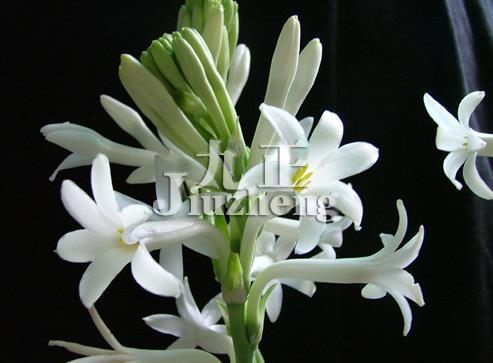
The night-blooming cestrum (Cestrum nocturnum) has slender, weak branchlets that are hairy and contain milky sap. The leaves are opposite; the blades are broadly ovate, heart-shaped to oblong-ovate, 4-9.5 cm long and 3-8 cm wide, with a short acuminate apex and a deeply heart-shaped base, entire margins, 7-9 palmate veins arising from the base, and hairs on the margins and veins. The umbel-like cymes are axillary and may bear as many as 30 flowers; the corolla has 5 lobes, oblong, yellow-green, with a fresh fragrance that is even stronger at night, hence the names "night-blooming cestrum" and "night-fragrant flower"; the corona is 5-lobed, fleshy, shorter than the anthers, borne on the gynostegium, with an acuminate tip; there is 1 pollinium per locule, elliptical, upright. The follicles are lanceolate, 7.5 cm long, with a thick exocarp and no hairs. The seeds are broadly ovate, about 8 mm long, with white silky hairs at the tip. It prefers a warm, humid, sunny, well-ventilated environment with loose, fertile soil; it is drought-tolerant and tolerant of poor soil, but not of waterlogging or cold, and growth stops after leaf fall in winter; after the warmth of spring it puts out branches and leaves, with axillary buds or flower buds at each node, and as it grows it continually produces lateral branches and sends out inflorescences, generally blooming successively from May to October, fragrant when in flower and even more strongly scented at night. It sets fruit in winter.
The effect of the night-blooming cestrum on the home environment
Walking through the supermarket, you can see many indoor air fresheners, with jasmine fragrance, rose fragrance, night-blooming cestrum fragrance... Actually, why buy these air fresheners? Wouldn't it be better to just grow a pot of fragrant flowers? Although growing flowers is a bit more troublesome, growing flowers can cultivate a person's temperament, and flowering plants can purify the air, while fragrant flowers can also give your home a faint, elusive freshness and create an elegant, clean, quiet and comfortable atmosphere.
The night-blooming cestrum flower, a veritable night-blooming cestrum, can give off a sweet scent, and is mysterious, because it blooms at midnight and few people get to see it in full bloom. Growing a pot of night-blooming cestrum at home not only fills your home with fragrance, but also makes guests envious and longing when they learn it is night-blooming cestrum.
Placing plants that give off a fresh fragrance, such as the night-blooming cestrum, in the bedroom can create a quiet and comfortable atmosphere in the bedroom, letting people fall peacefully and soundly asleep amid the natural fragrance.
However, green plants generally carry out photosynthesis only during the day, and at night only respire without photosynthesizing, so at night they consume the oxygen in the room and compete with people. Moreover, the night-blooming cestrum flower is also an oxygen-consuming flower and plant; even when photosynthesizing during the day it consumes a large amount of oxygen, affecting human health, and at night when photosynthesis stops it releases a large amount of waste gas. In addition, at night the fragrance of the night-blooming cestrum flower becomes stronger, because the night-blooming cestrum can release a large amount of strongly olfactory-stimulating particles at night, so it can make patients with high blood pressure and heart disease prone to dizziness, depression and discomfort, and can even worsen their condition. Therefore, it is not suitable to plant the night-blooming cestrum flower in the rooms of patients with high blood pressure and heart disease.
The feng shui effect of the night-blooming cestrum
Home is the harbor of the soul, carrying our sweat and dreams; we all hope that in the days to come we can live more smoothly and have good dreams every day. Therefore, plants that can bring us good dreams will bring us a good mood. The night-blooming cestrum, sending fragrance at night, gives you a comfortable and peaceful dream, accompanying you into dreamland. From this aspect, it can bring good feng shui.
Feng shui, people say it exists if you believe in it and does not exist if you don't, but feng shui is such a magical thing that it has continued for thousands of years. From this aspect, the night-blooming cestrum can ward off evil. Perhaps it is because the night-blooming cestrum blooms at midnight; while all living beings are sound asleep, she is blooming, guarding her sleeping children like a mother.
Moreover, the night-blooming cestrum bears such a beautiful name and story that looking at her stirs some inexplicable feeling in the heart, a certain tranquility, as the saying goes, "tranquility yields transcendence."
However, everything has two sides, good and bad, and if used inappropriately it can also lead to bad consequences. Although the night-blooming cestrum gives off a fresh fragrance at night, letting people fall asleep accompanied by its scent, not everyone can tolerate it. Because the night-blooming cestrum flower is an oxygen-consuming flower and plant, it consumes a large amount of oxygen when photosynthesizing during the day, and when photosynthesis stops at night it releases a large amount of waste gas and gives off strongly olfactory-stimulating particles, which can make patients with high blood pressure and heart disease prone to dizziness, depression and discomfort, and can even worsen their condition. So it is not suitable to plant the night-blooming cestrum flower in the rooms of patients with high blood pressure and heart disease. Therefore, from this aspect, the night-blooming cestrum does not count as a good feng shui plant.
But on the whole, growing the night-blooming cestrum still has more advantages than disadvantages; as long as it is planted correctly, its strengths can be promoted and its shortcomings avoided.
The effect of the night-blooming cestrum in matching home styles
The night-blooming cestrum, just as its name suggests, brings fragrance at night; the night-blooming cestrum flower blooms in the silent midnight when all earthly beings are sound asleep, with quite a personality of "all are asleep while I alone am awake." Many people stay up all night just to catch a glimpse of its beauty. Just ask, wouldn't growing such an enchanting plant at home make your home appear more tasteful?
The night-blooming cestrum flower is said to have originally been a fairy who violated the taboo of love and was turned into a seed by the Queen Mother of the West to guard a temple; later she fell in love with a firefly, but the firefly had originally been sent by the Queen Mother of the West to test the fairy, and if the fairy could let go of love she could return to heaven. But what is love? How could it be abandoned just because one says so? The seed the fairy became thus bloomed night after night for the firefly, waiting for the firefly to come, but she could never wait for it again. The flower language of the night-blooming cestrum is a pure heart, happiness, beauty, independence and rebellion, and it likes adventurous and thrilling things, and prefers to seek pleasure on the edge of danger. People all say that the owner's character is reflected in his life; an owner who grows such a mysterious and elegant plant must be a person of uncommon virtue and extraordinary refinement. This imperceptibly shapes the quiet and romantic style of the home.
In addition, growing a pot of night-blooming cestrum flower in the bedroom can create a quiet and comfortable atmosphere in the bedroom, allowing viewers to gain peace of mind and relax after a tiring day, and also letting people fall peacefully and soundly asleep amid the natural fragrance. But the night-blooming cestrum can release a large amount of strongly olfactory-stimulating particles at night, which can make patients with high blood pressure and heart disease prone to dizziness, depression and discomfort, and can even worsen their condition. Therefore, it is not suitable to plant the night-blooming cestrum flower in the rooms of patients with high blood pressure and heart disease.
The little night-blooming cestrum flower, with romance and purity; if your home is in a pastoral style or a romantic style, planting the night-blooming cestrum flower makes your home even more extraordinary and refined.
How to grow the night-blooming cestrum
1. How to grow the night-blooming cestrum: propagation
The night-blooming cestrum is mostly propagated by cuttings. In spring and autumn, in combination with pruning, select sturdy one-year-old branches and cut them into 8-10 cm long cuttings, insert them into a pot with half sand and half soil, and under conditions of 20-24°C and frequent misting to keep moist, they will root after 1 month, and can then be divided or potted up.
2. How to grow the night-blooming cestrum: planting
The night-blooming cestrum grows quickly and must be repotted every year, preferably in early April in spring, before it is moved outdoors. When repotting, remove some of the old soil and old roots, replace with new potting soil, and prune heavily to encourage new branches.
3. How to grow the night-blooming cestrum: temperature and light
For potted night-blooming cestrum, well-ventilated environmental conditions are required; from early May to the end of September it should be kept in a sunny place. Although the night-blooming cestrum likes plenty of sunlight, it should be protected from the scorching sun at noon in summer. In mid-to-late October each year it must be moved indoors, with a room temperature of 8-12°C; if the temperature is below 5°C, the leaves will turn yellow, wither and drop, leading to death.
4. How to grow the night-blooming cestrum: watering
After repotting, keep the potting soil moist (but avoid water accumulating in the pot); if the young leaves are found to droop slightly, water promptly.
Summer is the peak growing season; besides ensuring fertilization, the potting soil must be kept constantly moist, and if necessary water twice a day. For seedlings, mist the leaves 1-2 times a day.
5. How to grow the night-blooming cestrum: shaping and pruning
The branches of the night-blooming cestrum grow quickly; if allowed to grow naturally, they can grow about 1 m in a year, so it needs pruning every year to sprout more lateral branches and bloom more. The night-blooming cestrum is generally pruned in autumn, keeping each lateral branch 10-12 cm long. After the flowers fade, the dead branches and overly dense branches should be cut away.
6. How to grow the night-blooming cestrum: fertilizing
During growth, apply a thin, well-rotted liquid fertilizer once every 10-15 days; from mid-May it can ensure continuous fragrant blooms, enhancing its ornamental value. If a compound fertilizer of nitrogen, phosphorus and potassium can be applied, the effect is even better.
The above is an introduction to the effects and growing methods of the night-blooming cestrum; for more home plants, please stay tuned.
What kind of flowers are good to grow indoors?
Because of the characteristics of the indoor environment, such as light being dimmer than outdoors; indoor temperatures being higher than outdoors in winter and lower than outdoors in summer; indoor humidity being higher than outdoors in winter, while outdoor humidity is higher than indoors in summer, and so on, shade-tolerant flowers and plants are mostly placed indoors.
The main types of flowers suitable for indoor placement are:
(1) Trailing plants: mainly pothos, spider plant, inch plant, stringy stonecrop, etc.
(2) Foliage plants: mainly ponytail palm, snake plant, cast-iron plant, caladium, arrowhead plant, Swiss cheese plant, variegated corn plant, Schefflera, money tree, giant taro, beautiful kentia palm, rubber tree, sago palm, lady palm, Philodendron bipinnatifidum, asparagus fern, banyan and dwarf umbrella tree, etc.
(3) Flowering plants: mainly clivia, kalanchoe, gloxinia, calceolaria, cyclamen, primrose, begonia, camellia, pansy, etc.
(4) Fragrant plants: mainly banana shrub, jasmine, orchid tree, osmanthus, hyacinth, etc.
The main types of flowers to avoid placing indoors are: Chinese rose, tulip, lily, yellow azalea, oleander, night-blooming cestrum and hydrangea, because the fragrance of these flowers can stimulate the human body and cause adverse reactions.