How to Propagate Monstera deliciosa? Several Practical Methods
For Monstera deliciosa grown in pots in northern China, because a constant temperature cannot be maintained year-round, although perennial old plants do flower, they rarely set fruit, so stem cuttings are used to propagate new plants.
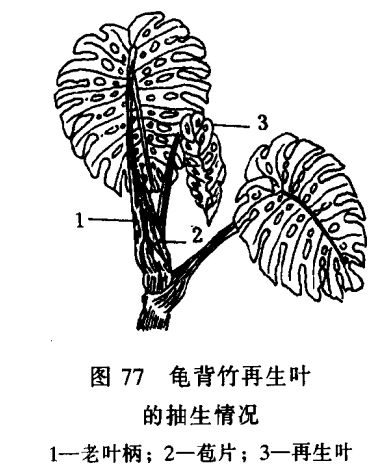
Potted Monstera deliciosa usually has only a single stem, and as new leaves emerge the stem keeps extending forward, rarely producing side branches. If you want to take cuttings, you have to cut the stem. When the main stem grows to about 1 m, cut it off 20 cm above the soil surface in the pot to use as a cutting. After some time, the dormant buds on the remaining section of stem begin to sprout, and 2 juvenile leaves can emerge; after the juvenile leaves have grown, regenerated leaves emerge from the leaf petioles, and thus 2 first-order side stems grow. After the first-order side stems have grown for 3 years they can again reach more than 1 m in length, and they can be cut again for cuttings, and so on.
For rooting Monstera deliciosa cuttings, brown peat is needed as the cutting medium, mixed with 1/3 coarse river sand to improve aeration. When inserting the stem, cut the stem into sections of 2-3 nodes with a sharp kitchen knife, taking care not to damage the crescent-shaped leaf scars. The foremost section of stem bears the terminal leaf, and the petiole of the terminal leaf contains the primordium of a new leaf, so after rooting it can directly produce a regenerated leaf and therefore takes shape quickly. The middle stem sections bear leaves, but there is no longer a new-leaf primordium in the petiole; the lower stem sections have no leaves. Therefore the stem sections should be treated differently when inserted.
The foremost stem section should be inserted upright with the terminal leaf attached; the middle stem section can retain 1 large leaf with 2/3 cut off and be inserted at an angle; the lower stem section has no leaves and can be laid flat together in a large pot.
Cuttings should be taken in late spring and early summer. Before insertion, cut off the aerial roots on the stem from the base to prevent mold and rot; after insertion, keep them shaded and moist, spray water frequently to raise air humidity, and keep the potting soil moist. After the Beginning of Autumn, new leaves can emerge.
How to Propagate Monstera deliciosa: Monstera deliciosa Propagation Methods / Division Is the Fastest to Show Results
Among foliage plants, Monstera deliciosa is a well-deserved star, so many people want to propagate it after growing it for a while. So how should Monstera deliciosa be propagated more scientifically? Today we will look at the main propagation methods for Monstera deliciosa.
How to Propagate Monstera deliciosa
Climate conditions differ slightly from season to season, and propagating Monstera deliciosa requires choosing the best method according to the season. So how do you propagate Monstera deliciosa? There are mainly three methods: sowing, cutting, and division. The detailed key points are below.
Propagation Methods for Monstera deliciosa
I. Propagating Monstera deliciosa by Seed
1. Time
The most suitable temperature for seed propagation is 20-25 degrees, which favors seed germination, so the season should be spring.
2. Selecting Seeds
Choose mainly plump, full seeds, and be sure to choose seeds that have already matured; do not choose seeds taken just after the fruit has formed. Store the seeds in a ventilated, cool place.
3. Soaking and Disinfecting
The selected seeds should be soaked in 40-degree warm water for 10 hours, and the soil used for sowing should also be disinfected. The disinfection method is simple: leave the soil to dry in the sun.
4. Begin Sowing
This is the most critical step of sowing among the propagation methods for Monstera deliciosa. Generally, dibbling is used, with each seed spaced 2-3 cm apart. After sowing, plastic film can be placed over the top to control temperature and maintain humidity. After 20 days they generally germinate, and after growing 5 leaves they can be transplanted; after transplanting, the correct cultivation methods for Monstera deliciosa should be used.
II. Methods for Propagating Monstera deliciosa by Cutting
1. Time
There is relatively more choice in timing for cutting propagation. Cuttings can be taken in spring or autumn, between April-May and between September-October. Cuttings can also be taken at other times except winter, but the results are not as good as in spring and autumn.
2. Specific Steps
First, choose the branch. Choose mainly a side branch with a solid stem that grew vigorously in the current year, ideally 20 cm long. Cut off the leaves at the base, keeping only the small upper leaves, and also cut off the aerial roots, as this helps with water absorption.
Next, choose soil mixed with peat or humus soil; the principle is good aeration and drainage. Then insert the selected branch into the prepared soil. Place it in an environment at 25 degrees, and it can root after 1 month. At first the axillary buds on its stem nodes begin to stir, so be sure to pay attention to care at this time.
III. Propagating Monstera deliciosa by Division
1. Time
Division propagation is generally chosen in summer and autumn, mainly from September-October, and the specific time can be chosen according to temperature and humidity conditions.
2. Propagation Method
Although division is not commonly used among the propagation methods for Monstera deliciosa, it is a relatively simple method. Split off an entire side branch of a large Monstera deliciosa, and note that it must have aerial roots, then plant it in a wooden tub or nutrient pot.
Summary: Among the propagation methods for Monstera deliciosa, three methods are relatively common. Division is the fastest to show results but is used the least, because before propagating you need to have a large Monstera deliciosa; only with this condition is division more practical, otherwise we should choose cutting or sowing.
How to Propagate Monstera deliciosa? Can Monstera deliciosa Be Grown Hydroponically? Hydroponic Techniques for Monstera deliciosa
Image: Monstera deliciosa
[Common Questions] How to Propagate Monstera deliciosa? Can Monstera deliciosa Be Grown Hydroponically? Hydroponic Techniques for Monstera deliciosa
[Expert Answer]
Propagation and cultivation of Monstera deliciosa:
Cutting and sowing methods can be used. Cuttings are mostly taken after the temperature rises in April in spring.——Generally, a stem section with two nodes can be cut as a cutting (if the stem section is thicker, it can also be cut into one-node sections), remove the leaves, lay it horizontally in a seedbed or pot, cover with soil, exposing only the buds on the stem section, and place it in a warm, semi-shaded place, keeping it moist. After about one month it can root and sprout. You can also cut off the entire stem, remove the leaves, lay it horizontally in a seedbed, cover half with soil, and after it roots and sprouts, divide it into small sections with roots and buds, then pot them for planting. You can also collect ripe fruit, strip out the seeds, and immediately sow them in river sand, keeping them moist; in 1-2 months they can germinate and emerge.
Hydroponic cultivation methods for Monstera deliciosa:
1. For hydroponic Monstera deliciosa, choose a small soil-grown plant, take the Monstera deliciosa out of the soil, wash the roots clean, and try not to damage the roots. Then cut off all the surrounding fibrous roots (do not cut the central main root). Remember to soak the Monstera deliciosa roots in a very dilute potassium permanganate solution for about 10 minutes.
2. Take a glass container, pour in an appropriate amount of clean water, and let two-thirds of the Monstera deliciosa roots be immersed in the water, with the remaining roots exposed to the air. Check the root condition from time to time. If everything is normal, change the water once a week until the Monstera deliciosa roots grow enough water roots, and then the hydroponic Monstera deliciosa is a success. Afterward, replace the hydroponic medium with nutrient solution and care for it normally.
3. It is best to place hydroponic Monstera deliciosa in a place indoors with ample diffused light. If it is in too dark a place for a long time, you can supplement with artificial light or keep it for a period in a place with suitable light every so often. In winter, place hydroponic Monstera deliciosa in a sunny and warm place, avoiding cold drafts. In the hot summer season, the environmental temperature for hydroponic plants should be<28℃,最适合放在空调房间。
4. Because Monstera deliciosa leaves are relatively large, use heavy containers for hydroponics to prevent tipping over. Monstera deliciosa leaves can sometimes develop brown spot disease, and thiophanate or carbendazim and similar treatments should be sprayed promptly to prevent the disease from spreading.
5. Change the water and clean the container regularly to reduce bacteria in the water and competition with the roots for dissolved oxygen, and increase the dissolved oxygen in the water as much as possible. In winter, replace the new nutrient solution regularly every week; in hot summer, replace the nutrient solution every day, and at the same time lower the salt concentration of the nutrient solution. Also, frequently shake the hydroponic plant bottle, which can increase the dissolved oxygen in the nutrient solution.
[Editor's Comments] Monstera deliciosa likes a moist environment and needs sufficient water during the growing period, so it is very suitable for hydroponics. If grown in soil, on dry days you also need to spray water on the leaves to maintain humidity, while hydroponics can save you this trouble. The editor of First Agricultural Economics above has introduced the propagation methods and hydroponic techniques for Monstera deliciosa. Friends who are interested may as well try growing it hydroponically at home themselves; perhaps there will be an unexpected surprise.