A Detailed Guide to Planting Methods and Cultivation Techniques for the Flamboyant Tree
The flamboyant tree (Delonix regia) originates from the tropics and is best suited to growing in hot, humid environments, thriving at temperatures between 20-30°C, which is why late spring to early summer and autumn are its most vigorous growing seasons in China. The flamboyant tree is not cold-tolerant, so plants grown outdoors must be protected from the cold in winter, keeping the temperature no lower than 10°C, otherwise there is a risk of freezing to death.
Soil: The flamboyant tree can tolerate relatively poor soil, but it most prefers fertile, organic-rich and loose soil conditions; grown in optimal soil, its flamboyant flowers bloom even more brilliantly and beautifully. The roots of the flamboyant tree are shallow-rooted, yet its root system is very well developed and firmly anchored, giving it strong wind resistance.
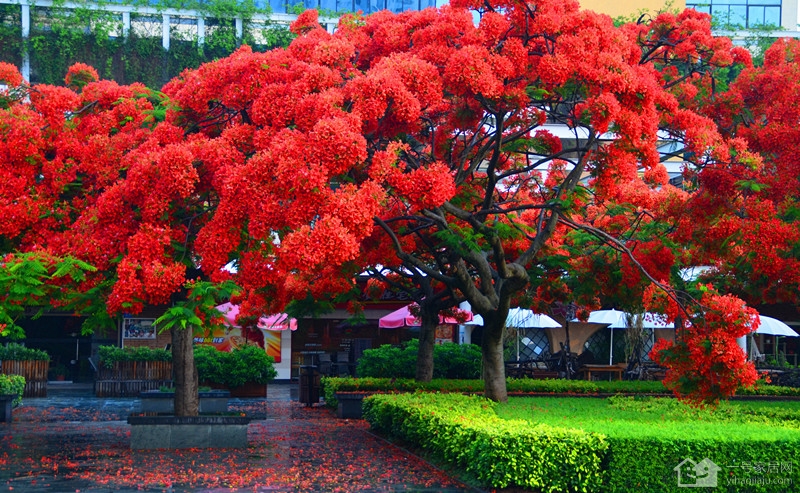
How to grow the flamboyant tree
The flamboyant tree (Delonix regia) originates from the tropics and by nature loves hot, humid environments; the temperature range best suited to its growth is 20-30°C, which is why late spring to early summer and autumn are its most vigorous growing seasons in China. The flamboyant tree is not cold-tolerant, so plants grown outdoors must be protected from the cold in winter, keeping the temperature no lower than 10°C, otherwise there is a risk of freezing to death.
Soil: The flamboyant tree can tolerate relatively poor soil, but it most prefers fertile, organic-rich and loose soil conditions; grown in optimal soil, its flamboyant flowers bloom even more brilliantly and beautifully. The roots of the flamboyant tree are shallow-rooted, yet its root system is very well developed and firmly anchored, giving it strong wind resistance.
Transplanting and planting out: Transplanting of the flamboyant tree concerns the growth of seedlings; seedlings about 1-2 years old should be transplanted to a fertile, loose and sunny environment. Transplanting is usually carried out in early spring, and after transplanting the row spacing of the plants should be maintained at around 60 cm. After 1-2 years of transplanting, once the seedlings have grown, they can be planted out permanently; planting out has low soil requirements and poor soil is acceptable, but the chosen site should also be open and sunny.
Watering: The flamboyant tree is drought-tolerant, but the amount of water given must be controlled. Because its roots have rhizobia, in poor soil it can fix nitrogen to increase soil fertility, but waterlogging will cause the rhizobia to die, thereby affecting the normal growth of the whole plant.
Propagation methods for the flamboyant tree
The common propagation method for the flamboyant tree is propagation by seed. Seeds are generally sown in spring and can mature in 12 months. Before sowing, the seeds need to be soaked: first soak the seeds in boiling water, then after the water cools, soak for about 2 days, changing the water once in between. Only after this treatment can the seeds be sown; they generally begin to germinate in about a week and begin to emerge in 3 weeks.
The flower language of the flamboyant flower
The flamboyant flower is the flower of the flamboyant tree, which originates from Madagascar and is the national flower and national tree there. The flamboyant flower can often be seen on school campuses; the flamboyant tree usually blooms around May, which is graduation season, filled everywhere with the sorrow of parting. In the sunlight, the flame-like flamboyant flowers add a touch of sentiment to the farewell, like a beloved teacher's earnest reminders to students about to travel far. Thus the flower language of the flamboyant flower is: farewell and longing.
When does the flamboyant flower bloom
The flamboyant tree is a tropical species; its young plants cannot bloom, and it generally only begins to flower after 6-8 years of planting, blooming in a red brilliance like nothing else under the sun. The flamboyant flower begins to sprout from the beginning of each month and enters its growth period after April, starting to bloom. Its flowers can open at around May. Its petals are usually axillary or terminal, and the flowers are larger in diameter than ordinary flowers, reaching about 7-15 cm. The number of petals is 5, the same as the number of its sepals, and they are mostly bright red.
The flamboyant flower has a relatively long flowering period, reaching about 5-8 months. After it begins to bloom around May, the period before July is its growth peak, with bright red blooms. But when temperatures surge in July, its growth activity begins to weaken, until temperatures drop after late August when it once again enters a growth peak, then slows down in winter until around December-January when the flamboyant tree begins to shed its leaves.
What is the flamboyant flower? Growing methods and precautions for the flamboyant flower
Speaking of the flamboyant flower, perhaps you have seen it but do not know its name; follow along with the editor to learn about the flamboyant flower. The flamboyant flower, named for its "leaves like the feathers of a flying phoenix, flowers like the crown of the red phoenix", is also known as golden phoenix flower, red-flowered michelia tree, fire tree, foreign michelia and so on. Because of its bright red or orange flowers combined with bright green pinnate compound leaves, the flamboyant tree is praised as one of the most colourful trees in the world. What are the growing methods for the flamboyant flower? What are the precautions for growing the flamboyant flower?
Growth habits
The flamboyant tree is a tropical tree species; it begins to flower after 6-8 years of planting, prefers high temperatures, high humidity and a sunny environment, with an optimal growth temperature of 20-30°C; it is not cold-tolerant, and winter temperatures should not be lower than 10°C. Deep, fertile, organic-rich sandy loam is ideal; it fears waterlogging, so drainage must be good; it is relatively drought-tolerant and tolerates poor soil. Generally a 1-year-old plant can reach 1.5-2 m in height, a 2-year-old plant can reach 3-4 m, and it begins to flower after 6-8 years of planting.
In South China, winter buds sprout in early February each year, with April-July being the growth peak; in late July, due to excessively high temperatures, growth decreases; after mid-to-late August, as temperatures drop, growth speeds up; after October, growth slows; and from December to January of the following year, the leaves fall.
Cultivation techniques
Seed sowing is commonly used to raise seedlings. The thousand-seed weight is about 400 grams. The seed coat absorbs water with difficulty, so the seeds need to be scalded with 80°C warm water to promote germination; after natural cooling, continue soaking for 24 hours, then drain and set aside.
Sow by the drill method; seedlings are relatively sensitive to frost, so early on a compound fertiliser can be applied, with less nitrogen fertiliser; after autumn, fertilising should stop to encourage early lignification. In winter, if the leaves have not yet fallen, they can be removed by hand, and plastic film covering or individual plant wrapping can be used to protect against frost. One-year-old seedlings can be lifted from the nursery and planted out.
Propagation methods
The flamboyant tree is mainly propagated by sowing. The seeds mature in December; collect the pods, remove the seeds and store them dry, then sow in the following spring. Before sowing, soak the seeds in boiling water, and after cooling continue soaking for 1-2 days, changing the clean water 1-2 times in between; after sowing, germination begins in 6-7 days, and full emergence can occur in more than 20 days; one-year-old seedlings can reach about 1.5 m.
Cultivation methods
Planting should be done in a sunny spot with fertile, deep, well-drained soil. After 1-2 years of growth, seedlings need to be transplanted once, preferably in early spring. The plant and row spacing should be around 60 cm, and 3-year-old seedlings can be used for planting out. The planting site should be chosen in an open, sunny place, and in dry weather it should be watered thoroughly. The flamboyant tree has low soil requirements and can grow well even in relatively poor soil, because its roots have rhizobia that can fix nitrogen and increase soil fertility; however, waterlogging will kill the rhizobia and affect plant growth. The trunk of the flamboyant tree will constantly produce branches and leaves; if allowed to grow naturally, the plant shape will vary greatly, so frequent pruning is needed. The flamboyant tree is not cold-tolerant, and in northern regions it can only be cultivated and maintained in a greenhouse.
For transplanting, the survival rate is high before bud break in spring; it can also be planted in the rainy season, but some branches and leaves should be pruned to ensure survival. The plant has strong sprouting ability, so the trunk-cutting method can be used to cultivate large seedlings; after planting out, loosen the soil and weed 2-3 times each year, water in good time, apply one topdressing each in spring and autumn, and promptly remove root suckers to ensure good tree growth.
Pest control
Common pests
The pest found on the flamboyant tree is an insect of the "noctuid moth" type. Its larvae feed on plant leaves, often eating all the host's leaves and seriously affecting the tree's growth and ornamental value. Pest damage to the flamboyant tree is most severe in July, August and September; the flamboyant tree noctuid moth is not harmful to humans, but some people may experience allergic symptoms as a result.
Control methods
Seize the period when the larvae are clustered and causing damage, and dust with powder in the early morning before the dew has dried. You can dust with 2.5% trichlorfon powder or 1.5% parathion (1605) powder or 1.5% dimethoate powder, at 1.5-2 kg per mu.
The above is the content I have compiled for you about the flamboyant flower; I hope it is helpful to you. Please continue to follow Duorou Huapu for more information.