How to disbud peony flowers? Master the correct disbudding method
Peony, also known by the aliases Jiangli and Licao, is a famous herbaceous flower of the genus Paeonia in the family Paeoniaceae. Its cultivation history in China spans more than 4,900 years, making it one of the earliest flowers cultivated in China. A scientific approach to disbudding can promote healthy growth of the flower buds.
Peonies can be divided into many varieties, such as Paeonia obovata, Paeonia mairei and Paeonia lactiflora. The petals of the peony are obovate, and the flower disc is shaped like a shallow cup. Its roots are made into traditional Chinese medicine and have antispasmodic and analgesic medicinal value. It ranks first among herbaceous flowers, is praised by people as the “Flower Fairy” and the “Flower Minister”, and is listed as one of the “Six Famous Flowers”. It is also called the “Flower God of May”. Because it has been regarded as the flower of love since ancient times, it is now honored as the representative flower of the Qixi Festival.
After peonies unfold their leaves and show buds in April, besides the main bud, there are also 3~4 side buds. To encourage the main bud's flower to be large and beautiful, the side buds should be removed after budding so that nutrients are concentrated in the main bud.
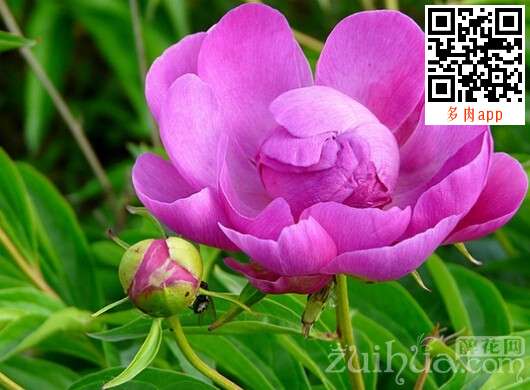
When disbudding, note the following:
① Disbudding should be done on a sunny morning so that the wounds heal as quickly as possible and the invasion of pathogens is reduced.
② Use sharp scissors and operate carefully. Do not damage or cut off the leaves beside the buds, otherwise the plant will be affected in flowering because of a reduction in the leaves that synthesize nutrients.
③ Carry out disbudding when the buds are nearly 1 cm in diameter. Keep the main bud and one side bud, and remove all the rest; if the main bud is damaged and growing unhealthy, wait until the side buds are slightly larger and use a side bud to replace the main bud. If the main bud is normal, keep the main bud and remove the side buds.
Pest and disease control:
The pests that harm peonies include white grubs, red spider mites and aphids. To prevent white grubs from biting the peony roots, a 1000-fold dilution of 50% phoxim can be used to drench the roots every early spring. For red spider mites and aphids, dimethoate can be sprayed to kill them. The main disease of peonies is brown spot disease. Its symptoms are brown spots appearing on the peony leaves in summer, and by late autumn the leaves gradually wither, and even the whole plant dies. The control method is to spray Bordeaux mixture 1 to 2 times a month from April until late autumn.
Summary: The above is an introduction to the methods of disbudding peonies. We hope everyone will exchange more experience in growing peonies.
Tips for disbudding peony flowers, and when is the best time to divide them
Friends who like peony flowers all know that it loves sunlight and is drought-tolerant. With changes in the climate rhythm, it undergoes phased developmental changes. These are mainly shown as alternating changes between the growth period and the dormant period. Today I will take everyone through an introduction to the tips for disbudding peony flowers, as well as related content on when is the best time to divide them.
After peonies unfold their leaves and show buds in April, besides the main bud, there are also 3~4 side buds. To encourage the main bud's flower to be large and beautiful, the side buds should be removed after budding so that nutrients are concentrated in the main bud.
When disbudding, note the following:
① Disbudding should be done on a sunny morning so that the wounds heal as quickly as possible and the invasion of pathogens is reduced.
② Use sharp scissors and operate carefully. Do not damage or cut off the leaves beside the buds, otherwise the plant will be affected in flowering because of a reduction in the leaves that synthesize nutrients.
③ Carry out disbudding when the buds are nearly 1 cm in diameter. Keep the main bud and one side bud, and remove all the rest; if the main bud is damaged and growing unhealthy, wait until the side buds are slightly larger and use a side bud to replace the main bud. If the main bud is normal, keep the main bud and remove the side buds.
When is the best time to divide peonies:
① Dividing peonies for propagation is convenient and simple. It can make peonies bloom earlier, can preserve the excellent characteristics of the mother plant, and gives bright flower colors, many petals and beautiful form.
② Peonies must be divided in autumn, because at this time the soil temperature is higher than the air temperature, which is favorable for wound healing and the sprouting of new roots, and enhances cold resistance. The time of division should not be too early or too late. If too early, the plants are prone to early sprouting, which affects growth and development the following year; if too late, because the weather turns cold, new roots on the divided plants are not easy to form, weakening their growth vigor the following year and reducing their ornamental value.
The above is all the content learned today about the tips for disbudding peony flowers and when is the best time to divide them. We hope flower lovers will find this article helpful after reading it. If you want to learn more, please continue to follow our Succulent Garden, and we will provide you with more related knowledge!