Detailed Explanation of the Key Cultivation and Management Techniques for Zinnia
Zinnia is an annual herbaceous plant that loves light and warmth, prefers somewhat moist conditions, and can also tolerate a certain degree of drought. It is robust and vigorous, and the cultivation soil should be loose and fertile. Poor, thin soil and excessive drought will directly affect the number of flowers, flower color, and flower diameter.
Although there are differences in height among zinnia varieties, they are generally all kept between 20-30 cm. They are suitable for use in flower beds and flower borders, and are also an excellent material in artistic flower displays. Sowing and seedling raising: For zinnia, each gram of seed contains about 125 seeds for the large-flowered type, about 300 for the medium-flowered type, and about 1,500 for the multi-flowered type. The largest demand is for flower beds, flower displays, and flower borders during the National Day period. The sowing time is generally best kept to June-July. There have also been trial autumn sowings, but due to the influence of temperature and other factors, there is a certain effect on flower color and plant shape, so autumn sowing is generally not adopted. The sowing medium uses a relatively loose artificial medium. Bed sowing and tray sowing may be used, and where conditions permit, plug tray seedling raising may also be used. The medium requires a pH value of 5.8-6.2 and an EC value of 0.75. After disinfection treatment, the sowing medium is kept at 22-24 degrees Celsius, and seedlings emerge in 3-5 days.
Stage One:
Three days after sowing, the radicle emerges, and the medium moisture level should be relatively drier. Too much moisture easily causes the seeds to rot. However, at this stage it is very important to keep the area around the seeds moist and with sufficient oxygen, so after sowing, covering with a thin layer of coarse vermiculite or loose rice husk ash is very beneficial for seed germination. The covering thickness should be such that the seeds are no longer visible. For open seedling raising, a shade net must be added to ensure humidity and lower temperature (when sowing is carried out in a germination chamber environment, appropriate supplemental light may be given). No fertilization is needed at this stage.
Stage Two:
Keep the soil relatively moist, neither too wet nor too dry. Too wet easily causes disease, and too dry causes the seedlings to wilt. At this time the main root grows to 1-2 cm, the cotyledons unfold, the first pair of true leaves begins to grow, and the seedlings can gradually be exposed to light. Fertilization can begin, generally using 0.05% urea or 50 ppm 20-10-20 water-soluble fertilizer. Nitrogen promotes vegetative growth.
Stage Three:
The seedlings enter a rapid growth period, and water management should be strengthened, carrying out a cycle from dry to wet and then to dry. This is beneficial for the root growth of the seedlings and can also avoid leggy growth. At this stage, attention should be paid to pest and disease control. A topdressing of 0.1% urea or compound fertilizer may be applied as appropriate. For the compound fertilizer type, an N-P-K ratio of 15-15-15 may be used (or according to market supply conditions, the N and K contents may be slightly higher and the P content may be lower). Where conditions permit, the medium and ambient temperature may be appropriately lowered to about 20 degrees Celsius, but when sowing is carried out under bed-sowing protected conditions, temperature control is very difficult. This stage also requires a full-light environment, otherwise it easily causes the seedlings to become leggy. According to the growth vigor at the seedling stage, control water appropriately. Pay attention to ventilation of the larger environment to prevent disease. Spray chlorothalonil or thiophanate-methyl about once every week. If leggy growth occurs at this stage, spray B9 immediately to control height.
Cultivation Techniques for Zinnia
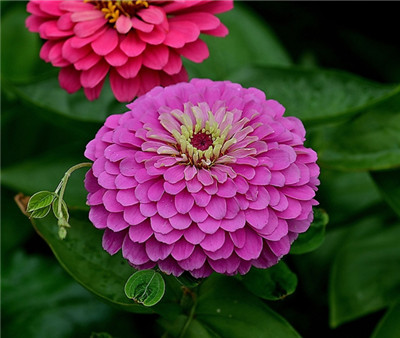
It loves light and warmth, prefers somewhat moist conditions, and can also tolerate a certain degree of drought. It is robust and vigorous, and the cultivation soil should be loose and fertile. Poor, thin soil and excessive drought will directly affect the number of flowers, flower color, and flower diameter. For zinnia potted plants used in large-scale commercial production, seed propagation is generally used. Occasionally, producers use cutting propagation to reduce production costs, but the quality cannot meet certain requirements. The main varieties used in production include the large-flowered double type "Dreamland" and "Short Stuff"; the multi-flowered single type "Dasher Gold", "Crystal", and "Star"; and the medium-flowered single type "Festival" and other series. The optional colors include red, rose red, pink, yellow, white, orange, and so on. Although there are differences in height among zinnia varieties, they are generally all kept between 20-30 cm. They are suitable for use in flower beds and flower borders, and are also an excellent material in artistic flower displays.
Sowing and seedling raising: For zinnia, each gram of seed contains about 125 seeds for the large-flowered type, about 300 for the medium-flowered type, and about 1,500 for the multi-flowered type. The largest demand is for flower beds, flower displays, and flower borders during the National Day period. The sowing time is generally best kept to June-7. There have also been trial autumn sowings, but due to the influence of temperature and other factors, there is a certain effect on flower color and plant shape, so autumn sowing is generally not adopted. The sowing medium uses a relatively loose artificial medium. Bed sowing and tray sowing may be used, and where conditions permit, plug tray seedling raising may also be used. The medium requires a pH value of 5.8-6.2 and an EC value of 0.75. After disinfection treatment, the sowing medium is kept at 22-24 degrees Celsius, and seedlings emerge in 3-5 days.
Stage One: Three days after sowing, the radicle emerges, and the medium moisture level should be relatively drier. Too much moisture easily causes the seeds to rot. However, at this stage it is very important to keep the area around the seeds moist and with sufficient oxygen, so after sowing, covering with a thin layer of coarse vermiculite or loose rice husk ash is very beneficial for seed germination. The covering thickness should be such that the seeds are no longer visible. For open seedling raising, a shade net must be added to ensure humidity and lower temperature (when sowing is carried out in a germination chamber environment, appropriate supplemental light may be given). No fertilization is needed at this stage.
Stage Two: Keep the soil relatively moist, neither too wet nor too dry. Too wet easily causes disease, and too dry causes the seedlings to wilt. At this time the main root grows to 1-2 cm, the cotyledons unfold, the first pair of true leaves begins to grow, and the seedlings can gradually be exposed to light. Fertilization can begin, generally using 0.05% urea or 50 ppm 20-10-20 water-soluble fertilizer. Nitrogen promotes vegetative growth.
Stage Three: The seedlings enter a rapid growth period, and water management should be strengthened, carrying out a cycle from dry to wet and then to dry. This is beneficial for the root growth of the seedlings and can also avoid leggy growth. At this stage, attention should be paid to pest and disease control. A topdressing of 0.1% urea or compound fertilizer may be applied as appropriate. For the compound fertilizer type, an N-P-K ratio of 15-15-15 may be used (or according to market supply conditions, the N and K contents may be slightly higher and the P content may be lower). Where conditions permit, the medium and ambient temperature may be appropriately lowered to about 20 degrees Celsius, but when sowing is carried out under bed-sowing protected conditions, temperature control is very difficult. This stage also requires a full-light environment, otherwise it easily causes the seedlings to become leggy. According to the growth vigor at the seedling stage, control water appropriately. Pay attention to ventilation of the larger environment to prevent disease. Spray chlorothalonil or thiophanate-methyl about once every week. If leggy growth occurs at this stage, spray B9 immediately to control height.
Stage Four: The root system has already formed well. When there are 3 pairs of true leaves, if leggy growth occurs, spray B9 immediately to control height. The temperature and humidity requirements are the same as in Stage Three. After the hardening-off stage, prepare for transplanting and potting up.
Transplanting/Potting Up: For plug tray seedlings, when there are 2 pairs of true leaves, they can be transplanted and potted up; for tray-sown and bed-sown seedlings, they can also be directly potted up when there are 3-4 pairs of true leaves. According to the requirements for plant height and plant diameter, 12 x 13 nutrient pots are generally used for potting up, which can be done in one step without the need for repotting. Plug tray seedlings have less root damage and are easy to transplant and survive; for open seedling raising, when lifting the seedlings, as much soil as possible should be retained, and transplanting should be carried out in the evening or on cloudy days to increase the survival rate.
Light regulation: Zinnia is a sun-loving plant. Both growth and flowering require ample sunlight. Insufficient sunlight easily causes stem node leggy growth and affects the ornamental effect. After potting up, the entire growth period does not require shading.
Temperature regulation: Although zinnia loves warmth, under hot summer conditions its growth vigor is somewhat weaker and the flowering effect is not ideal. The optimum temperature for growth and flowering is 15-20 degrees Celsius.
The sowing date for zinnia is kept in summer in order to prepare flowers for the National Day. If temperatures above 35 degrees Celsius are encountered during the growth period, growth is generally not affected.
Cultivation management: During the plum rain season, when there is excessive rain, it easily causes excessively rapid internode elongation, so attention should be paid to draining accumulated water and spraying B9 at the appropriate time.
In summer, when there is long sunshine and little rain, and it is too dry, growth vigor is easily weakened and flower color is affected. At this time, attention should be paid to water and fertilizer management. Throughout the growth period, water should be controlled appropriately; alternating dry and wet conditions in the pot soil are beneficial for root development and height control. For potted plants, fertilization is generally once every 7-10 days. Depending on the growth situation, topdressing may be carried out. 0.2% urea and compound fertilizer are used alternately, and urea application is stopped after one month. After flowering, depending on the growth situation, the interval for topdressing compound fertilizer may be appropriately extended. Because the lateral branches of zinnia have the habit of terminal bud formation and flowering, if natural growth is not controlled, the flowering position will become higher and higher, affecting the beauty of the plant shape. Pinching should be done at the appropriate time before and after transplanting to control the plant shape. Pinching generally retains 2-3 pairs of true leaves. Zinnia can be pruned, but after pruning the growth vigor is poorer, so this method is generally not adopted.
Pests and diseases: The main diseases of zinnia are: damping-off at the seedling stage, bacterial wilt during the growth period, stem rot, and leaf spot; the main pests are: noctuid moths, red spider mites, cabbage caterpillars, and so on.
Quality at leaving the nursery: Production uses 13 cm nutrient pots. They can leave the nursery when the first flower shows color to before full bloom. The crown width should generally be between 20-25 cm, with a full plant shape and uniform flowering.
Zinnia seedlings are very prone to leggy growth in the later growth stage. To prevent leggy growth, first, appropriately lower the temperature and increase ventilation; second, ensure a sufficient nutritional area and increase the spacing between plants and rows; third, pinch to promote axillary bud growth. This is generally done when the plant height is about 10 cm, pinching while retaining 2-4 pairs of true leaves. To make the plant short and still flower, a dwarfing agent is often sprayed when the axillary buds grow to about 3 cm after pinching. For seedlings that are not leggy and are cultivated in the open field, if height is to be limited, pinching should also be done. Five to 7 days before planting, increase ventilation for hardening off to adapt to open-field environmental conditions.
Zinnia can regulate its flowering period by adjusting day length. Because it is a relative short-day plant, when the day length is longer than 14 hours, flowering is delayed, taking 70 days from sowing to flowering, and there are more ligulate flowers; when the day length is shorter than 12 hours, flowering is earlier, taking only 60 days from sowing to flowering, but there are more tubular flowers. In addition, the flowering period can also be controlled by adjusting the sowing date and pinching time.
(Reporter, China Landscape Web)Cultivation and Management Techniques for the Herbaceous Flower Zinnia
Zinnia is an annual herbaceous plant that loves light and warmth, prefers somewhat moist conditions, and can also tolerate a certain degree of drought. It is robust and vigorous, and the cultivation soil should be loose and fertile. Poor, thin soil and excessive drought will directly affect the number of flowers, flower color, and flower diameter.Although there are differences in height among zinnia varieties, they are generally all kept between 20-30 cm. They are suitable for use in flower beds and flower borders, and are also an excellent material in artistic flower displays. Sowing and seedling raising: For zinnia, each gram of seed contains about 125 seeds for the large-flowered type, about 300 for the medium-flowered type, and about 1,500 for the multi-flowered type. The largest demand is for flower beds, flower displays, and flower borders during the National Day period. The sowing time is generally best kept to June-7. There have also been trial autumn sowings, but due to the influence of temperature and other factors, there is a certain effect on flower color and plant shape, so autumn sowing is generally not adopted. The sowing medium uses a relatively loose artificial medium. Bed sowing and tray sowing may be used, and where conditions permit, plug tray seedling raising may also be used. The medium requires a pH value of 5.8-6.2 and an EC value of 0.75. After disinfection treatment, the sowing medium is kept at 22-24 degrees Celsius, and seedlings emerge in 3-5 days.
Stage One:
Three days after sowing, the radicle emerges, and the medium moisture level should be relatively drier. Too much moisture easily causes the seeds to rot. However, at this stage it is very important to keep the area around the seeds moist and with sufficient oxygen, so after sowing, covering with a thin layer of coarse vermiculite or loose rice husk ash is very beneficial for seed germination. The covering thickness should be such that the seeds are no longer visible. For open seedling raising, a shade net must be added to ensure humidity and lower temperature (when sowing is carried out in a germination chamber environment, appropriate supplemental light may be given). No fertilization is needed at this stage.
Stage Two:
Keep the soil relatively moist, neither too wet nor too dry. Too wet easily causes disease, and too dry causes the seedlings to wilt. At this time the main root grows to 1-2 cm, the cotyledons unfold, the first pair of true leaves begins to grow, and the seedlings can gradually be exposed to light. Fertilization can begin, generally using 0.05% urea or 50 ppm 20-10-20 water-soluble fertilizer. Nitrogen promotes vegetative growth.
Stage Three:
The seedlings enter a rapid growth period, and water management should be strengthened, carrying out a cycle from dry to wet and then to dry. This is beneficial for the root growth of the seedlings and can also avoid leggy growth. At this stage, attention should be paid to pest and disease control. A topdressing of 0.1% urea or compound fertilizer may be applied as appropriate. For the compound fertilizer type, an N-P-K ratio of 15-15-15 may be used (or according to market supply conditions, the N and K contents may be slightly higher and the P content may be lower). Where conditions permit, the medium and ambient temperature may be appropriately lowered to about 20 degrees Celsius, but when sowing is carried out under bed-sowing protected conditions, temperature control is very difficult. This stage also requires a full-light environment, otherwise it easily causes the seedlings to become leggy. According to the growth vigor at the seedling stage, control water appropriately. Pay attention to ventilation of the larger environment to prevent disease. Spray chlorothalonil or thiophanate-methyl about once every week. If leggy growth occurs at this stage, spray B9 immediately to control height.
Stage Four:
The root system has already formed well. When there are 3-4 pairs of true leaves, if leggy growth occurs, spray B9 immediately to control height. The temperature and humidity requirements are the same as in Stage Three. After the hardening-off stage, prepare for transplanting and potting up.
Transplanting/Potting Up: For plug tray seedlings, when there are 2-3 pairs of true leaves, they can be transplanted and potted up; for tray-sown and bed-sown seedlings, they can also be directly potted up when there are 3-4 pairs of true leaves. According to the requirements for plant height and plant diameter, 12 x 13 nutrient pots are generally used for potting up, which can be done in one step without the need for repotting. Plug tray seedlings have less root damage and are easy to transplant and survive; for open seedling raising, when lifting the seedlings, as much soil as possible should be retained, and transplanting should be carried out in the evening or on cloudy days to increase the survival rate.
Light regulation: Zinnia is a sun-loving plant. Both growth and flowering require ample sunlight. Insufficient sunlight easily causes stem node leggy growth and affects the ornamental effect. After potting up, the entire growth period does not require shading.
Temperature regulation: Although zinnia loves warmth, under hot summer conditions its growth vigor is somewhat weaker and the flowering effect is not ideal. The optimum temperature for growth and flowering is 15-20 degrees Celsius. The sowing date for zinnia is kept in summer in order to prepare flowers for the National Day. If temperatures above 35 degrees Celsius are encountered during the growth period, growth is generally not affected.
Cultivation management: During the plum rain season, when there is excessive rain, it easily causes excessively rapid internode elongation, so attention should be paid to draining accumulated water and spraying B9 at the appropriate time; in summer, when there is long sunshine and little rain, and it is too dry, growth vigor is easily weakened and flower color is affected. At this time, attention should be paid to water and fertilizer management. Throughout the growth period, water should be controlled appropriately; alternating dry and wet conditions in the pot soil are beneficial for root development and height control. For potted plants, fertilization is generally once every 7-10 days. Depending on the growth situation, topdressing may be carried out. 0.2% urea and compound fertilizer are used alternately, and urea application is stopped after one month. After flowering, depending on the growth situation, the interval for topdressing compound fertilizer may be appropriately extended. Because the lateral branches of zinnia have the habit of terminal bud formation and flowering, if natural growth is not controlled, the flowering position will become higher and higher, affecting the beauty of the plant shape. Pinching should be done at the appropriate time before and after transplanting to control the plant shape. Pinching generally retains 2-3 pairs of true leaves. Zinnia can be pruned, but after pruning the growth vigor is poorer, so this method is generally not adopted.
Pests and Diseases: The main diseases of zinnia are: damping-off at the seedling stage, bacterial wilt during the growth period, stem rot, and leaf spot; the main pests are: noctuid moths, red spider mites, cabbage caterpillars, and so on.