How to grow flame vine? Detailed guide to cultivation methods and precautions
Layering propagation or cutting propagation. Layering propagation can be done in spring or summer; roots begin to form in about 1 month, and in about 3 months it can be separated from the mother plant and transplanted. Cutting propagation is also carried out in spring and summer.
For the cultivation site, choose a spot with ample sunlight and cool, breezy ventilation. Flame vine is not demanding about soil, but when grown in fertile soil rich in organic matter, well-drained and with a deep soil layer, it grows more vigorously.
The planting hole should be dug somewhat larger, and enough base fertilizer should be applied; the base fertilizer should preferably be decomposed compost with an appropriate amount of soybean cake or bone meal added. The soil in the hole must be mixed evenly, and watered thoroughly once, and left to ferment for 1 to 2 months before it can be planted. After planting, the first watering should be thorough, and shade is needed. When the seedling grows to about 70 cm tall, a trellis should be set up, its branches guided onto the trellis, and pinching should be done to encourage lateral branches to sprout, which helps it bloom more.
Fertilizer and water must be appropriate. Flame vine grows fast, blooms abundantly, and the flowering period is also long, so fertilizer and water must be sufficient. During the growing period, a topdressing is needed once a month. The topdressing should preferably be decomposed, diluted soybean cake water or compound fertilizer, to promote luxuriant branches and leaves and flowers all over the branches. Keep the soil moist; the frequency of watering should depend on the moisture condition of the soil. In hot summer, besides watering, spray water on the branches and leaves 2 to 3 times a day and sprinkle water on the surrounding ground to increase air humidity.
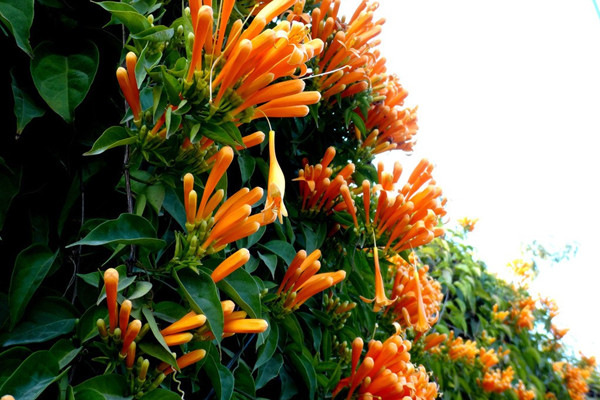
Cultivation methods for flame vine
Potting soil selection
For potted flame vine, a large, deep cylindrical flower pot is generally chosen. Flame vine is not demanding about soil; when growing flame vine, you can choose soil rich in organic matter and well-drained, with a deep soil layer. Generally, a mix of leaf mold, garden soil and sand can be used, with some decomposed fertilizer or soybean cake added as base fertilizer.
Light and temperature
Flame vine likes a growing environment with ample sunlight and a warm climate; it is not cold-tolerant and needs to be kept at a relatively high temperature in winter. For overwintering, it generally needs to be above 10°C; in northern regions it can be placed indoors in a sunny spot to overwinter indoors.
Water and fertilizer management
Watering flame vine should follow one principle: water when dry, and do not let water accumulate in the pot soil. Generally, when summer temperatures are high, water more; sometimes it is necessary to sprinkle water on the flower pot and the ground to increase air humidity and lower the temperature. In autumn, watering should be appropriately reduced.
For fertilizing flame vine during the growing season, generally apply a diluted liquid fertilizer once every two weeks. During the flower bud stage, apply phosphorus fertilizer once or twice; after the flowers fade, also apply nitrogen fertilizer once. During overwintering, control the amount of watering and stop fertilizing.
Precautions for growing flame vine
Pruning and shaping
When growing flame vine, to improve the ornamental effect, timely pruning and shaping are needed. When the flame vine plant grows to a certain height, a flower trellis can be set up to guide it to climb and form a unique shape. When necessary, pinch the top to encourage new branches to sprout and bloom more. Promptly cut off old branches, diseased branches and residual branches to avoid consuming nutrients.
Pests and diseases
The common diseases of flame vine are leaf spot and powdery mildew, which can be treated with carbendazim. The main pests are whiteflies and scale insects, which can be treated by spraying omethoate emulsifiable concentrate.
How to grow potted flame vine, cultivation methods and precautions for flame vine / regular pruning
Flame vine is a flower native to South America and was later introduced to our country; today it is already fairly common in our country. When growing this flower, there are many points to note. So how do you grow potted flame vine? What are the cultivation methods and precautions for flame vine? Below, the editor will walk everyone through it.
I. How to grow potted flame vine
To know how to grow potted flame vine, we first need to understand its growth habits. Flame vine is a light-loving plant, so light is a very important point in the process of growing it. In addition, fertilization, watering and other aspects also need attention. The specific care details are in the section below on cultivation methods and precautions for flame vine. Let's take a look below.
II. Cultivation methods for flame vine
1. Soil selection
In the process of growing flame vine, soil selection is very important. Generally, it is best to choose a mix of leaf mold, garden soil and sand, so that the soil drains relatively well, which will greatly help the growth of flame vine. This shows the importance of soil in the cultivation methods for flame vine.
2. Fertilization requirements
Fertilizer is one of the main nutrients in the growth process of flame vine. Especially during the growing period, flame vine has a relatively large demand for fertilizer, basically requiring fertilization once every half month. However, when fertilizing, everyone should note that the fertilizer must first be diluted with water so that it can be absorbed better; applying concentrated fertilizer directly can easily burn the plant.
3. Watering management
In the cultivation methods for flame vine, watering is indispensable, but it cannot be done casually; you still need to master the frequency. When watering flame vine, we can maintain the principle of water when dry, but remember not to water too much and cause water accumulation, otherwise it can easily lead to root rot.
4. Light management
Flame vine likes to grow in an environment with ample sunlight. It likes a warm climate, but it does not have strong resistance to cold, so a relatively high temperature needs to be maintained in winter. For overwintering, it generally needs to be above 10°C. If it is in a northern region, we can place it indoors in a sunny spot and overwinter it indoors.
III. Precautions for growing flame vine
1. Regular pruning
When growing flame vine, in order to keep it ornamental, we need to prune it regularly, and also promptly prune away some old branches and diseased branches. This not only reduces nutrient consumption, but also encourages new branches to sprout, so that it can bloom more flowers when the flowering period comes.
2. Pest and disease control
During the growth of flame vine, if care is improper, problems such as pests and diseases can easily occur. Such problems are extremely harmful to flame vine; they not only greatly affect its appearance, but if not dealt with in time, they can also cause the plant to wither. Actually, the methods for dealing with such problems are very simple. Friends who are interested can refer to the article on pest and disease control for flame vine, which contains a detailed introduction.