What are the cultivation methods and precautions for Houttuynia cordata (fish mint)
The seed germination rate is not high; germination is best at an alternating temperature of 17-25°C, with a germination rate of about 20%. Propagation by division, cuttings and rhizomes is all possible. Division propagation is done from late March to April: dig out the mother plant, divide it and transplant the divisions into a sandy soil seedbed to raise seedlings, or transplant them directly. For cutting propagation, in spring and summer, cut healthy, pest-free and disease-free branches as cuttings, cut them into 12-15 cm lengths with at least three nodes, and insert them into a sandy loam seedbed at a row spacing of 16×10 cm or 14×10 cm. Water after inserting, shade them, and move the seedlings out for planting once they have rooted. For rhizome propagation, which can be done in February-March, dig out white, thick rhizomes, cut them into small sections with more than 2 axillary buds, and raise seedlings or plant them in shallow furrows in a seedbed or in the field.
Land preparation and planting
Choose fertile, loose sandy loam or organic-rich soil that drains and irrigates easily and faces the sun with wind protection for cultivation. After deep plowing and loosening the soil, make raised beds 1.5-1.6 m wide, 30 cm high, with a furrow bottom width of 20 cm. Apply 3000-4000 kg of farmyard manure per mu as base fertilizer, open shallow furrows or dig holes for planting at a plant and row spacing of 14×20 cm, water after planting, and keep the soil moist.
Field management
If drought occurs during the seedling stage, water in the morning and evening to keep the bed soil moist. From seedling survival until the rows close, cultivate, weed and topdress 2-3 times, mainly with nitrogen fertilizers such as human excrement and urine or chemical fertilizers. Each weeding should be combined with topdressing: apply 1000-1500 kg of human excrement and urine or 15-25 kg of urea per mu, applying it dilute first and then concentrated. After each harvest, topdress mainly with nitrogen fertilizer to promote plant sprouting; the second time, apply mainly phosphorus and potassium fertilizer and earth up the soil to help the plants overwinter and lay a good foundation for sprouting the following year.
Harvest and processing
From March to May, cut the more tender Houttuynia cordata for eating. If it is grown mainly for medicinal use, it can be harvested only once in the planting year, in September-October; in the second year it can be harvested twice, the first time in June and the second time in September-October. If it is processed to make beverages, according to the production process requirements, cut the whole plant at ground level with a sickle, wash it clean and dry it in the sun, and it can then be stored for later use.
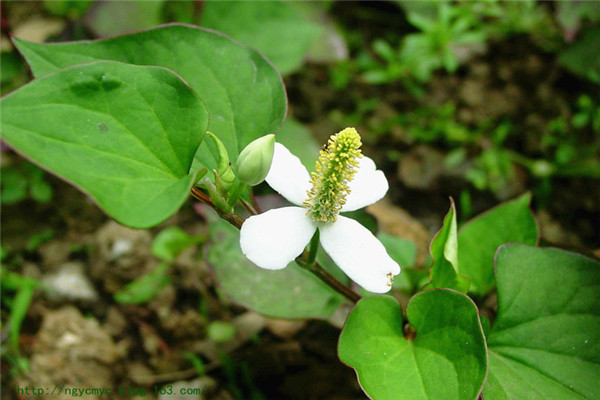
Cultivation methods for Houttuynia cordata
Planting
Choose fertile, loose sandy loam or organic-rich soil that drains and irrigates easily and faces the sun with wind protection for cultivation. After deep plowing and loosening the soil, make raised beds 1.5-1.6 m wide, 30 cm high, with a furrow bottom width of 20 cm. Apply 3000-4000 kg of farmyard manure per mu as base fertilizer, open shallow furrows or dig holes for planting at a plant and row spacing of 14x20 cm, water after planting, and keep the soil moist.
Management
If drought occurs during the seedling stage, water in the morning and evening. From seedling survival until the rows close, cultivate, weed and topdress 2-3 times, mainly with nitrogen fertilizers such as human excrement and urine or chemical fertilizers.
Each weeding should be combined with topdressing: apply 1000-1500 kg of human excrement and urine or 15-25 kg of urea per mu, applying it dilute first and then concentrated.
After each harvest, topdress mainly with nitrogen fertilizer to promote plant sprouting; the second time, apply mainly phosphorus and potassium fertilizer and earth up the soil to help the plants overwinter and lay a good foundation for sprouting the following year.
Harvest and processing
From March to May, cut the more tender Houttuynia cordata for eating. If it is grown mainly for medicinal use, it can be harvested only once in the planting year, in September-October. In the second year it can be harvested twice, the first time in June and the second time in September-October.
If it is processed to make beverages, according to the production process requirements, cut the whole plant at ground level with a sickle, wash it clean and dry it in the sun, and it can then be stored for later use.
Propagation methods for Houttuynia cordata
The seed germination rate of Houttuynia cordata is not high; germination is best at an alternating temperature of 17-25°C, with a germination rate of about 20%, so division, cuttings and rhizome propagation are often used. Also, Houttuynia cordata is rarely grown at home; most is propagated on a large scale.
Division propagation
From late March to April, dig out the mother plant and transplant the divisions into a sandy soil seedbed to raise seedlings, or transplant them directly.
Cutting propagation
In spring and summer, cut healthy, pest-free and disease-free branches as cuttings, cut them into 12-15 cm lengths with at least three nodes, and insert them into a sandy loam seedbed at a row spacing of 16x10 cm or 14x10 cm. Water after inserting, shade them, and move the seedlings out for planting once they have rooted.
Rhizome propagation
This can be done in February-March: dig out white, thick rhizomes, cut them into small sections with more than 2 axillary buds, and raise seedlings or plant them in shallow furrows in a seedbed or in the field.
Houttuynia cordata cultivation methods, precautions for cultivating Houttuynia cordata
Houttuynia cordata prefers a warm, humid climate. It grows well under shady and moist conditions and dislikes drought. When planting, fertile sandy loam and humus loam are best; it should not be planted in clay or alkaline soil.
Growth habits and environmental requirements of Houttuynia cordata:
1. Under natural conditions it often grows wild in shady mountain areas, along forest edges and roadsides, and in grass at the edges of ditches and low-lying land. It prefers a warm, humid climate, grows well under shady and moist conditions, dislikes drought, has a wide temperature tolerance, and its underground stems overwinter,
2. At -10~0°C it will not freeze to death; when the temperature is 12°C the underground stems grow and can emerge, the early growth stage requires 16~20°C, and the underground stem maturation stage requires 20~25°C. Houttuynia cordata likes moisture and tolerates waterlogging, requiring moist soil, with field soil water-holding capacity of 75% to 80%. The soil should be slightly acidic, pH 6~7. It is not strict about soil requirements; fertile sandy loam and humus loam are best, but it can also grow in clay soil. Fertilization is mainly with nitrogen fertilizer, with appropriate application of phosphorus and potassium fertilizer; under conditions of sufficient organic matter, the underground stems grow thick and strong.
Cultivation methods for Houttuynia cordata:
1. Site selection:Choose a plot with loose, fertile soil that drains and irrigates easily. If using paddy field, plow and sun the field in winter, apply 2000~4000 kg of decomposed organic fertilizer and 25 kg of compound fertilizer per 667 sq m, plow and break up the soil and level it, and make raised beds 1.3~1.5 m wide and 30 cm high, with length depending on the terrain, furrow spacing of 30~40 cm, and plant on the bed surface.
2. Planting:Houttuynia cordata can be propagated by seed, but root division propagation is more common. Planting can be done in spring or autumn, but spring is better. Planting can be done in holes or in rows: apply organic fertilizer into the holes or furrows, cover with 2~3 cm of fine soil, select pest-free and disease-free, thick underground stems and cut them into 4~6 cm short sections, each with 2~3 nodes, place them flat in the planting holes or furrows at a plant spacing of 5~8 cm, then cover with soil about 5~6 cm thick. If the soil is dry, spray water to settle the roots and keep the soil moist.
3. Fertilization:Houttuynia cordata fertilization is mainly nitrogen and potassium, with less phosphorus needed, but it must not be lacking. When the seedlings emerge to about 3 cm tall, the first topdressing can be done: use 1 part decomposed human excrement and urine mixed with 4~5 parts water, add urea at 2% of the manure liquid, and water it on. In the middle and later stages, production enters the vigorous growth period and fertilizer demand increases relatively; while ensuring nitrogen fertilizer, apply phosphorus and potassium fertilizer in combination, especially potassium fertilizer, which is particularly important for rhizome formation.
4. Field management:In Houttuynia cordata production, cultivation and weeding should be carried out together with fertilization, and field management should be strengthened in the middle and later stages. The soil should be kept moist throughout the growing period; water timely during drought, and drain excess water promptly in the rainy season. Weed and loosen the soil before the rows close; after the rows close, combine promotion and control. When the aboveground parts grow excessively, pick the tender stems and leaves in time; when the aboveground stems and leaves turn yellow and become small, topdress appropriately to promote bushy growth. If the plants are not being kept for seed, remove the flower buds that appear in time so that flowering does not consume a large amount of nutrients.
Pest and disease control for Houttuynia cordata:
1. Diseases:The stems and leaves of Houttuynia cordata all have a fishy smell, so there are rarely insect pests, but diseases include southern blight and leaf spot.
2. Control methods:1) Choose reasonable crop rotation, preferably paddy-upland rotation; 2) Choose soil that drains and irrigates easily and is loose and fertile; 3) Strictly select seed material and remove diseased seed stems; 4) Strengthen field management, pay attention to drainage during prolonged rainy periods, and pay attention to irrigation during drought; 5) In the early stage of disease, choose mancozeb, chlorothalonil, thiophanate-methyl, etc. for spraying or root drenching.
Harvesting Houttuynia cordata:
Houttuynia cordata can be dug for eating all year round; in spring and summer pick the tender stems and leaves, and in autumn and winter dig the underground stems. Artificially cultivated Houttuynia cordata can be harvested 2~3 times for tender stems and leaves. One week after each harvest, it can be watered with diluted human excrement and urine or biogas slurry plus an appropriate amount of nitrogen-phosphorus-potassium compound fertilizer. When harvesting the underground stems, leave a portion or the cut ends; when the temperature rises the following year, they will sprout and emerge, and timely management such as weeding, loosening the soil, thinning seedlings and topdressing can be carried out, so continuous production is possible for many years.