Water Lily Cultivation and Management Methods and Technical Key Points
Beautiful water lilies can be grown not only in ponds but also in pots.
For pond cultivation, drain the pond water in early spring, apply base fertilizer, then add fresh pond mud and refill with water. The water should be added in several rounds until fully filled. As new leaves grow, gradually add more water; during the flowering season, the water depth can be maintained at 70-80 cm. In winter, more water should be added, keeping the water depth above 110 cm so the rhizomes can overwinter safely.
For potted plants, choose a pot with an inner diameter and depth of at least 40 cm × 60 cm. Around the Spring Equinox each year, repot and change the mud while dividing the rhizomes, and add decomposed soybean cake residue or bone meal, hoof pieces and other fertilizers rich in phosphorus and potassium at the bottom of the pot as base fertilizer. Under the rhizome, place at least 30 cm of fertile river mud, and cover with soil until the top buds are just submerged, then place it in a pond or vat, keeping the water depth at 40-50 cm. During hot seasons, the water layer must be kept clean; if it stays too long, change the water to prevent aquatic algae from growing and affecting the display. After flowering, remove spent flowers promptly and apply additional fertilizer as appropriate.
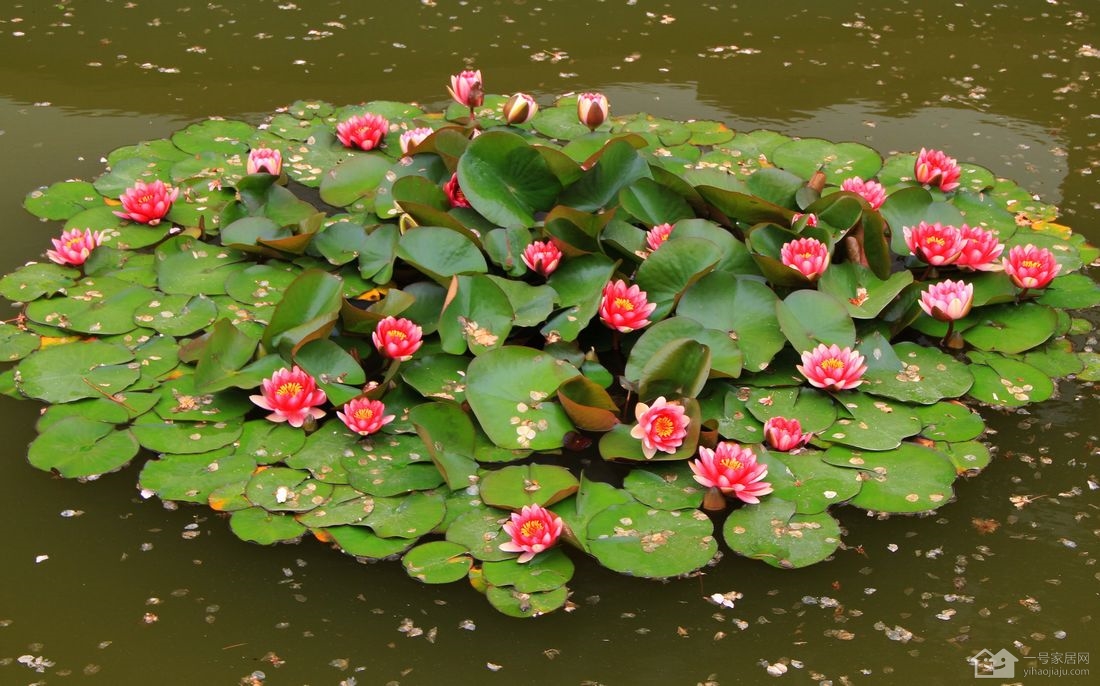
Water lily, also known as Ziwulian or water celery flower, is a plant of the family Nymphaeaceae in the order Ranunculales. It is a perennial aquatic herb; the rhizome is thick and fleshy. The leaves are of two types: floating leaves are round or ovate, with a curved notch at the base, heart-shaped or arrow-shaped, and usually there are no emergent leaves; submerged leaves are membranous and fragile. The flowers are large and beautiful, floating on or rising above the water surface; sepals are nearly free; petals are white, blue, yellow, or pink, in multiple whorls, sometimes the inner whorls gradually becoming stamens; the connective may or may not have appendages; carpels are ring-shaped, adnate and half-sunken in the fleshy cup-shaped receptacle, partly fused with it below, and extending above into a style, with the stigma forming a concave stigma disc, and ovules anatropous, pendulous on the inner wall of the ovary.
The berry is spongy, irregularly dehiscent, and matures underwater; the seeds are hard, wrapped in a gelatinous substance, with a fleshy cup-shaped aril, a small embryo, a little endosperm and abundant perisperm. It is distributed from Northeast China to Yunnan, and west to **; it also occurs in Korea, Japan, India, the Soviet Union, and North America. It grows in ponds and marshes. The rhizome can be eaten or used for brewing wine, and is also used in medicine to treat chronic infantile convulsions; the whole plant can be used as green manure.
Water lilies like sunlight and good ventilation, so tropical and hardy water lilies that bloom during the day close their flowers at night and open again in the morning. In ponds with shade from trees on the bank, they can still bloom but grow weakly. They are not strict about soil quality and can grow normally at pH 6-8; the optimal water depth is 25-30 cm, and the maximum should not exceed 80 cm. They prefer loam rich in organic matter. They sprout and grow leaves in March-April, bloom successively from May to August, and each flower lasts 2-5 days. After flowering, they set seed. In October-November the stems and leaves wither. They sprout again the following spring. In the Yangtze River basin, they sprout from late March to early April, form buds in late April or early May, reach full bloom from June to August, enter the yellow-leaf stage from October to November, and enter dormancy after November. They grow in ponds and lakes, and are often cultivated in some park pools.
Cultivation and Management of Water Lilies
Water lilies can be potted or pond-grown. For pond cultivation, drain the pond water in early spring, apply base fertilizer, then add fresh pond mud and refill with water. The water should be added in several rounds until fully filled. As new leaves grow, gradually add more water; during the flowering season, the water depth can be maintained at 70-80 cm. In winter, more water should be added, keeping the water depth above 110 cm so the rhizomes can overwinter safely. For potted plants, choose a pot with an inner diameter and depth of at least 40 cm × 60 cm. Around the Spring Equinox each year, repot and change the mud while dividing the rhizomes, and add decomposed soybean cake residue or bone meal, hoof pieces and other fertilizers rich in phosphorus and potassium at the bottom of the pot as base fertilizer. Under the rhizome, place at least 30 cm of fertile river mud, and cover with soil until the top buds are just submerged, then place it in a pond or vat, keeping the water depth at 40-50 cm. During hot seasons, the water layer must be kept clean; if it stays too long, change the water to prevent aquatic algae from growing and affecting the display. After flowering, remove spent flowers promptly and apply additional fertilizer as appropriate. Potted plants kept indoors should be moved into a cold room or to the bottom of deep water for overwintering in winter. During the growing period, provide sufficient light and do not keep them in shade for long periods.
Now let's start planting water lilies:
1. Flower pot: Try to choose one with an outward-flaring opening. Leaves grow better with an outward-flaring opening than with an inward one. The wider the pot opening, the larger the flowers will be (the size of the pot bottom matters little). The depth of the pot affects the flowering interval; the deeper it is, the longer the interval.
2. Soil: Try to choose soil with relatively high clay content, such as clay or Yangmingshan soil.
3. Next, put a small amount of slow-release fertilizer or root fertilizer at the bottom of the pot (too much will rot the roots). Put about 1/4-1/3 soil in the pot, press it firm, then bury the corm with the bud point facing up in the soil. If the corm is buried deep, the flowering interval will be longer but the flowers larger; if buried shallow, the interval will be shorter and the flowers smaller. After planting, move it to a place with sufficient light, fill with water, and wait for leaves and flowers to grow (if there are too many leaves, some can be pruned).
4. If you want to plant more than two corms together, unlike planting other flowers, the two corms should be planted closely adjacent to each other. If planted separately, when the leaves of the stronger one shade the bud point of the weaker one, the weaker one cannot get light and will die. In addition, when planting them together, it is best to use the same species or same color group, because dark colors (such as purple, blue) are more vigorous than light colors (white, yellow). Remember this!
5. After flowering, the flowers can be cut for arrangement (except Ziwulian). The lifespan of a flower is about 3-6 days. On the first day the flower is relatively straight, then it gradually bends more and more until it bends into the water. If flowers are cut for arrangement, the flowering interval will be shortened; if they are allowed to fade on the plant, the interval will be longer.
6. Fertilizing: About every one and a half to two and a half months, apply slow-release fertilizer or root fertilizer about 3-5 cm away from the corm, but do not apply any more after the end of September, because autumn is gradually approaching and water lilies will enter dormancy; fertilizing at that time may instead cause root rot.
7. After entering autumn and winter, water lilies will also enter dormancy as the temperature drops. At this time, it is best not to disturb them again; only top up the water when it is low. For fragrant water lilies, varieties with spotted leaves have a longer dormancy period than those without spots, and light-colored varieties have a longer dormancy period than dark-colored ones.
8. Transplanting and bud division: This can be done every year after Qingming and before Mid-Autumn Festival. When dividing buds, be careful not to damage the bud points; the size of the corm is not very important. In one pot, it is recommended not to have too many bud centers crowded together, or the leaves will become smaller and the plant will not bloom. Therefore, division should generally be done once or twice every two years on average.
9. Some varieties carry out another kind of asexual reproduction at the center of the leaf. If you find a bud center growing at the center of a leaf, leave it alone at first and let it grow. When that leaf begins to turn yellow, cut off the leaf stalk together with the bud center, place it in a water basin or flower pot, and similarly place it in a place with sufficient light. After about two weeks, when the bud point has grown larger and roots have formed, it can be planted like a normal plant and will also bloom that same year.
If you want to learn more related information, you can continue to follow No.1 Home Network.