How to grow Dianthus chinensis (fringed pink)? Detailed guide to cultivation methods and precautions
Cultivation techniques
Propagate by layering or cuttings using vegetative shoots, or by division in spring.
Cultivation management
1. Transplanting: 3 to 4 weeks after sprouting, the seedlings can be transplanted into flower pots with a diameter of 9 to 11 cm.
2. Substrate: The growing substrate must be well-drained, with a clay content of 15%. About 15% woody fiber and bark can be added, and 1 to 1.5 kg of complete balanced fertilizer should be applied per cubic meter of substrate. The substrate should contain iron chelates and trace nutrients, with a pH of 5.5 to 5.8.
3. Light: Dianthus chinensis is a day-neutral plant. Supplementary lighting is needed in winter and spring, combined with cultivation at temperatures of 15°C to 18°C.
4. Temperature: The optimal growing temperature is 10°C to 12°C. Under frost-free winter conditions, the temperature can be maintained between 3°C and 5°C. The plants require 8 to 10 weeks of vernalization. In spring, the plants begin to grow at temperatures of 15°C to 18°C for 7 to 8 weeks. Under cool temperatures of 8°C to 10°C and natural growing conditions, the cultivation time of the plants will be extended. The temperature must be above 15°C for the plants to flower.
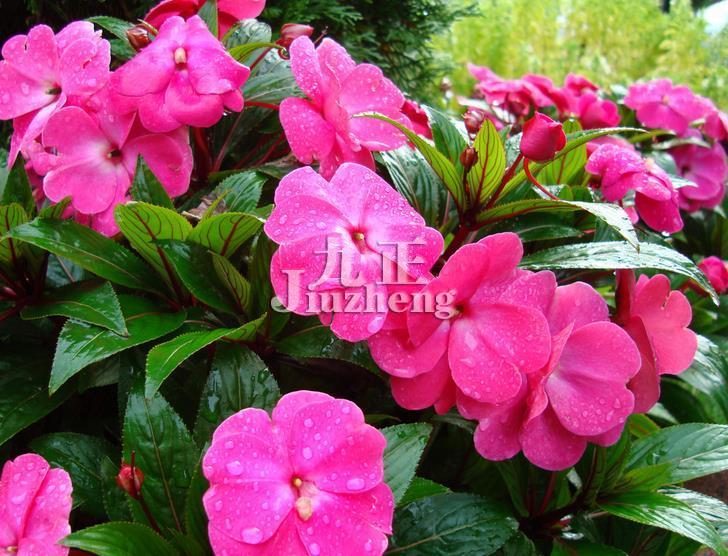
1. It changes its face and has many names, making it hard to pin down. Impatiens balsamina, also known as Tougucao, Jinfenghua, Sajinhua, Jijicao, Zhijiahua, Jixingzi, Hainahua, Jiazhenghua, Xiaotaohong, Xiaodianhong, Zhijiacao and Jizhuazihua.
2. Despite its many identities, it has only one appearance. The Impatiens balsamina plant consists of six parts: roots, stems, leaves, flowers, fruits and seeds. It has soft hairs or is nearly smooth. The leaves are alternate, broadly or narrowly lanceolate, up to about 10 cm long, with acuminate tips, sharply toothed margins and wedge-shaped bases; there are several pairs of glands near the petiole. Its flowers resemble butterflies, with colors including pink, bright red, purple, white-yellow, and sprinkled gold, and they vary easily. Some varieties can produce flowers of several colors on the same plant. Impatiens balsamina is mostly single-petaled; the double-petaled form is called Fengqiuhua. According to ancient flower records, there were over 200 varieties of Impatiens balsamina, and many varieties have now been lost. Because Impatiens balsamina varies easily, some good varieties have been produced through artificial cultivation and selection, such as Wuse Dangtoufeng, whose flowers grow at the top of the stem and are large and brightly colored, as well as Shiyangjin and others. According to different flower shapes, they can also be divided into rose type, camellia type, dianthus type, etc. The flowering period of Impatiens balsamina is from June to August. It produces capsules that are spindle-shaped with white down; when mature, they burst open into 5 spirally curled valves; the seeds are numerous, spherical, black, and peach-shaped. When mature, the outer shell bursts open on its own, ejecting the seeds for self-sowing propagation, so seeds must be collected in time.
3. There are many beautiful stories behind it. Through the ages, many poets have written beautiful lines about Impatiens balsamina. For example, Yang Weizhen of the Yuan Dynasty wrote in "Impatiens balsamina": "On a golden plate with dew, the immortal flower is pounded, loosening the slender jade to leisure. A trace of sorrow resembles a parrot's beak, ten parts of spring rise on the peony bud. Delicately flicking pink tears, tossing red beans, playfully pinching flower branches, threading crimson clouds. When female companions meet, they frequently ask, several times mistaking it for the palace chastity mark." It is clear how wonderfully it is written, with the charm of a young girl, the thoughts of a parrot, and the sorrow of a beauty. In Dream of the Red Chamber, there is a saying: "Before seeing the person, you hear the voice - this is Xue Baochai." I should say, before seeing its appearance, you know its look - this is Impatiens balsamina. It can be seen that what is described here is clear at a glance, and yet so beautiful.
The effect of Impatiens balsamina on the home environment
What differences are there before and after placing Impatiens balsamina?
1. Impatiens balsamina plays an indispensable role in greening the home. Through photosynthesis, Impatiens balsamina can absorb carbon dioxide and release oxygen, while people inhale oxygen and exhale carbon dioxide during breathing, thus balancing oxygen and carbon dioxide in the indoor air. At the same time, through the leaves' heat absorption and water evaporation, Impatiens balsamina can lower air temperature, relatively regulate temperature in winter and summer, provide shade and heat insulation in summer, and in winter, experiments have shown that a balcony-connected greenhouse with plants, compared with one without plants, can not only create an oxygen-rich space convenient for the beneficial cycle of oxygen and carbon dioxide between people and Impatiens balsamina, but also has a better greenhouse effect.
2. Impatiens balsamina also has a great function in beautifying the home. Impatiens balsamina can keep indoor air humidity at an excellent level, and its bright colors add a lot of spring atmosphere to the home. At the same time, the beautiful Impatiens balsamina has great ornamental value. In a small house, it makes the space seem endlessly spring-like, as if living in an ocean of fresh flowers; in a large house, it can be arranged to present a noble home style.
3. Growing Impatiens balsamina adds a touch of poetry to the home. "Don't touch me" is the flower language of Impatiens balsamina, because its seed pods eject many seeds at the slightest touch. Its noble character gives the whole home a distinctive style. In addition, henna is a natural plant that grows in tropical regions, an annual upright fleshy herb, also known as Zhijiacao and Xiaotaohong. Because its flower head, wings and tail all curl upward like a phoenix, its scientific name is also called Impatiens balsamina. Because henna contains unique natural plant pigments, henna is very widespread in **Uyghur life. Henna has been cultivated for thousands of years. Girls use henna juice to dye their nails and hair, and also apply it to the palms, backs of hands, arms and legs for skin care. This tradition has continued to the present day. A natural doctor that can stay at home at all times has become the guardian of beauties, making people live with peace of mind.
The feng shui role of Impatiens balsamina
1. Impatiens balsamina helps improve the residential feng shui of people whose Five Elements belong to fire. Gardening feng shui is only a tiny part of feng shui as a whole, but it uses simple plants to achieve the effect of changing feng shui, and it can also beautify the home environment. So-called gardening feng shui, simply put, is dividing plants into the five categories of metal, wood, water, fire and earth, and planting appropriate plants according to the home environment and personal feng shui conditions. Impatiens balsamina is suitable for people whose Five Elements belong to fire. If there is too much black in the home or the earth energy is too weak, this kind of potted plant can be used for adjustment, and Impatiens balsamina is very suitable.
2. Impatiens balsamina can embellish the atmosphere at home, add vitality, and powerfully improve feng shui. Seeing Impatiens balsamina reminds one of winter jasmine. The pink and red ones are full of festive atmosphere, and that touch of spring color instantly lifts the spirits. If Impatiens balsamina is placed in your home, it will probably have the same effect.
3. With Impatiens balsamina at home, people live healthily and with peace of mind. Legend has it that henna is a natural plant growing in tropical regions, an annual upright fleshy herb, also known as Zhijiacao and Xiaotaohong. Because its flower head, wings and tail all curl upward like a phoenix, its scientific name is also called Impatiens balsamina. Because henna contains unique natural plant pigments, henna is very widespread in **Uyghur life. Henna has been cultivated for thousands of years. Girls use henna juice to dye their nails and hair, and also apply it to the palms, backs of hands, arms and legs for skin care. This tradition has continued to the present day. For a person, if they become better looking, they will certainly be very happy, especially for women. If some of these Impatiens balsamina are grown at home, and used to care for one's skin when there is time, the skin will look a little younger every day. Would people not be happy? When people are happy, their health is naturally good, and they live happily. Living in such a residence, can you say its feng shui is bad?
The effects of Impatiens balsamina
1. Impatiens balsamina has very good medicinal effects.
It can resist fungi and treat onychomycosis. Impatiens balsamina has a strong fungal-inhibiting effect, and at the same time its colors are brilliant. Using it to dye nails can both treat onychomycosis and paronychia, and is a pure natural dyeing method with no harm to the nails. Its main pharmacological activities are anti-allergic, anti-inflammatory, anti-fungal, etc. Experiments show that the extract of Impatiens balsamina contains components that antagonize both histamine H1 receptors and PAF receptors, and has a good anti-acute and anti-chronic allergy effect; the extract also contains a certain amount of effective components with anti-inflammatory and antibacterial effects, among which the antibacterial effect is obvious. Moreover, using it to dye nails also has a long history in China. Pharmacological effects of Impatiens balsamina: Impatiens balsamina is widely used to treat bruises, relieve pain, dispel rheumatism, treat onychomycosis, etc.
Decoctions, tinctures and water infusions of Impatiens balsamina all have obvious excitatory effects on the isolated uterus of rabbits and guinea pigs, and have obvious excitatory effects on the uterus in situ of anesthetized rabbits.
The water decoction of Impatiens balsamina has varying degrees of inhibitory effects on Staphylococcus aureus, hemolytic streptococcus, Pseudomonas aeruginosa, Shigella flexneri, Shigella sonnei and Salmonella typhi.
2. The growth of Impatiens balsamina can provide a standard for judging whether the temperature and humidity environment at home is good.
Impatiens balsamina likes sunlight, fears dampness, tolerates heat but not cold, and is suitable for growing in loose, fertile, slightly acidic soil, but it also tolerates barren conditions. Impatiens balsamina has strong adaptability, transplants easily and grows quickly. If the indoor temperature and humidity are suitable for the growth of Impatiens balsamina, it proves that the temperature here is also suitable for people to live in, and that it is a good environment.
3. Regulate the feng shui of the residence. People whose Five Elements belong to fire should choose plants with red flowers or red fruits, all of which are "fire" element plants, and choose red flower vessels to meet the requirement. If there is too much black in the home or the earth energy is too weak, this kind of potted plant can be used for adjustment, and Impatiens balsamina is very suitable.
Impatiens balsamina indeed brings people unexpected rewards.
The role of Impatiens balsamina in matching home styles
1. Placing it in the living room is a pursuit of beauty. Impatiens balsamina can keep indoor air humidity at an excellent level, and its bright colors add a lot of spring atmosphere to the home. At the same time, the beautiful Impatiens balsamina has great ornamental value. In a small house, it makes the space seem endlessly spring-like, as if living in an ocean of fresh flowers; in a large house, it can be arranged to present a noble home style.
2. Placing Impatiens balsamina in the bedroom reflects a tasteful home style. In an era without nail polish, people often used Impatiens balsamina to dye their nails. This is described in ancient poems. The Yuan Dynasty poet Yang Weizhen's poem on Impatiens balsamina says: "On a golden plate with dew, the immortal flower is pounded, loosening the slender jade to leisure. A trace of sorrow resembles a parrot's peck, ten parts of spring rise on the peony bud. Delicately flicking pink tears, tossing red beans, playfully pinching flower branches, threading crimson clouds. When female companions meet, they frequently ask, several times mistaking it for the palace chastity mark." It can be seen that in the past, Impatiens balsamina was the embodiment of beauty.
3. Placing Impatiens balsamina beside the TV and in the kitchen reflects a healthy home style. Placed in these places, besides being ornamental, the whole plant, flowers and seeds of Impatiens balsamina can be used as medicine, with effects such as promoting blood circulation, stimulating menstruation, dispelling wind, reducing swelling, relieving pain and detoxifying; especially the petals can treat rheumatic joint pain, onychomycosis, amenorrhea and abdominal pain, bruises and injuries, etc. It is unintentionally a small family doctor. When the owner unfortunately suffers a minor illness, it can provide timely and surface-level treatment, and it is present at all times and everywhere.
If your home currently has no fresh flowers as decoration, try placing an Impatiens balsamina. You will gradually discover its help in separating home spaces. If your home already has other fresh flowers, consider changing them and planting Impatiens balsamina instead. Your home will surely gain a lot of new atmosphere.
Care methods for Impatiens balsamina
1. Cultivation is the foundation of care, and care is the follow-up work of cultivation. Therefore, to care well for Impatiens balsamina, we must first cultivate it well. Let us start from its living habits.
Impatiens balsamina likes sunny terrain and loose, fertile soil, and can also grow in relatively barren soil. Pinch the tips when it grows from the initial 8 cm to 20-30 cm. After planting, the main stem of the plant should be topped to enhance its branching ability and make the plant shape full. After 5 leaves, apply decomposed dilute human waste, etc. once every half month, and apply phosphate fertilizer and plant ash once before and after budding. After flowering, cut off the flower base so that it does not set seeds, and the flowers will bloom more abundantly; remove flowers at the base at any time, which will encourage the tops of each branch to bloom successively, but it is prone to variation.
Therefore, when caring for it in the future, we must remember these basic requirements, so as to benefit its growth.
2. The care of Impatiens balsamina needs attention in the following aspects.
1. Reasonable light and temperature. Impatiens balsamina likes light and also tolerates shade. It should receive at least 4 hours of scattered sunlight every day. In summer, shade it to prevent excessively high temperatures and scorching sun exposure. The suitable growing temperature is 16-26°C, and the environmental temperature during the flowering period should be controlled above 10°C. In winter, it should be moved into a greenhouse to prevent freezing.
2. Pay attention to details in watering and fertilizing. After planting, water promptly. During the growing period, pay attention to watering and keep the pot soil moist often, especially in summer when more watering is needed, but waterlogging and long-term excessive soil moisture must be avoided. If there is a lot of rain, pay attention to drainage and flood prevention, otherwise the roots and stems rot easily. After planting, fertilize frequently, and especially avoid alternating dryness and moisture. In summer, never water wilted plants under the scorching sun. Especially during the flowering period, they must not suffer drought, otherwise the flowers fall easily.
3. Control the flowering period well. If you want to delay the flowering period, you can sow in early July. You can also use the method of pinching, while removing early-opening flowers and buds, so that the plant continues to expand, and topdress once every 15-20 days. After September, more flower buds will form, so that they bloom on National Day.
3. The pests and diseases encountered by Impatiens balsamina are somewhat different from those of other plants, and this must be handled differently.
1. Powdery mildew of Impatiens balsamina.
Symptoms: This disease mainly occurs on leaves and tender shoots. It generally begins in June, and after July the leaf surface is covered with a white powdery layer. Subsequently, small yellow granules form in the white powdery layer, and the color gradually deepens, finally becoming dark brown.
Transmission route: The pathogen overwinters in diseased plant residues and seeds. The following year, when the environment is suitable, the pathogen spreads by wind and rain. August to September is the peak period of the disease.
Control methods: First, do not plant too densely, provide appropriate ventilation, strengthen fertilizer and water management, and enhance the disease resistance of the plants. Remove diseased leaves and diseased plants, destroy them in a centralized manner, and reduce sources of infection. Then, during the disease period, use 15% triadimefon wettable powder at 1000-1200 times dilution, or 70% thiophanate-methyl wettable powder at 1000 times dilution for control. Avoid spraying at high temperatures above 32°C to prevent phytotoxicity.
The influence of the climate of the place of origin on flower cultivation
The various beautiful herbaceous flowers cultivated by people today can be said to come from all over the world. The herbaceous flowers grown in various places are all derived from wild species in nature through artificial introduction and domestication. Although artificially cultivated, their habits still remain consistent with natural wild conditions. The climates of different places in the world may be similar in a certain season, but some different regions have extremely disparate differences. The climate of each place inevitably has a very close influence on the ecological habits of plants native to that place. Therefore, understanding the climatic conditions of the places of origin of various flowers and creating corresponding cultivation environments and reasonable technical management measures to meet the requirements of growth and development will make the cultivated herbaceous flowers flourish with abundant leaves and grow normally. These herbaceous flowers mainly belong to 5 climate types.
Below, the editor will describe the characteristics of each climate type and the main flowers.
(1) China climate type
Also called the continental east coast climate type, with cold winters and hot summers, and a relatively large temperature difference. In summer, the prevailing wind blows from the ocean to the continent, hot and rainy; in winter, the prevailing wind blows from the inland to the ocean, cold and dry. The main herbaceous flowers include Dianthus chinensis, gaillardia, purslane, Phlox drummondii, verbena, petunia, salvia, milkweed, snow-on-the-mountain, strawflower, China aster, Nicotiana, etc.
(2) Europe climate type
Also called the continental west coast climate type. Its climate characteristics are warm winters and cool summers, a relatively small temperature difference, and relatively little rainfall. Winter is not too cold, and summer temperatures are not high either, generally not exceeding 15-17°C. Such herbaceous flowers mainly include pansy, cornflower, daisy, baby's breath, ornamental kale, forget-me-not, stock, foxglove, etc.
(3) Mediterranean climate type
There is more rainfall from autumn to the following spring, while summer is dry with very little rainfall. The minimum winter temperature is 6-7°C, and the summer temperature is 20-25°C. This type includes open-field annual autumn-sown herbaceous flowers that are not cold-resistant in winter and must be properly protected against cold to overwinter safely. Such herbaceous flowers include Dianthus, calceolaria, schizanthus, monkey flower, California poppy, Clarkia, godetia, etc.
(4) Mexico climate type
Located in tropical mountain plateaus, with winters that are not cold and summers that are not hot. The year-round temperature is 14-37°C, and rainfall varies greatly depending on the region. Such herbaceous flowers are not cold-resistant in winter and fear summer heat; they prefer coolness. Examples include zinnia, cosmos, marigold, ageratum, nasturtium, primrose, etc.
(5) Tropical climate type
High temperatures year-round, small temperature difference, large rainfall, with a clear distinction between rainy and dry seasons. Annual herbaceous flowers native to this region can be cultivated in the open field, such as four o'clock flower, periwinkle, morning glory, cockscomb, Impatiens balsamina, pothos, ornamental pepper, salvia, etc.