How to grow Catharanthus roseus (Madagascar periwinkle)? Detailed guide to cultivation methods
Catharanthus roseus originates from the tropical regions of Asia and likes warmth; it is not tolerant of severe cold, dislikes wetness and fears waterlogging. It can be grown in general soil, but saline-alkaline soil is unsuitable; sandy soil that drains well and is airy is best.
When growing Catharanthus roseus in pots, use loose soil rich in humus, and pot up the seedlings when they have grown 6-7 true leaves. When the seedlings are 7-8 cm tall, pinch out the growing tips once, and this can be done twice more later to encourage more branching and more flowers. Normally, Catharanthus roseus should not be watered too much; too much moisture affects growth and development. During the growing period, apply some nitrogen fertilizer, and during the bud stage, increase the application of some phosphorus fertilizer. After flowering, the spent flowers must be cut off.
Catharanthus roseus dislikes wetness and fears waterlogging, so the potting soil should not be watered too much; excessive moisture affects growth and development. Especially for plants overwintering indoors, watering should be strictly controlled and it is better to keep them on the dry side, otherwise they are very prone to cold damage. For open-ground cultivation, during midsummer rain showers, take care to drain promptly to avoid waterlogging that causes the whole patch to die.
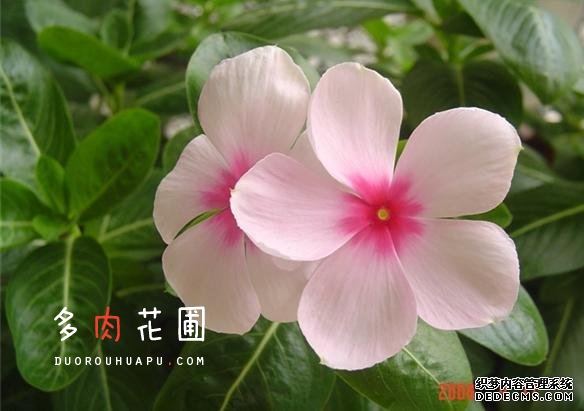
Biological characteristics of Catharanthus roseus
Catharanthus roseus originates from eastern Africa. It likes a warm, slightly dry and sunny environment. The suitable growth temperature is 18-24°C from March to July, and 13-18°C from September to March of the following year; in winter the temperature should not be lower than 10°C.
Catharanthus roseus dislikes wetness and fears waterlogging, so the potting soil should not be watered too much; excessive moisture affects growth and development. Especially for plants overwintering indoors, watering should be strictly controlled and it is better to keep them on the dry side, otherwise they are very prone to cold damage. For open-ground cultivation, during midsummer rain showers, take care to drain promptly to avoid waterlogging that causes the whole patch to die.
Propagation of Catharanthus roseus:
Catharanthus roseus is mostly propagated by sowing. Sow in early spring; the seedlings grow slowly at first. When the young seedlings grow 3-4 true leaves, begin thinning and transplanting, and when they have 6-8 pairs of true leaves they can be planted in place. If planted in flower beds in May, water once every 3-5 days and appropriately apply additional phosphorus and potassium fertilizer, and then there will be many flowers and lush leaves. Cutting propagation: in spring, take tender branches from old overwintered plants, cut them 8 cm long with some leaves attached, and insert them into moist sandy loam; the rooting temperature is 20°C-25°C, and take care to shade them and maintain humidity. When the seedlings are 10 cm tall, pinch off the tops to encourage bushing out, then pot them in 3-inch pots and gradually move them up to 7-inch pots. Also, the ripe fruits of Catharanthus roseus can split open by themselves and scatter the seeds, so watch carefully: when the fruits turn yellow, pick them promptly, otherwise it is difficult to collect the seeds. It can be planted three crops a year, with an annual yield of more than 1300 kg of dried herb per mu.
During the growing season, apply topdressing about once every 30 days, and water as needed at all times, but do not let water accumulate; pay attention to drainage during the rainy season. To encourage branching, pinch out the growing tips 2-3 times from planting until mid-August, and then the plants will have abundant flowers and lush leaves. The overwintering temperature is 10-12°C. For sowing Catharanthus roseus, begin sowing when the temperature rises to about 10C; when the seedlings grow 4-5 pairs of true leaves, transplant once. Tender branches from old overwintered plants can also be taken in spring for cuttings. It is easy to manage.
Cultivation methods and precautions for Madagascar periwinkle, suitable for pot cultivation
Madagascar periwinkle, also known as riri chun, riri xin, riri flower, Catharanthus roseus, sishi chun, five-petal plum, yanlaihong, tiantiankai, and so on. Below, the editor has compiled the cultivation methods and precautions for Madagascar periwinkle; let's learn about them together.
I. Cultivation methods for Madagascar periwinkle
1. Cultivation method for Madagascar periwinkle: fertilizing
During the growing season, apply topdressing about once every 30 days, and water as needed at all times, but do not let water accumulate; pay attention to drainage during the rainy season. To encourage branching, pinch out the growing tips 2-3 times from planting until mid-August, and then the plants will have abundant flowers and lush leaves. The overwintering temperature is 10-12°C. For sowing Catharanthus roseus, begin sowing when the temperature rises to about 10C; when the seedlings grow 4-5 pairs of true leaves, transplant once. Tender branches from old overwintered plants can also be taken in spring for cuttings. It is easy to manage.
When fertilizing, every ten days you can adopt a method of applying compound fertilizer and liquid fertilizer alternately. The bottom of the pot for Catharanthus roseus should also have a layer of base fertilizer spread as much as possible to ensure the nutrient content of the potting soil.
2. Cultivation method for Madagascar periwinkle: watering
Catharanthus roseus dislikes wetness and fears waterlogging, so the potting soil should not be watered too much; excessive moisture affects growth and development. Especially for plants overwintering indoors, watering should be strictly controlled and it is better to keep them on the dry side, otherwise they are very prone to cold damage. For open-ground cultivation, during midsummer rain showers, take care to drain promptly to avoid waterlogging that causes the whole patch to die.
3. Cultivation method for Madagascar periwinkle: temperature
Madagascar periwinkle likes a warm, slightly dry and sunny environment. The suitable growth temperature is 18-24°C from March to July, and 13-18°C from September to March of the following year; in winter the temperature should not be lower than 10°C.
4. Propagation method for Madagascar periwinkle:
It is mostly propagated by sowing. Sow in early spring; the seedlings grow slowly at first. When the young seedlings grow 3-4 true leaves, begin thinning and transplanting, and when they have 6-8 pairs of true leaves they can be planted in place. If planted in flower beds in May, water once every 3-5 days and appropriately apply additional phosphorus and potassium fertilizer, and then there will be many flowers and lush leaves.
Cutting propagation: in spring, take tender branches from old overwintered plants, cut them 8 cm long with some leaves attached, and insert them into moist sandy loam; the rooting temperature is 20°C-25°C, and take care to shade them and maintain humidity. When the seedlings are 10 cm tall, pinch off the tops to encourage bushing out, then pot them in 3-inch pots and gradually move them up to 7-inch pots. The ripe fruits can split open by themselves and scatter the seeds, so watch carefully: when the fruits turn yellow, pick them promptly, otherwise it is difficult to collect the seeds. It can be planted three crops a year, with an annual yield of more than 1300 kg of dried herb per mu.
5. Cultivation method for Madagascar periwinkle: disease control
Common diseases and pests: leaf rot, rust, and root-knot nematode damage often occur.
Control methods: for leaf rot, spray with 500 times dilution of 65% zineb wettable powder. For rust, spray with 2000 times dilution of 50% carboxin wettable powder. For root-knot nematode, spray with 50 times dilution of 80% dibromochloropropane emulsifiable concentrate to control it. Or use microbial bacterial fertilizer more often for control.
II. Precautions for growing Madagascar periwinkle
1. It is relatively suitable for pot cultivation, but be careful not to let the plant grow too tall, which would affect indoor decoration and ornamental value. Therefore, after the plant survives potting, pinch out the growing tips several times to encourage more branching and more flowering; after flowering, the spent flowers must be cut off.
2. It prefers fertile and well-drained soil and tolerates poor soil, but must not be on the alkaline side. In compacted, poorly aerated clay soil, the plant grows poorly, the leaves turn yellow, and it does not flower.
3. For sowing, it is best to use a relatively loose artificial medium; you can sow in beds or boxes for seedling raising, and if conditions permit, plug trays can be used for seedling raising. The medium requires a pH value of 5.8~6.2 and an EC value of 0.5~0.75, and should be disinfected. After sowing, keep the medium temperature at about 22~25°C.