What are the cultivation methods for camellias? Explained in one article
Camellia is a relatively common flower in daily life. The cultivation methods of camellia are divided into ground planting and pot planting. Among the cultivation methods of camellia, pot planting is further divided into garden cultivation and nursery cultivation.
Ground planting among the cultivation methods of camellia
It is further divided into garden cultivation and nursery cultivation. If used for landscaping, there must be shade trees as companions; for nursery cultivation, shade trees should be planted in rows. In warm areas, autumn planting is generally better than spring planting. Fertilization must grasp three key periods, namely: apply topdressing between February and March to promote the growth of spring shoots and flower buds; apply topdressing in June to promote secondary branch growth and improve drought resistance; apply base fertilizer from October to November to improve the plant's cold resistance and lay a good foundation for new shoot growth the following spring. Cleaning the garden is one of the effective measures to prevent and control pests and diseases and strengthen the tree vigor. Winter plowing can eliminate overwintering pests. Throughout the year, 5 to 6 times of intertillage and weeding are needed, but intertillage should be stopped during the high-temperature summer season to reduce soil moisture evaporation. The main pests of camellia include: tea tussock moth, tea leaf roller, tea black citrus aphid, etc. The main diseases include: tea gray blight, camellia algal leaf spot, and camellia anthracnose, etc. The control methods are: remove dead branches and fallen leaves to eliminate sources of infection. Strengthen cultivation management to enhance the plant's disease resistance, and use chemical control.
Pot planting among the cultivation methods of camellia
The ratio of pot size to seedling should be appropriate. The potting soil used should preferably be garden soil mixed with 1/2 to 1/3 of cut pine needles that have been composted for 1 year. Pot them in November or February to March of the following year; never pot them during the high-temperature season. After potting, water thoroughly, and water appropriately at ordinary times. The amount of watering should change with the seasons. Around Qingming, the plant enters the growth and sprouting period, so the amount of water should gradually increase. After the new shoots stop growing (around late May), watering should be properly controlled to promote flower bud differentiation. June is the plum rain season, so waterlogging should be prevented. In the high-temperature summer season, leaf surface evaporation is high, so leaf spraying is needed; spraying should preferably be done in the early morning or evening, and never at noon. In winter, the plant gradually enters dormancy, so the frequency of watering should be reduced accordingly. Never water with cold water under high temperature and strong sun, so as to avoid root discomfort and physiological leaf drop. On hot or windy days, leaf surface evaporation is high, so more watering or spraying is needed. When air humidity is high, reduce the amount of watering. If drought dehydration occurs and branches and leaves wilt, immediately place the plant in a shaded place, water thoroughly, and spray the leaf surface at the same time. Generally, large-leaf, large-flowered camellia varieties and fast-growing varieties have high water demand and should be watered more. Precious varieties such as: Shixiangjing, Yuanfengguan, Jiujinbaozhu, Fengxian, Luzhuqiu, etc. have low water evaporation, and excessive watering can cause leaf drop and bud drop. In the high-temperature summer and autumn seasons, shade and cooling should be carried out in time. In winter, anti-freezing measures should be taken. Potted plants overwintering indoors should preferably maintain 3 to 4 degrees Celsius; if the temperature exceeds 16 degrees Celsius, it will promote early sprouting. For potted camellia, fertilization, pruning, and pest and disease control are basically the same as for open-field cultivation.
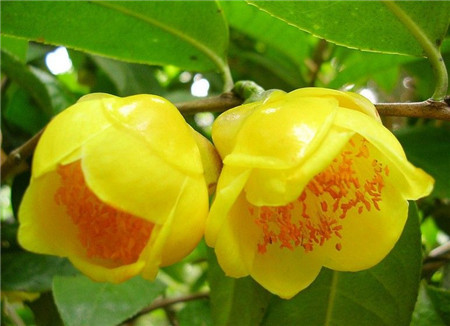
Key points for cultivating camellias in winter
Because of its graceful plant form, dense and glossy dark green leaves, and brilliant and colorful flowers, camellia is treasured by the world horticultural community. However, winter is not an easy season for camellia to get through, and because camellia is relatively precious, winter care must not be taken lightly.
Camellia (detailed introduction)
I. Light:In winter, camellia should be placed indoors in a sunny place. If the light is too weak, camellia will grow poorly and is prone to pests and diseases.
II. Temperature:Camellia likes warmth and fears cold. The indoor temperature must not be lower than 5°C, and the best temperature is 10°C to 15°C.
III. Humidity:Generally, indoor air is relatively dry in winter, so water should often be sprayed on camellia leaves to form a humid microclimate, but do not spray water when there are many cloudy and rainy days.
IV. Watering:In winter, watering camellia depends on the situation. Generally, water once every three days and keep the potting soil moist; avoid waterlogging or half-watering. Tap water should be left to stand for one or two days until the chlorine in the water evaporates before use. One percent ferrous sulfate can be dissolved in the water to improve water quality.
V. Fertilization:Camellia likes fertilizer. In autumn and winter, flower buds develop quickly, so apply a small amount of flower-type fertilizer once a week; too much nitrogen fertilizer tends to scorch the flower buds, and after flowering, fertilizer should be applied sparingly or not at all.
Cultivation techniques for camellia
Overview
Camellia, also known as tea flower, is a plant of the genus Camellia in the family Theaceae. Camellia has abundant floral beauty and is dignified and elegant, and is one of China's traditional top ten famous flowers. It is also one of the world's famous flowers.
Camellia originated in China. In the early 7th century AD, Japan introduced camellia from China, and by the early 15th century it introduced large numbers of Chinese camellia varieties. In 1739, the United Kingdom introduced Chinese camellia for the first time, and afterward camellia was introduced to European and American countries. To date, countries such as the United States, the United Kingdom, Japan, Australia, and Italy have developed rapidly in camellia breeding, propagation, and production, and have entered the stage of industrial production, with interspecific hybrids and new varieties constantly coming onto the market.
China has a long history of cultivating camellia. Camellia cultivation has existed since the Southern Dynasties. In the Tang Dynasty, camellia was cultivated as a precious ornamental plant. By the Song Dynasty, camellia cultivation was already very popular. In the Southern Song Dynasty, camellias from Wenzhou were introduced to Hangzhou and developed rapidly. In the Ming Dynasty, the "Flower History" described and classified camellia varieties. By the Qing Dynasty, camellia cultivation was even more flourishing, and camellia varieties continuously appeared. Since 1949, China's camellia cultivation level has improved to a certain extent, and variety selection and breeding have also developed. At present, China has more than 300 camellia varieties. Batch production has begun in Zhejiang, Fujian, Jiangsu, and other places. At present, it has become a major potted ornamental flowering plant on the flower market in winter.
Morphological characteristics and varieties
Camellia is an evergreen broad-leaved shrub. Leaves are alternate, leathery, elliptical, with serrated edges, dark green. Flowers are solitary or 2-3 borne at the top of branch tips or in leaf axils. Flowers are single or semi-double. Double. Common varieties include single-petaled types such as Chenxi, with wrinkled petal edges and pure white flowers; Saijinguang, with white flowers marked with peach-red lines and sprinkled with fine dots; Dahuajinxin, with large red flowers and a flower diameter of 6-7 cm; semi-double types include Sailuoyang, with red flowers and white spots; Dasongzi, with dark red flowers; Zuiyangfei, with pink flowers; Xingtaomudan, with peach-red flowers. Double types include Baibaozhu, with pure white flowers; Hongfurong, with oleander-red flowers; Huafurong, with white flowers and red lines; Huabaozhu, with pink flowers and irregular red stripes; Wuhepengqiu, with large red flowers; Huafoding, with large red flowers and a small amount of white spots; Hongshibaxueshi, with red flowers; Chidan, with large red flowers; Huaheling, with light red flowers and white spots.
Biological characteristics
Camellia originated in China. It likes warm, humid, and semi-shaded environments. It fears high temperatures and avoids strong sun.
The suitable growth temperature for camellia is 18-25°C, 13-18°C from March to September, and 10-13°C from September to March of the following year. When the temperature is above 12°C, it begins to sprout; above 30°C, growth stops. The initial flowering temperature is 2°C, and the suitable temperature for flower opening is 10-20°C. Cold-resistant camellia varieties can tolerate -10°C for a short time, while ordinary varieties tolerate -3 to -4°C. If the summer temperature exceeds 35°C, leaf scorching will occur. Camellia is suitable for environments with sufficient water and humid air, and avoids dryness. In the hot, dry summer and autumn seasons, watering or spraying should be done in time, and the relative air humidity is best at 70%-80%. During the plum rain season, pay attention to drainage to avoid root waterlogging and rot.
Camellia is a semi-shade plant and is suitable for growing under scattered light. It fears direct sunlight and exposure, and seedlings need shading. However, long-term excessive shade is unfavorable for camellia growth, resulting in thin leaves and fewer flowers, affecting ornamental value. Adult plants need more light to facilitate flower bud formation and flowering.
For open-field cultivation, choose deep, loose soil with good drainage, and a pH of 5-6 is most suitable; alkaline soil is not suitable for camellia growth. For potting soil, use fertile, loose, slightly acidic loam or leaf mold.
Propagation methods
Cutting, grafting, layering, sowing, and tissue culture propagation are commonly used.
Cutting propagation: mid-June and around the end of August are most suitable. Select current-year semi-mature branches from the outer part of the crown with firm tissue, intact leaves, and plump leaf buds as cuttings, 8-10 cm long, leaving 2 leaves at the tip. When cutting, keep a little old branch at the base if possible; after insertion, callus tissue forms easily and roots develop quickly. Cut the cuttings in the early morning and insert them immediately after cutting, inserting about 3 cm into the substrate. When inserting, the leaves should overlap each other, and after insertion, press firmly with fingers. Shallow insertion is better, as it allows air circulation and faster healing and rooting. The cutting bed needs shading, and the leaf surface should be sprayed daily to keep it moist, with the temperature maintained at 20-25°C. About 3 weeks after insertion, healing begins, and roots form after 6 weeks. When the roots are 3-4 cm long, transplant them into pots. When cutting, dip the base of the cuttings in 0.4%-0.5% indolebutyric acid solution for 2-5 seconds, which has a clear effect of promoting rooting.
Grafting propagation: often used for varieties that are difficult to root by cuttings or have few propagation materials. Grafting from May to June, when new shoots have become semi-lignified, gives the highest survival rate, and after successful grafting, buds sprout and shoots grow quickly. The rootstock is mainly oil tea. Seeds are collected in October, stored in sand in winter, sown in early April of the following year, and when the seedlings grow to 4-5 cm, they can be used for grafting. Using the greenwood cleft grafting method, cut off the germ part of the bud rootstock with a blade, make a vertical cut upward along the pith in the center of the cross-section of the hypocotyl, then take one camellia scion section and cut the base below the node into a regular wedge shape. Immediately insert the prepared scion into the bottom of the rootstock slit, align the cambium on both sides, tie with cotton thread, and cover with a clean plastic bag. Remove the bag after about 40 days, and sprouting and shoot growth occur after about 60 days.
Layering propagation: in the plum rain season, select vigorous 1-year-old branches, make a ring cut 20 cm from the tip, 1 cm wide, wrap with leaf mold and then cover with plastic film. Roots form after about 60 days, and after cutting off they can be directly potted, with a high survival rate.
Seed propagation: suitable for single or semi-double varieties. Seeds mature in mid-October and can be sown immediately. Shallow sowing is better. Use vermiculite as the substrate, cover with 6 mm, keep at room temperature 21°C, and provide 10 hours of light each night, which can promote seed germination. Germination begins 15 days after sowing, and within 30 days the seedlings reach 8 cm in height. Transplant when the seedlings have 2-3 leaves.
Tissue culture propagation: seedlings are often used as explants. After routine disinfection, cut them into 1 cm lengths and inoculate them on MS medium supplemented with kinetin 1 mg/L, 6-benzylaminopurine 1 mg/L, and indoleacetic acid 0.1 mg/L. After 4 weeks of culture, only callus tissue forms, and no buds form. After transfer to new medium, single shoots of 4 cm begin to form, then soak in indolebutyric acid 0.5 mg/L solution for 20 minutes, then transfer to 1/2 MS medium, and roots grow after 4 weeks. After growing for 8 weeks on the rooting medium, transplant the seedlings into pots containing perlite and peat.
Cultivation management
Camellia pot cultivation commonly uses 15-20 cm pots. The camellia root system is fragile, so care must be taken not to damage the roots when transplanting. For potted camellia, repot every year after flowering in spring or in September-October, prune leggy branches or dead branches, and replace with fertile leaf mold. Camellia likes moisture, but the soil should not be too wet, especially in pots; overly wet potting soil easily causes root rot. Conversely, if irrigation is not thorough and the soil is too dry, leaves curl, which also affects flower bud development.
After repotting camellia in spring, there is no need to fertilize immediately. After entering summer, during the period of vigorous stem and leaf growth, fertilize once every half month or use "Huiyou" 21-7-7 acid fertilizer. From bud appearance in September to the flowering period, apply 1-2 additional applications of phosphorus and potassium fertilizer. In late summer and early autumn, camellia begins to form flower buds. Each branch tip should preferably retain 1-2 flower buds, not too many, so as to avoid consuming nutrients and affecting the opening of the main flower bud. When removing buds, pay attention to the position of leaf buds to maintain a beautiful plant shape. At the same time, remove dried and useless buds by hand.
Pest and disease control
When camellia is cultivated indoors or in a greenhouse, if ventilation is poor, it is easily harmed by red spiders and scale insects, which can be controlled by spraying with 40% omethoate emulsifiable concentrate at 1000 times dilution or by washing clean. In the plum rain season, air humidity is high, and anthracnose often occurs, which can be controlled by spraying with equal-strength Bordeaux mixture or 25% carbendazim wettable powder at 1000 times dilution.
Post-production handling
Camellia has a beautiful crown, bright green leaves, large and colorful flowers, and a long flowering period, blooming right around New Year's Day and Spring Festival. Potted plants placed in living rooms, studies, and balconies present an elegant and luxurious atmosphere. When planted in courtyards, accompanied by flower walls and rocks in front of pavilions, the scenery is natural and pleasant. During storage and transportation, prevent high temperatures and dry air; otherwise flower buds and flowers are prone to falling off, affecting quality.
Calla lily flower forcing requires ventilation Identification and control of flower pests How to promote flower rooting? Forcing peonies to bloom in a winter greenhouse