What are the methods and steps for grafting hibiscus?
Hibiscus is the state flower of Hawaii and the national flower of Malaysia. Its colors are rich, gorgeous and noble. Nowadays many people graft hibiscus to achieve different colors of hibiscus flowers on a single hibiscus tree, which greatly enhances its ornamental value. So how is hibiscus grafted?
Grafting methods for hibiscus:
First, select a vigorously growing golden hibiscus as the rootstock, and choose multiple one-year-old branches on the plant as rootstock branches for grafting, then cut them off at a suitable height. Next, on one side of the rootstock branch where there is a small amount of xylem, make a straight downward cut at the cut surface. Then select well-grown branches of dark red hibiscus and pink hibiscus as scions. Slant-cut one side of the lower end of the scion, and shave off a little cortex on the other side. The prepared scion generally should retain one or two buds, then quickly insert the scion into the cut on the rootstock branch, align the cambium, and tie it tightly with plastic tape.
After it survives, appropriately prune away the excess branches of the golden hibiscus (rootstock), so that the dark red hibiscus and pink hibiscus can better obtain nutrients and water from the golden hibiscus plant for growth and development. Through pruning and shaping, a truly spectacular wonderful flower is formed, with flowers of diverse colors set off against green leaves. In particular, this double-petaled, brightly colored large-flowered hibiscus is even more beautiful and endearing.
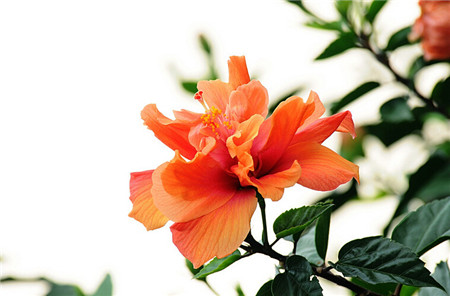
To carry out grafting, the grafting period must also be well mastered to improve the survival rate. Generally speaking, grafting can be done in spring, summer, autumn, and even late winter, but it is best to choose when the temperature most favorable for callus formation of that variety arrives, so that the time from grafting to survival can be shortened to the minimum. In this way, the specific grafting period for each variety often depends on the temperature required for callus formation, and must also be flexibly controlled due to differences in climate conditions in various places.
For branch grafting of hibiscus, late spring and early summer are best. Those who are interested might as well give it a try.
Using high-position grafting technology for the propagation of flowers and the combination of flowers of different species and genera is a very applicable technical method. In practice, the author has carried out some grafting of flowers of different species and genera, such as the grafting of cotton rose hibiscus with Chinese lantern flower, and the grafting of multi-colored bougainvillea, all of which were successful.
That is all for the introduction to hibiscus grafting methods. After reading it, do you not find it amazing? Just think about it: a single hibiscus tree covered with hibiscus flowers of different colors, how beautiful that would be. Flower lovers who grow hibiscus can give it a try.
How to graft hibiscus
Many people have heard of grafting plants, but may not have actually practiced it. In fact, grafting is not as difficult as everyone thinks. We only need to have some understanding of the whole process, and then we can fully grasp the essentials. Below we introduce how to graft hibiscus.
How to graft hibiscus1. How to graft hibiscus——time
Grafting hibiscus requires choosing the right time. Hibiscus is in a vigorous growth stage from March to June, or from September to October it is in a stable period. Grafting can be carried out during either period. Overall, it is recommended that you choose warm times to graft hibiscus. Hibiscus grafting will proceed more smoothly in a warm environment, and there is no need to worry about rotting or freezing damage.
2. How to graft hibiscus——process
First choose the rootstock. Cactus can be used as the rootstock. The main stem of cactus is relatively firm and has good supporting strength, and at the same time hibiscus and cactus match each other better and look good. After cutting off a section of hibiscus branch, insert it into the sand bed where the cactus is planted. When cutting the branch, you can wait until the cut has slightly dried and there is no sticky sap before insert the cuttings, which will make it more stable.
3. How to graft hibiscus——care
After grafting hibiscus, you need to pay attention to follow-up care. At the beginning, maintain a ventilated and breathable environment. Later, once roots have formed, you can begin watering, but be careful not to touch the joint.
Hibiscus grafting steps
Hibiscus grafting steps