How to grow Chinese hibiscus? Detailed cultivation and management methods
Chinese hibiscus grows vigorously and has a long flowering period, so it needs plenty of nutrients, which means the potting soil must be very fertile. The potting soil mix for cultivating Chinese hibiscus should be prepared in different ratios according to its growth stage. During the growing period, pay attention to fertilizer management.
After potting, place it in semi-shade. After 10-15 days of recovery, move it to a spot with plenty of sunlight. According to dry and wet climate conditions, water 1-2 times a day. After more than 2 months of growth, it can be moved into a 5-inch pot. The potting soil should be prepared with 8 parts garden soil and 2 parts manure soil, and when repotting, place some cake fertilizer powder at the bottom as base fertilizer.
When the seedlings grow to a height of 20 cm, carry out the first pinching to encourage the lower axillary buds to sprout. During the process of the base sprouting into branches, select and keep 3-4 new shoots of similar growth strength and even distribution, and remove the remaining axillary buds so that nutrients are concentrated for the growth of the retained branches.
In the second year, when it is moved outdoors for cultivation in warm spring, it can be moved into an 8-inch pot. The potting soil can use 6 parts garden soil and 4 parts manure soil, with hoof pieces, horn shavings and bone meal placed at the bottom of the pot as base fertilizer. At the same time, leave about 10 cm on each branch and cut it back, and after sprouting, keep 2 branches per branch and remove all the other small branches.
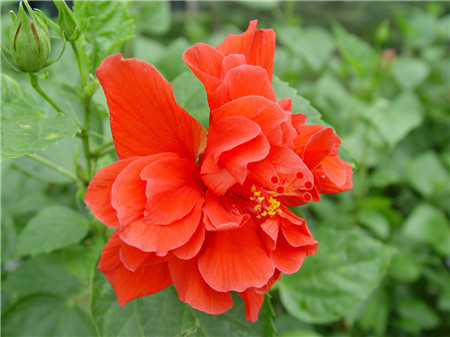
In the third year, there is no need to repot in spring, but short-pruning should continue. The pruning principle is to remove weak growth and keep strong growth, remove dense growth and keep sparse growth, so that the plant clump is both full and well-balanced, cultivating a beautiful framework. In the fourth year in spring and every 2 years thereafter, repot, gradually changing to 10-12 inch pots, with potting soil prepared in a ratio of 6 parts garden soil to 4 parts manure soil. When repotting, shake off the old soil at the edges and trim away some old roots.
Fertilizer and water management during the growth period of Chinese hibiscus: in midsummer, water once each morning and evening; in spring and autumn, if the potting soil is dry in the morning, add a small amount of water, and in the afternoon water once generally. During the growth period, also pay attention to spraying water on the leaves to increase air humidity, especially when placed on a balcony, where spraying should be given more attention.
In winter, water according to overwintering conditions. When overwintering in a greenhouse, water once every 1-2 days; when overwintering in an ordinary room, water once every 5-7 days, and the amount of water should not be large. For topdressing during the growth period, generally apply liquid fertilizer once every 15-20 days; when the plant is young, the fertilizer should be dilute and the frequency should be frequent, while adult plants should receive stronger fertilizer and the interval can be longer. When moving indoors for overwintering, scatter a thin layer of dry fertilizer on the surface of the potting soil; coarse cake fertilizer powder or sauce residue powder granules can both be used as fertilizer.
Chinese hibiscus has few diseases. Common pests include aphids on tender branches and leaves and scale insects on branches and stems. Both pests can be killed by spraying with 40% dimethoate 1000-fold solution. When a small number of scale insects are found, they can be brushed off with a hard-bristled brush.
Cultivation and management techniques for Chinese hibiscus
1. Morphological characteristics: Malvaceae, Hibiscus genus. Evergreen shrub or small tree. When potted, it is generally 1-3 m tall, with an upright stem, many branches, and gray bark. Leaves alternate, broadly ovate, pointed at the tip, with coarse serrations or incisions along the leaf margin, entire at the base, and the leaf surface is dark green and glossy. Flowers are solitary in the leaf axils on the upper part of the branches, with slender pedicels; the calyx is cup-shaped and five-lobed, green; the flowers are large, about 10 cm in diameter, and are divided into single and double types; the single type is trumpet-shaped, and flower colors include red, orange, yellow, white, rose red and so on. The flowering period is very long and can continue throughout the year, but for each individual flower it can only open for one day, that is, "opening in the morning and falling at dusk." The capsule is oval, smooth and beaked, and potted plants rarely set fruit.
2. Growth habits: native to southern China, and now commonly cultivated throughout China. It likes a warm and humid climate and an environment with ample sunlight and good ventilation. It has no strict requirements for soil, but dislikes saline-alkali soil and prefers slightly acidic soil. For potting, loose, fertile, well-drained sandy loam or clay loam is suitable. During the growth period, it likes abundant water and fertilizer, but fears waterlogging and rain damage. The branches have strong sprouting ability and are suitable for pruning and shaping. Flowers are borne in the leaf axils of new branches and wilt on the same day after opening.
In the south it is cultivated in the open field, while in the north potted cultivation is suitable for a medium greenhouse. When the room temperature is below 5°C, the leaves turn yellow and fall off; below 0°C, it is prone to freezing damage.
3. Propagation methods: Chinese hibiscus can be propagated by cuttings and grafting, but cuttings are mostly used. Cutting propagation is generally mostly carried out in combination with pruning. The suitable period for cuttings: indoors, from January to April; in the open field, the survival rate is relatively high during the rainy season in the dog days. The best cuttings are annual semi-lignified terminal branches, about 10 cm long; each cutting should retain 3-4 buds, keep 3-4 leaves at the upper part, and remove the lower leaves. The lower cut of the cutting should preferably be below a node, and the cut should be smooth; if the cutting has flower buds, they should be removed. The sand or soil used for the cutting bed should be disinfected and sterile; insert about 2-3 cm deep, and after insertion cover with plastic film to maintain humidity. Set up reed curtains above for shade. The room temperature can be kept at 18-25°C, and the relative humidity at 85-95%. If the soil temperature in the bed can be slightly increased to be about 2-3 degrees higher than the air temperature, it is even more favorable for rooting. When taking cuttings, it is best to do so separately by variety, mainly based on rooting speed, and plant them in different cutting beds so that they are easier to manage. For example, many double large-flowered types root very slowly and grow weakly after survival; while Hanging Basket (Gongshou Flower Basket), Lantern, and Laxian (Lingnan hibiscus) root very quickly and also grow well after survival, among which Lingnan hibiscus is the most outstanding. Within one week after insertion, water thoroughly; after one week, ventilate appropriately and reduce the amount of water, so as to keep the soil merely moist. Depending on the cutting variety and environmental conditions such as temperature, survival time varies; generally rooting can occur in 2 weeks to 40-50 days.
How to cultivate Chinese hibiscus? Propagation and pest and disease control cultivation techniques for Chinese hibiscus
Chinese hibiscus, also called zhujin, is a very popular ornamental plant with rich flower colors and many varieties. According to the editor's understanding, most of this flower is planted in courtyards, but it is also a potted plant. Below are the propagation and pest and disease control cultivation techniques for potted Chinese hibiscus!
Propagation
Cutting propagation
Carry out from March to October, with the highest survival rate during the plum rain season, and carry out indoors in winter. Cuttings are preferably semi-lignified branches of the current year, and stem segments can also be used for cuttings. The cutting length is 10 cm; cut off the lower leaves, keep the terminal leaves, make the cut smooth, insert into a sand bed, maintain relatively high air humidity, and keep the temperature at 18°C-21°C. After insertion, they can be transplanted in 40-45 days. If treated with "Root Sun" rooting agent, the rooting period can be shortened.
Treating Chinese hibiscus cuttings with "Root Sun" rooting agent has a particularly notable effect: single-petaled varieties can root in about 23 days after insertion, and double-petaled varieties can root in about 29 days after insertion, about 16-22 days faster than cuttings without any treatment. The seedling stage growth time is short, and there is no need for weeding or fertilizing. Spray 1-2 times with fungicide and water 1-2 times a day, and the survival rate can reach more than 90%, while the survival rate of double-petaled varieties is relatively low, about 40%-50%. Therefore, double-petaled varieties are mostly propagated by grafting, and the survival rate is high.
Grafting propagation is carried out in spring and autumn. It is mostly used for Chinese hibiscus varieties that are difficult to root or root slowly by cuttings, especially double-petaled varieties with low cutting survival rates. Use branch grafting or bud grafting, with single-petaled Chinese hibiscus as the rootstock. Grafted seedlings can sprout branches and bloom in the same year.
Zhujin peony flower potted Chinese hibiscus
Potting management
When the Chinese hibiscus root system grows to 3-4 cm long, it can be transplanted into pots. Potted Chinese hibiscus is commonly planted in pots with a mouth of 15-20 cm, with 1 plant per pot. Because Chinese hibiscus is not strict about the environment but likes sunlight and a hot, dry climate, and is also relatively sensitive to water and fertilizer, cultivation management should do a good job in watering, fertilizing, pinching and pruning, light, temperature and other technical work according to its growth characteristics.
Watering: During the growth and flowering seasons, give the roots sufficient water so that it can grow vigorously and bloom well. For potted Chinese hibiscus, water once a day in spring and autumn, and once each morning and evening in summer. Sprinkle more water around the placement area to increase air humidity, but never water at noon in midsummer, otherwise the plant will wither. In winter, because the temperature is low, strictly control the amount of watering, otherwise the plant's cold resistance will weaken and it will be prone to freezing damage. In winter, wait until the potting soil is dry before watering. Chinese hibiscus grown in the open field should also be watered thoroughly only when the soil is dry.
Fertilizing: Chinese hibiscus likes fertilizer. During the seedling stage, apply a mixed fertilizer once every 15 days. After flower buds appear, switch to bone meal or chemical fertilizer with a higher phosphorus content. Especially during the flowering and bud-developing stage, a large amount of phosphorus and potassium fertilizer is needed. If only nitrogen fertilizer is applied, it will not only fail to bloom, but the branches will also grow excessively, making it difficult for flower buds to form, so fertilizing must be balanced. After October, gradually reduce fertilizing, and stop fertilizing in winter.
Pinching and pruning: When newly planted young seedlings grow to 10-15 cm high, promptly remove the terminal buds and keep a height of 6-8 cm. When the newly sprouted branches grow to 6-8 cm, carry out a second pinching, that is, remove the terminal buds, and repeat this several times to form a full crown. Chinese hibiscus has strong sprouting ability and tolerates pruning. Prune the plant once in early spring when the temperature rises, in order to increase the number of branches and achieve a large amount of flowering. Pruning is mainly for shaping, removing weak branches, diseased and pest-infested branches, and slender branches, and cutting back thick branches and excessive-growth branches. In summer, if growth is too fast, prune once within 1-2 months.
Temperature: The suitable growth temperature for Chinese hibiscus is 15°C-25°C, from March to October it is 18°C-25°C, and from October to the following March it is 13°C-18°C. In winter, the temperature should not be lower than 5°C. If the temperature is below 5°C, the leaves turn yellow and fall off; below 0°C, it is prone to freezing damage. Above 35°C, dahonghua can still grow normally. Light: Chinese hibiscus likes full sun and does not tolerate shade. With sufficient light, it grows robustly, has fewer pests and diseases, and produces large, numerous, brightly colored flowers. Insufficient light easily causes flower and bud drop and yellowing and falling of leaves. Even if it blooms, the flowers are small, the leaf color is dull, and it is prone to pests and diseases.
Road greening effect
Pest and disease control: diseases
Common diseases include phytophthora rot, leaf spot, stem rot, root-knot nematode disease, anthracnose, sooty mold, flower rot, and so on.
① Phytophthora rot. Water-soaked gray lesions appear on the leaves, rapidly enlarge, and develop into dark brown and rot. If the lesion girdles the stem, the plant soon dies.
Control method: At the initial stage of disease, spray or drench the diseased plant with zineb 500-fold solution or 25% metalaxyl wettable powder 500-800-fold solution, or spray Bordeaux mixture.
② Leaf spot. At the early stage of infection, pale yellow and red-yellow spots appear on the leaves. After the lesions expand, they become round or oval, and later the leaves dry up and fall off.
Control method: Use 25% carbendazim wettable powder 300-600-fold solution, 50% thiophanate-methyl 1000-fold solution, 70% maneb 500-fold solution, 80% mancozeb 400-600-fold solution, 50% captan 500-fold solution, etc., spraying once a week for 2-3 consecutive times.
③ Stem rot. This disease mostly occurs in the rainy season, and is severe under high temperature and rainy conditions.
Control method: During the disease period, spray with 75% chlorothalonil 800-fold solution or 65% zineb 600-fold solution. For severely diseased nursery land, 70% fenaminosulf wettable powder can be used to disinfect the soil.
④ Root-knot nematode disease. At the early stage of damage, leaf growth is weak, and red-brown blighted spots appear at the edges. They spread inward, and later the leaves dry up and fall off.
Control method: Use undiluted dichlorvos mixture to fumigate the soil and disinfect the soil, then sow or transplant two weeks later. It can also be controlled by burying 15-50 g of 3% carbofuran granules in the pot.
⑤ Anthracnose. It mainly damages leaves, causing yellowing and falling of leaves, and in severe cases can cause branch tips to die.
Control method: Remove dead branches and diseased leaves, destroy them centrally or bury them deeply in the soil; strengthen cultivation management, appropriately increase phosphorus and potassium fertilizer, promote robust plant growth and improve disease resistance; at the initial stage of disease, spray 1:1:200 Bordeaux mixture, or 50% carbendazim wettable powder 1000-fold solution, or 75% chlorothalonil wettable powder 600-800-fold solution, once every 10 days. For 2-3 consecutive times, the effect is notable.
⑥ Sooty mold. It mainly attacks leaves and branches.
Control method: Timely control aphids and scale insects. At the initial stage of disease, spray with 40% dimethoate 1000-fold solution or 40% emulsifiable concentrate supusha 800-1000-fold solution over the whole plant.
⑦ Flower rot. The pathogen first invades from the tip of the petals. After onset, the diseased part is water-soaked and faded. Finally the petals turn brown and rot, and the flowers fall off.
Control method: At the initial stage of disease, spray 1:1:200 Bordeaux mixture, or 65% zineb wettable powder 600-fold solution, or 75% chlorothalonil wettable powder 600-800-fold solution, once every 2 weeks for 2-3 consecutive times.
Sooty mold pests and diseases
Common pests include aphids, scale insects, red spider mites, stinging moths, etc., which use piercing-sucking mouthparts to suck sap on the tender buds, tender branches, and tender leaves of Chinese hibiscus, often causing leaf discoloration and even curling.
Control method: Spray with 10% chuchongjing emulsifiable concentrate 1500-2000-fold solution, or spray with 0.01% dicofol solution, or spray the whole plant with 40% emulsifiable concentrate supusha 800-1000-fold solution. Once a week for 2-3 consecutive times, the effect is relatively good.
Chinese hibiscus is a beautiful ornamental flowering plant, and its planting method is simple and easy to survive. It likes light, and as long as it is given enough sunlight, the flowering period will increase. It is a kind of flower and plant very suitable for courtyards, gardens and other places. Flower-loving friends can take a look at its potted propagation methods.