Jasmine Winter Care Methods and Precautions
Winter is just around the corner, and gardening friends who love growing jasmine have begun discussing winter care methods for jasmine. Below, the editor briefly introduces the winter care methods for jasmine.
1. In winter, as long as jasmine shows stopped growth, it is dormant, regardless of whether it drops leaves or not. The manifestation of dormancy is greatly related to temperature. The specific situations are analyzed as follows:
1) Only a small amount of leaf drop, with most leaves remaining evergreen - this is called evergreen dormancy, and it occurs when the temperature is above 15 degrees.
2) Heavy leaf drop, but healthy branches - this is called deciduous dormancy, and it occurs when the temperature is between 3 and 15 degrees.
3) If the temperature is below 3 degrees, not only will there be heavy leaf drop, but the plant is also very susceptible to cold damage. Too low a temperature is not conducive to jasmine overwintering.
Supplement: As a special case, during the overwintering period, when the temperature exceeds 22 degrees, jasmine will continue to grow, which is off-season growth. At this time, it is suitable to do light pruning on jasmine, only targeting leggy leafy branches; but overall, maintain the existing plant shape.
2. During the overwintering period, jasmine itself does not need much fertilizer, so there is no need to apply additional fertilizer at this time. If fertilizer is applied at this time, it will actually do more harm than good and is unfavorable for overwintering.
3. During the overwintering period, water jasmine as usual, still checking the surface soil, and when watering, it must be watered thoroughly - just care for it in a simple, rough manner.
4. During the overwintering period, jasmine has already stopped growing, so keeping it warm is the most important thing. At this time, maintain the existing plant shape and do not prune it heavily.
The reasons are as follows:
Because through the performance of the branches and leaves, you can judge whether its condition during overwintering is still healthy. Maintaining the existing plant shape can, to a certain extent, help it resist the low temperatures of winter.
Because pruning it too early, for jasmine, actually does more harm than good, and if not done properly, even overwintering may become a problem later.
Moreover, during the entire overwintering period, jasmine has stopped growing, and combined with the low temperature, even if it is pruned heavily, it will not sprout quickly.
In short, when pruning jasmine, especially heavy pruning such as close cropping, you must consider the season. When the temperature is too low and jasmine is not growing vigorously, do not do this.
For close cropping of jasmine, choosing May and June, when jasmine grows most vigorously, that is, late spring and early summer, is the most suitable. At that time, jasmine grows very vigorously, and doing heavy pruning can allow it to sprout quickly in a short time, achieving the effect of adjusting the plant shape.
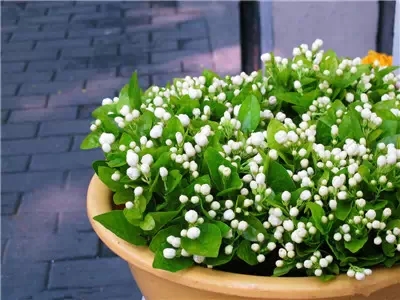
Potted Care Methods for Growing Jasmine - How to Grow Jasmine at Home
There are always some colors that need to be filled in. Large or small, a rain, at the top of the earth. After April, it is the sound of waves. Wind rustles into the ears, so quickly, sunlight has traveled a circle from the trees and brought back a group of leaves. And bird songs. Birds chirping in the gradually warming breeze, streets reflected above the streets, songs sung within ballads. Above the earth. A kind of listening, seizing sunlight and wind, seizing the power of the years. So, do you understand jasmine? Below, the editor will introduce jasmine to you.
(1) Choosing a pot
Based on the characteristics of jasmine's root system, which requires good permeability and a relatively moist environment, potted jasmine should preferably use unglazed clay pots. Glazed pots and porcelain pots can only be used for short-term display planting. The unglazed clay pots suitable for planting jasmine generally come in 3 specifications: 25 cm diameter, 15 cm height; 30 cm diameter, 17 cm height; 36 cm diameter, 22 cm height. It is advisable for the pot diameter to be slightly smaller than the tree crown, which helps maintain soil moisture.
(2) Preparation of growing soil
Use 4 parts loam soil, 4 parts compost, 2 parts sand, plus a small amount of bone meal, cake fertilizer, plant ash, etc., piled and made. The growing soil is required to be fertile, loose, strong in water and fertilizer retention, and good in permeability. Decayed garbage sifted through a 16-mesh sieve can be used instead of sand, and disinfected with formalin. Evenly sprinkle 2 L of 1.5% formalin into 100 m3 of soil, then cover with straw or a mat, and it can be used after 48 hours.
(3) Potting
First cover the drainage hole with a tile or broken pot piece, add 3 cm of coarse growing soil or coarse sand or coal cinder, then use the prepared growing soil for planting. When planting, first wash the seedling roots clean, cut off the main root and excessively long lateral roots and damaged roots. Cut and truncate the stem at 15-20 cm from the root crown to set the trunk, then divide 4-6 seedlings into 2 clumps or 3 clumps and plant them in the pot.
(4) Repotting
When jasmine planted in a pot grows from small to large and the root system fills the entire pot, the plant needs to be moved from a small pot to a large pot. Generally, before jasmine sprouts, prune the root system and then move it into a larger pot.
(5) Management
When not repotting, remove 2 cm of old surface soil and add new growing soil.
Fertilizing:
The principle of fertilizing potted jasmine is to apply lightly and frequently. For additional fertilizer, mainly use fertilizer water made from bone meal, human and livestock manure and urine, and oil cake, composted, decomposed, and fermented, supplemented by urea and compound flower fertilizer. When new buds sprout, apply the above decomposed fermented fertilizer at a concentration of 5% once every other day, and every 3-4 days apply 100 g each of urea and compound fertilizer added to 25 kg of fertilizer water once. During the flowering season, fertilizer needs to be applied once every 2-3 days, with a fertilizer-to-water ratio of 4:8 or 3:7.
Watering:
For watering potted jasmine, still grasp the principle of not watering until the potting soil is dry. When spring and autumn temperatures are relatively low, water once every 2-3 days; in summer, water once every 1-2 days. During the "dog days" of June-August, with high temperatures and drought, and a large amount of water evaporation, water once in the morning and once in the afternoon each day. From November onward, strictly control water supply throughout the winter. During the flowering period, the amount of watering should not be too much; especially for jasmine used for flower viewing, moisture should be controlled even more, which can prolong the flowering period.
Shaping and pruning:
Same as open-field cultivation. As long as you cultivate carefully, adjust soil, fertilizer, and water properly, pinch, trim shoots, and remove leaves in a timely manner, pay attention to pest and disease control, and strengthen cold protection and heat preservation, you can achieve a bumper harvest of potted jasmine.
The above is all the content I have learned about jasmine today. I hope gardening friends will find it helpful after reading this article. If you want to learn more about jasmine-related content, please continue to follow our Succulent Garden for more content.
Winter Care for Potted Jasmine and Management Methods for Potted Jasmine
Winter Care for Potted Jasmine and Management Methods for Potted Jasmine
Winter is just around the corner, and gardening friends who love growing jasmine have begun discussing overwintering management methods for jasmine. Below, the reporter briefly introduces jasmine care methods and the overwintering care and management methods for potted jasmine. Potted jasmine is actually not difficult to grow well. According to jasmine's growth habits: the growing soil is required to be rich in organic matter and have good water permeability and aeration performance. Based on jasmine's characteristics of liking moisture, being intolerant of drought, fearing waterlogging, and liking aeration, master the watering time and amount. Potted jasmine generally should be repotted and have its soil changed once a year. Jasmine likes fertilizer, especially because its flowering period is long, it needs more fertilizer. Jasmine is not tolerant of low temperatures and has poor cold resistance. Apart from being plantable in courtyards in South China and Fujian, it is grown as a potted plant in other regions. Every year after Frost's Descent and before the Start of Winter, jasmine is moved indoors to overwinter. The details are introduced as follows:
For potted jasmine, the growing soil is required to be rich in organic matter and have good water permeability and aeration performance. Generally, 4 parts garden soil, 4 parts compost, 2 parts river sand or rice husk ash can be used, plus an appropriate amount of fully decomposed dry cake residue, chicken and duck manure, etc., and sift out the powder and coarse particles, using the coarse particles to line the bottom and cover the surface. The best time for potting is before new shoots sprout each year in April-May. Choose a suitable flower pot according to the size of the seedling. When potting, hold the seedling with one hand and shovel in growing soil with the other. After the soil covers all the roots, lift the plant slightly upward and shake the pot a few times so that the soil and roots come into close contact. Then press the potting soil firmly with your hands, leaving the soil surface 2 cm below the pot rim for watering. After planting, water to settle the roots, then place it in a slightly shaded place for 7-10 days, avoiding direct sunlight, and gradually expose it to light afterward. The key to daily management is water. Based on jasmine's characteristics of liking moisture, being intolerant of drought, fearing waterlogging, and liking aeration, master the watering time and amount. By June-July it can bloom. At this time the root system has resumed normal growth, and diluted alum fertilizer water should be applied once every 7-10 days. Afterward, it can be managed as a mature jasmine plant, and it does not need repotting again that year.
Jasmine likes fertilizer, especially because its flowering period is long, it needs more fertilizer.
It also likes acidic soil. Normally, apply 1:10 alum fertilizer water once a week. After the first flowering, it is advisable to use bean cake, etc. as additional fertilizer, applied into the surface soil. During flowering, apply bone meal and phosphate fertilizer as appropriate. If conditions permit, apply decomposed human manure and urine, which can make jasmine flowers more fragrant. During the high temperatures of full bloom, fertilizer should be applied once every 4 days. You may as well use heavy fertilizer and heavy water. Generally water in the morning, apply fertilizer in the evening, and water again the next day to dilute it, which helps jasmine roots absorb it. The fertilizer applied should not be too concentrated, otherwise it easily causes root rot. Before applying fertilizer, use a small shovel to loosen the potting soil slightly, and do not apply fertilizer when the potting soil is too dry or too wet. Applying fertilizer when the soil is neither dry nor wet gives the best effect.
In order to make potted jasmine full and beautiful in shape, after the flowers fade, promptly cut off the withered flowering branches to promote new shoots from the base and control plant height. Stop fertilizing in early September to improve branch maturity, which is beneficial for overwintering. Jasmine fears cold. When the temperature drops to 6-7°C, it should be moved indoors, and at the same time attention should be paid to opening windows for ventilation to avoid yellowing and leaf drop. At this time the temperature is often unstable. When the weather turns warm, it should still be moved outdoors for ventilation and light. When jasmine is moved indoors for the winter, it should be placed in a room with ample sunlight, and the room temperature should be above 5°C. Water about once every 7 days to keep the potting soil slightly moist. In this way, even in winter the branches and leaves can remain fresh and green without losing their ornamental effect.
Potted jasmine generally should be repotted and have its soil changed once a year.
When repotting, remove part of the old soil and residual roots around the jasmine root system, replace with new growing soil, and improve the soil's aggregate structure and nutrients anew, which is beneficial to jasmine's growth. After repotting, water thoroughly just as when potting, to facilitate close contact between roots and soil and restore growth. Before repotting, jasmine should be pruned once. For branches grown in the previous year, leave only about 10 cm, and cut off diseased and dead branches as well as overly dense and overly thin branches. During the growing period, often thin out old leaves that are too densely grown, which can promote axillary bud germination and produce more new branches and more flower buds. In spring, April-May, jasmine is just sprouting branches and growing leaves, and water consumption is not large, so it can be watered once every 2-3 days, around noon, following the principle of seeing dryness and wetness, and watering thoroughly when watering; May-June is jasmine's spring flowering period, so watering can be slightly more; midsummer June-August is a high-temperature climate, exactly when jasmine grows quickly and leaf transpiration also speeds up during the full flowering period, with strong sunlight and high water demand, so it can be watered once in the morning and once in the evening. In dry weather, water should also be sprayed on the leaves and the ground around the pot. Because jasmine is neither tolerant of drought nor tolerant of waterlogging, on rainy summer days the accumulated water in the pot should be poured out promptly. In autumn, when the temperature drops, watering can be reduced to once every 1-2 days; in winter, the amount of watering must be strictly controlled. If the potting soil is too wet, it is unfavorable for overwintering.
Jasmine is not tolerant of low temperatures and has poor cold resistance. Apart from being plantable in courtyards in South China and Fujian, it is grown as a potted plant in other regions. Every year after Frost's Descent and before the Start of Winter, jasmine is moved indoors to overwinter.
When first brought indoors, jasmine should be placed in a well-ventilated, sunny place. Before severe cold arrives, the whole pot can be enclosed in a plastic film bag. It is best to use wire, small bamboo sticks, etc. along the pot rim to build a support frame, and then put on the plastic film bag. During the day, place it near the window in a sunny spot, and avoid northwest-facing doors and windows so that northwest wind does not blow on it. At night, move the potted plant away from the window and place it in the warmest place. When the temperature rises above 10°C, promptly open the plastic bag for ventilation and air exchange. At night, the temperature is best maintained at around 5°C-8°C. In short, as long as it stays above 0°C and the potting soil does not freeze, it can overwinter safely.
Watering during the overwintering period is the key to the success or failure of care and management.
In principle, water as little as possible and stop fertilizing. After being brought indoors, the amount of watering should generally be reduced by 30%-40% compared with when outdoors. Specifically, it should also be treated according to differences in plant vigor, size, and pot material. Be sure to wait until the pot is dry and the leaves are soft before watering moderately. The water temperature should preferably be slightly higher than the soil temperature. Watering time should preferably be around noon. Near the time of moving out (moving out before Qingming Festival), because the temperature rises, plant transpiration increases, and the evaporation of water from the potting soil increases, more attention should be paid to watering during this period. Both dryness and excessive moisture should be prevented, and the principle of "slightly dry with moisture" should be grasped. Do not wait until the pot is dry and the leaves are soft before watering.