Detailed Explanation of Cyclamen Hydroponic Methods and Steps
Growing cyclamen in water only began to appear in Europe in the last year or two. Because this cultivation method frees cyclamen from traditional flower pots and substrate, it is both clean and attractive, and can give blooming cyclamen plants many cultivation and application forms. As soon as it appeared on the market, it won enthusiastic welcome from consumers.
In fact, hydroponic cyclamen is not difficult. First, you need to select a satisfactory potted cyclamen and prepare a container for hydroponic cyclamen. In this way, once the preparatory work is complete, you can begin making a hydroponic cyclamen. For hydroponic cyclamen, the purchased potted cyclamen should be tipped out of the pot together with the substrate (flower soil), placed under a tap and rinsed clean with a relatively gentle stream of water. You can also place the plant together with the substrate in a basin of water, rinse the substrate off in the water, and then wash it clean with running tap water. Note that throughout the entire process of removing the substrate, movements must be gentle, and damage to the cyclamen root system should be avoided as much as possible. The rinsed clean cyclamen plant can then be placed in the pre-prepared hydroponic container, water added, and a beautiful hydroponic cyclamen is made. It should be pointed out that no fertilizer needs to be added to the water for cultivating cyclamen. The nutrients in the cyclamen corm can allow the cyclamen plant to maintain normal growth and flowering for 4-6 weeks. At the same time, the water level must be kept below the corm. Generally, depending on water evaporation, add water to the container 1-2 times per week to maintain the water level.
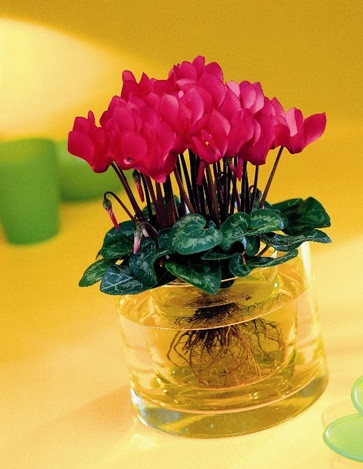
Water culture time and method. The flowering period of cyclamen is generally from October to June of the following year, so the water culture time is generally from September to April of the following year. Remove the selected cyclamen plant from the pot, wash the substrate adhering to the roots with 20°C warm water, and be careful not to damage the roots. Then place it directly into a pre-prepared container, with the water depth level with the root zone, and at deepest not exceeding 1/3 of the corm, so as to avoid corm rot. Finally, place it in a suitable indoor location, add water regularly, and add nutrient solution. After two to three months of water culture and after the flowers fade, take the plant out and plant it in cultivation substrate to pass the summer.
Water quality and water temperature. The water used for water-cultured cyclamen is best mountain spring water or magnetized water, with clean water quality, not turbid, without sediment, and containing various trace elements essential for plants. During the entire water culture period, no water change is needed. Tap water contains chlorine, which is unfavorable for flower growth, and is also easily turbid and prone to sediment, requiring a water change every few days, so it should be avoided as much as possible. The water temperature should be close to the indoor temperature at the time, generally 10°C to 20°C.
Light and indoor temperature. Cyclamen likes a sunny and well-lit environment. The water culture container should be placed on an indoor tabletop or windowsill with ample sunlight, and should not be placed directly on a radiator. The most suitable indoor temperature is 15°C to 20°C, with the maximum not exceeding 25°C and the minimum not lower than 10°C.
Cyclamen Hydroponic Method
Growing cyclamen in water only began to appear in Europe in the last year or two. Because this cultivation method frees cyclamen from traditional flower pots and substrate, it is both clean and attractive, and can give blooming cyclamen plants many cultivation and application forms. As soon as it appeared on the market, it won enthusiastic welcome from consumers.Hydroponic Cyclamen
In fact, hydroponic cyclamen is not difficult. First, you need to select a satisfactory potted cyclamen and prepare a container for hydroponic cyclamen. In this way, once the preparatory work is complete, you can begin making a hydroponic cyclamen. For hydroponic cyclamen, the purchased potted cyclamen should be tipped out of the pot together with the substrate (flower soil), placed under a tap and rinsed clean with a relatively gentle stream of water. You can also place the plant together with the substrate in a basin of water, rinse the substrate off in the water, and then wash it clean with running tap water. Note that throughout the entire process of removing the substrate, movements must be gentle, and damage to the cyclamen root system should be avoided as much as possible. The rinsed clean cyclamen plant can then be placed in the pre-prepared hydroponic container, water added, and a beautiful hydroponic cyclamen is made. It should be pointed out that no fertilizer needs to be added to the water for cultivating cyclamen. The nutrients in the cyclamen corm can allow the cyclamen plant to maintain normal growth and flowering for 4-6 weeks. At the same time, the water level must be kept below the corm. Generally, depending on water evaporation, add water to the container 1-2 times per week to maintain the water level.
Water culture time and method. The flowering period of cyclamen is generally from October to June of the following year, so the water culture time is generally from September to April of the following year. Remove the selected cyclamen plant from the pot, wash the substrate adhering to the roots with 20°C warm water, and be careful not to damage the roots. Then place it directly into a pre-prepared container, with the water depth level with the root zone, and at deepest not exceeding 1/3 of the corm, so as to avoid corm rot. Finally, place it in a suitable indoor location, add water regularly, and add nutrient solution. After two to three months of water culture and after the flowers fade, take the plant out and plant it in cultivation substrate to pass the summer.
Water quality and water temperature. The water used for water-cultured cyclamen is best mountain spring water or magnetized water, with clean water quality, not turbid, without sediment, and containing various trace elements essential for plants. During the entire water culture period, no water change is needed. Tap water contains chlorine, which is unfavorable for flower growth, and is also easily turbid and prone to sediment, requiring a water change every few days, so it should be avoided as much as possible. The water temperature should be close to the indoor temperature at the time, generally 10°C to 20°C.
Light and indoor temperature. Cyclamen likes a sunny and well-lit environment. The water culture container should be placed on an indoor tabletop or windowsill with ample sunlight, and should not be placed directly on a radiator. The most suitable indoor temperature is 15°C to 20°C, with the maximum not exceeding 25°C and the minimum not lower than 10°C.
Can Cyclamen Be Grown Hydroponically? Cyclamen Hydroponic Methods and Care Guide
Cyclamen, also known as rabbit ear flower, rabbit flower, yipin crown, and radish begonia. Its flower language is introversion. Cyclamen is very suitable for potting, especially indoor potting, where it can often be seen. Below we explain the hydroponic methods and care guide for cyclamen.
1. Growth characteristics
It belongs to the Primulaceae family, Cyclamen genus. Cyclamen plants are 15-40 cm tall, with a flattened round fleshy corm. Leaves are clustered at the top of the corm, with long petioles, nearly heart-shaped, green with silvery-white markings, and margins with blunt teeth of varying sizes. Flowers emerge from the leaf axils, mostly large, with fleshy long peduncles (15-25 cm); calyx with 5 lobes, 5 petals, bases united into a short tube, upper parts recurved and twisted, like rabbit ears, hence the name "rabbit ear flower." The plant form is even more like an immortal stepping on clouds, incomparably elegant, hence it is also called "cyclamen." Flower colors are rich, including white, red (bright red, purple-red, orange-red, pink), purple, and mixed colors, and some are fragrant. The flowering period lasts up to 5 months. It is a precious potted flower for winter and spring.
2. Hydroponic method
(1) In late August, after cyclamen dormancy ends and before growth resumes, select plants with corms above 3 cm, more than 10 leaves, no pests or diseases, and healthy growth, dig them out, wash the roots, and use them for hydroponics.
(2) Generally, for corms above 3 cm, choose a container with a diameter above 15 cm. Anchor the corm to be transplanted in the planting cup with foam plastic, ceramsite, sphagnum moss, or vermiculite, leaving 1/3 of the corm exposed; do not bury the growth point, and immerse the protruding root system in the nutrient solution. When converting from soil culture or substrate culture to hydroponics, it is advisable to acclimatize for 1 week. After 1 week, provide light in the morning and evening; after 1 month, provide full-day light. The nutrient solution height should preferably submerge 1/2 of the root system.
(3) Use Garden Test nutrient solution at about 1/2 of the standard concentration, pH 6-7, and replace once every 25-30 days.
3. Care guide
(1) Temperature and light
The temperature suitable for cyclamen growth is 10-20°C. When the temperature is above 30°C, the plant enters a dormant state. Above 35°C, if ventilation is poor, root rot may occur. The safe wintering temperature in winter is 10°C; if below 10°C, the flowers will suffer cold damage. Cyclamen likes ample diffused light and avoids direct sunlight.
(2) Watering
When the indoor air is too dry, cyclamen flower buds are prone to drying up and turning black, and the leaves will also gradually turn yellow, significantly shortening the flowering period. Therefore, water should often be sprayed on the leaf surface to increase air humidity.
(3) Fertilizing
When changing the water for hydroponic cyclamen, add nutrient solution; after the flowering period, simply maintain it with clean water.
(4) Changing water
At the very beginning of cyclamen hydroponics, place the plant in a dark place and change the clean water once every 5 days. After 1 week, new roots can grow from the bottom of the corm, and at this point it can be moved to a well-lit place for care. When the water roots reach more than 5 cm, switch to hydroponic nutrient solution for care. The figure shows hydroponic cyclamen.
(5) Pest and disease control
Hydroponic cyclamen is prone to soft rot and aphid infestation. During the high-temperature season from July to August, if ventilation is poor, soft rot is likely to occur and must be prevented in time. Dense old leaves and dead leaves can be pruned; if aphids are found, kill them promptly and observe at any time for recurrence.