A complete guide to iris planting methods, easy for beginners to get started
Iris is a bulbous plant, and autumn is the season for planting irises every year. Many gardening enthusiasts like to grow irises, but they are not familiar with the planting methods for irises. How to grow irises well is a problem many enthusiasts encounter. Below is a brief introduction to a few practices for growing irises well:
1. For planting, soil that drains well and is moderately moist is suitable. Before planting, decomposed compost should be applied, and oil cake, plant ash, etc. can also be used as base fertilizer. As for planting depth, on well-drained loose soil the top of the rhizome should be 5 cm below the ground, while on clay soil the top of the rhizome should be slightly above the ground, to benefit the plant's growth.
2. Iris likes sufficient sunlight and is also slightly tolerant of shade. After planting, the iris's light exposure should be increased to help the flower spikes emerge.
3. Base fertilizer can be applied before planting, and chemical fertilizer can be applied as a top dressing during the growing period. Watering depends on the situation; during the growing period, water once a week, and as the temperature drops, gradually reduce the amount of watering. In colder regions in winter, the clumps should be covered with manure or leaves, etc. for cold protection.
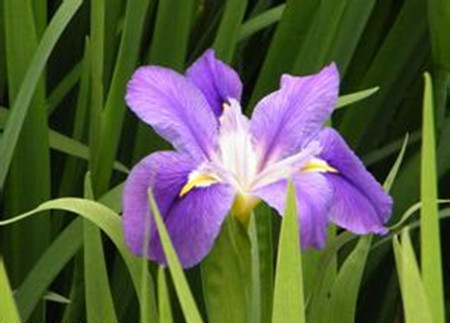
Iris planting methods
Iris——the flowers have a delicate fragrance, and essence can also be extracted from them to make perfume. So, what are the planting methods for irises? Let's take a look at its specific methods:Iris, also known as butterfly orchid, is a genus of plants in the iris family, a collective name for a group of herbaceous flowering plants. In our country, iris is often used to symbolize love and friendship, a bright future, boundless prospects, and keen perception. It has the symbolism of freedom and light, and its flowers have a delicate fragrance and can be used to extract essence for making perfume. Iris gets its name because its petals are shaped like the tail of an iris bird; its genus name iris means “rainbow” in Greek, referring to the rich variety of flower colors. In addition, iris is the national flower of France.
I. Propagation methods
Iris can be propagated by dividing the rhizomes:
Dig up the rhizomes, remove the old roots, divide each plant into 2-3 parts, keep 2-3 healthy buds in each part, then plant them in the soil, with the original downward-facing white side still facing down, and the gray side facing up. Still follow the original depth, and the deepest must not exceed 5 cm, otherwise the rhizomes are prone to rot.
II. Propagation conditions
Iris likes a cool, moist environment with sufficient sunlight and ample light, and is also slightly tolerant of shade. After planting, the iris's light exposure should be increased to help the flower spikes emerge. However, its cold tolerance is relatively poor; the minimum overwintering temperature is 4°C, and the suitable growing temperature is around 18°C. In garden cultivation, such plants are usually grown in greenhouses, sprouting and growing in autumn, flowering in winter and spring, and dormant in summer, requiring fertile, moist, well-drained neutral sandy soil.
III. Propagation and care
Before planting iris, the soil must be watered. Decomposed compost can be applied as base fertilizer, and oil cake, plant ash, etc. can also be used as base fertilizer; chemical fertilizer can be applied as a top dressing during the growing period. During the planting period, keep the soil moist to promote rapid rooting. After planting, soil temperature is the most important factor; the minimum temperature is 5-8°C, and the maximum temperature is 20°C. The level of soil temperature directly affects the emergence rate. If the soil temperature is too low, flowering capacity will be reduced, so the optimal soil temperature should be kept between 16-18°C.
Watering depends on the situation; during the growing period, water once a week, and as the temperature drops, gradually reduce the amount of watering. After the plant turns yellow, watering must be stopped. After the potting soil has dried appropriately, place it in a cool, ventilated place, and in autumn take it out and replant it. If water supply is insufficient or excessive, it will lead to uneven plant growth, delay the plant's sprouting and development, cause the plant height to become shorter and the flowers to abort, and easily cause infection by Pythium.
IV. Pests and diseases
In conditions of poor air circulation, accompanied by cloudy days or humid, warm and wet weather, and with excessive moisture, bacterial and fungal diseases are especially likely to occur.
The above are the cultivation methods for iris. Friends who like iris can plant it according to the methods above. If you like this article, then share it, so as to help those gardening friends who need knowledge in this area.
Iris growth habits and iris planting methods
Iris is a type of flower with relatively high ornamental value. Iris has the symbolism of freedom and light, and can also be used to extract essence for making perfume, so many people grow irises at home. Let's take a look below at the growth habits of iris and the planting methods for iris.
I. About iris
Iris, also known as blue butterfly and purple butterfly, is a perennial herb in the iris family, native to central China and Japan, and mainly distributed in central and southern China. Iris has many flower colors, a long flowering period, and tolerates extensive management. It is both an excellent cut flower and a good material for landscaping, and can be used for flower borders and foundation planting, and can also be used as an accent in rockeries and the like. Iris can be cultivated in greenhouses and can also be cultivated in open fields. Iris has the symbolism of freedom and light, and can also be used to extract essence for making perfume, so many people grow irises at home. Iris is also known as butterfly orchid and belongs to the iris family. Iris flowers are beautiful and brightly colored, and are good materials for arranging gardens, residential communities, and making flower baskets. After the flowering period, management proceeds normally until the stems and leaves turn yellow from June to July. After the plant turns yellow, watering must be stopped. After the potting soil has dried appropriately, place it in a cool, ventilated place, and in autumn take it out and replant it.
Iris originated in Egypt, Africa, and later, due to its fame, it is now cultivated all over the world. It grows best in a cool, moist environment with sufficient sunlight, but its cold tolerance is relatively poor; the minimum overwintering temperature is 4°C, and the suitable growing temperature is around 18°C. In garden cultivation, such plants are usually grown in greenhouses, sprouting and growing in autumn, flowering in winter and spring, and dormant in summer, requiring fertile, moist, well-drained neutral sandy loam soil.
II. Growth habits of iris
Perennial herb. The rhizome is elongated or lump-shaped, creeping horizontally or extending obliquely, slender or thick. The leaves are mostly basal, overlapping each other, arranged in 2 rows; the leaves are sword-shaped, linear, or thread-like, with parallel veins, the midrib obvious or absent, the base sheath-like, and the apex tapering. Most species have only a flower stem and no obvious aboveground stem; the flower stem is drawn out from the leaf cluster, and in most species extends above the ground, while a few are shortened and do not extend, with the apex branched or unbranched; the inflorescence is borne at the top of the branches or only 1 flower is borne at the top of the flower stem; several bracts are borne at the base of the flower and inflorescence, membranous or herbaceous; the flowers are relatively large, blue-purple, purple, red-purple, yellow, white; the perianth tube is trumpet-shaped, thread-like, or very short and inconspicuous, with 6 perianth segments arranged in 2 whorls; the outer whorl has 3 perianth segments, usually larger than the inner whorl, often reflexed and drooping in the upper part, claw-like at the base, mostly grooved, smooth, without appendages or with crest-like and hairy appendages; the inner whorl has 3 perianth segments, upright or inclined outward.
Stamens 3, inserted at the base of the outer perianth segments, anthers dehiscing outward, the filaments free from the base of the style; the pistil has a single style, the upper part with 3 branches, the branches flattened, arching and curved, brightly colored, petal-like, the apex again 2-cleft, the lobes semicircular, triangular, or narrowly lanceolate, the stigma borne at the base of the lobes at the top of the style, mostly semicircular, ligulate; the ovary inferior, 3-locular, with axile placentation, ovules numerous. The capsule is elliptical, ovate, or spherical, with or without a beak at the apex, dehiscing loculicidally at maturity; the seeds are pear-shaped, flattened semicircular, or irregular polyhedra, with or without appendages.
III. Iris planting methods
1. Soil disinfection. Soil disinfection is a very important step, generally using deep plowing and sun-drying or chemical disinfection methods. Deep plowing and sun-drying generally lasts about 20 days, and chemical disinfection generally uses chlorothalonil or quintozene sprayed for disinfection.
2. Fertilization. Before planting, cow or horse manure or dried chicken manure can be applied as base fertilizer; after the base fertilizer is applied, it should be mixed evenly with the cultivation soil. After planting in spring and surviving, urea can be applied once as a top dressing in early summer, a phosphorus-potassium fertilizer once in early autumn, and in late autumn, combined with watering for freezing, cow or horse manure can be applied lightly once more, or it can be spread directly on the nursery plot.
3. Watering. Iris likes water, and during cultivation the soil should be kept moist. If the soil is too dry, it is not conducive to plant growth. Generally, in non-rainy seasons, water thoroughly about once every 10 days; in the rainy season, natural rainfall can suffice; in late autumn, sufficient antifreeze water should be provided. In early spring of the following year, thawing water should be provided in time, and the thawing water must be given sufficiently and thoroughly.
4. Weeding. For the nursery plot where iris is planted, weed control work should be done in advance. If there are weeds during the planting process, they should be pulled out by hand in time, and chemical herbicides should be avoided as much as possible for removing weeds.
The above is the relevant introduction in this article. I believe that after reading it, you also have a simple understanding of this. If needed, you can continue to follow No. 1 Home Network to learn more information.