What points should be noted when planting peonies?
Peonies (Paeonia lactiflora) originated in northern China and are perennial herbaceous plants with fleshy roots. There are now over a thousand varieties worldwide, and about 180 in China. Peonies are highly adaptable and cold-hardy, and can overwinter outdoors in northern China. Wild species are currently distributed in areas such as the Qinling Mountains and the Dabie Mountains. However, three points should be noted when planting peonies:
1. Soil
Drainage must be good. Peonies prefer a cool climate and can be cultivated in temperate to subtropical regions of China. They have the characteristic of sprouting in spring and rooting in autumn. In summer, during hot and scorching seasons, the plants enter a semi-dormant state. They prefer fertile, loose, well-drained sandy loam and dislike saline-alkaline soil. Since peonies have fleshy roots, they are drought-tolerant but afraid of waterlogging. If the soil is compacted and waterlogged, the fleshy roots of peonies can easily rot, so low-lying areas and saline-alkaline land are not suitable for cultivation.
Therefore, when planting in the ground, choose a cool location with ample sunlight. For potted plants, avoid overwatering. Throughout the dormant period from the beginning of winter to early spring, the soil should be kept moist, not too dry, but drainage must be unobstructed and waterlogging avoided, otherwise the underground tuberous roots will easily rot and die.
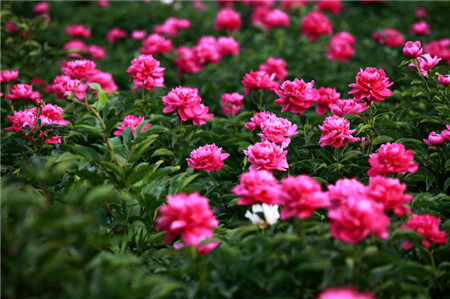
2. Division
Peonies are generally propagated by division. As the saying goes, "Divide peonies at the Spring Equinox, and they will never bloom." Therefore, peonies are usually divided in October after the above-ground parts have withered; spring is not suitable for transplanting. When dividing, dig out the root clump, cut it along the natural cracks in the roots with a sharp knife, so that each division has 3 to 5 plump, well-developed buds and the root mass below them. Be sure not to damage the bud eyes, then plant in sandy soil that has been enriched with base fertilizer, covering with 3 to 4 cm of soil, keeping the soil moist but not waterlogged. Generally, divided plants will bloom in the second year after planting.
Potted peonies can be repotted once every one to two years in conjunction with division, and as much of the original soil as possible should be retained when repotting. If the clump is not large, do not divide it.
3. Flowering Period
During the growing period of peonies, especially during the bud stage and flowering period, they must not lack water. At the same time, side buds should be removed promptly; once side buds appear, they should be picked off so that nutrients are concentrated and the terminal bud produces larger flowers. After the flowers fade, the flower stalks should be cut off promptly to prevent seed formation and nutrient consumption.
Half a month after the peony flowers fade, that is, in late June, fertilization should be carried out to promptly replenish the nutrients consumed during the flowering period, laying a foundation for the peony to enter its second period of vigorous growth.
Peony Cultivation Methods and Points to Note When Planting Peonies
The peony is a flowering plant with a long history of cultivation and closely resembles the tree peony commonly seen in our daily lives. They are often planted together to enhance ornamental value. So how do you grow peonies? Let us take a look at the cultivation methods and points to note for peonies.
Introduction to Peonies:
Peony (Paeonia lactiflora), also known as Jiangli or Licao, belongs to the order Saxifragales, family Ranunculaceae, genus Paeonia, and is a perennial herbaceous flowering plant. Peonies are praised as the "Flower Immortal" and "Flower Minister," listed as one of the "Six Famous Flowers," and also known as the "Flower God of May." Because they have been regarded as the flower of love since ancient times, they are now honored as the representative flower of the Qixi Festival. Peonies are a traditional famous flower of China, cold-tolerant, fond of cool climates, intolerant of waterlogging, and ranked alongside the king of flowers, the tree peony.
How to Grow Peonies:
Peonies are cold-hardy, fond of fertilizer but afraid of waterlogging, prefer moist soil but are also drought-tolerant, enjoy sunlight, and prefer cool climates in summer. Potted peonies are prone to leaf scorch under the scorching sun in midsummer and should be shaded. Peonies have fleshy roots and a relatively long root system, so they should be planted in fertile, loose, well-drained sandy loam. Planting in clay or low-lying waterlogged areas can easily cause root rot.
Peony Cultivation Methods:
1. Planting time for peonies: Peonies enjoy sunlight and are cold-hardy. They prefer cool temperatures and fear heat, growing poorly under high summer temperatures. Autumn is the best time to plant peonies.
2. Soil: For ground planting, choose a sunny spot with high terrain and good drainage. Never plant in low-lying areas prone to waterlogging. Peonies have fleshy roots, so choose loose, fertile, slightly acidic sandy soil when planting. They are not suitable for growing in alkaline soil. If the soil is too alkaline, it will cause leaf yellowing and even shrinkage and death.
3. Cultivation points: For open-field cultivation, apply barnyard manure and deep plow, then break up the soil finely and form raised beds. Generally, the bed height is 10-15 cm, the bed width is 70 cm, and the length is unlimited. The planting spacing is 80 cm. When planting, dig holes according to the length and size of the root system. Note that the roots should be spread out and not planted too deep. Cover with soil to a depth of 4-5 cm above the terminal buds. After planting, water thoroughly once and mound soil over the plants for winter.
4. Fertilizer and water management: Apart from natural rainfall, ground-planted peonies do not need frequent watering. Usually, water only a few times when water demand is highest around the flowering period and during spring droughts, to supplement the insufficient soil moisture. Each watering should not be excessive. Fertilizer application should be controlled. Apply fertilizer three times a year. The first time is when new shoots are rapidly emerging and leaves and flower buds are extending, mainly with quick-acting fertilizer, called flower-promoting fertilizer.
5. Shaping and pruning: To make peony flowers more numerous and colorful and the plants grow robustly, shaping and pruning are very important. Peony shaping mainly includes trunk establishment, branch pruning, bud removal, bud thinning, and removal of faded flowers. Peonies can be shaped for trunk establishment 2-3 years after planting. For varieties with particularly strong and vigorous growth, they can be pruned into single-trunk peonies. For varieties with weak growth and few branches, generally thin out weak branches and retain strong ones.
6. Pest and disease control: Common peony diseases and pests include brown spot disease, anthracnose, rust disease, root rot, root-knot nematode disease, longhorn beetles, red spiders, scarab beetles, mole crickets, etc. Among these, brown spot disease, anthracnose, and rust disease are fungal diseases. Pest and disease control should focus on early prevention. Once pests or diseases occur, according to the degree of occurrence, use the above-mentioned dosages, appropriately shorten the spraying interval, and increase the number of applications.
Points to Note When Planting Peonies:
After planting, peonies should not be frequently transplanted, otherwise the roots will be damaged, affecting growth and flowering. To ensure good growth of peonies, reasonable fertilization is needed every year. After each fertilization, water thoroughly and immediately loosen the soil to reduce water evaporation. During the rainy season, frequent cultivation and weeding should be carried out.
For potted peonies, after the Frost's Descent (around late October), cut off withered branches and leaves to prevent pests and diseases. During the winter, there is no need to move them indoors; place them on a balcony or under the eaves in a sunny spot, and just ensure the potting soil does not become too dry.
Before peonies bloom, once side buds appear, they can be removed promptly so that nutrients are concentrated and the terminal bud produces larger and more beautiful flowers. After the flowers fade, if you do not plan to propagate by seed, cut off the flower stalks at any time to prevent seed formation and nutrient consumption.
The above is an introduction to peony cultivation methods. We hope the above content is helpful for everyone to understand and learn about peony cultivation methods and points to note, so that everyone can know how to grow peonies and cultivate beautiful peony flowers at home.
Introduction to Peony Planting Techniques and Points to Note!
Peonies are praised as the "Flower Immortal" and "Flower Minister," listed as one of the "Six Famous Flowers," and also known as the "Flower God of May." Because they have been regarded as the flower of love since ancient times, they are now honored as the representative flower of the Qixi Festival. In addition, peonies are an important flower in Dream of the Red Chamber; "Shi Xiangyun sleeping drunk on peony petals" is one of the most beautiful scenes in Dream of the Red Chamber. Today, let us briefly introduce the planting techniques and related points to note for peonies.
Peony Planting Techniques: Division Planting
Division planting is the most commonly used peony planting method. Seedling production in peony-growing areas basically uses this method for propagation. It has three advantages: first, it flowers earlier than the sowing method; seedling plants take 4-5 years to bloom, while divided plants can bloom the following year; second, division is simple and easy to perform, saves labor in management, and is conducive to widespread application; third, it can maintain the excellent traits of the original variety. The disadvantage is a low propagation coefficient; a three-year-old mother plant can only be divided into 3-5 daughter plants, which is difficult to adapt to and meet the needs of modern large-scale production and the continuously rapidly growing domestic and international flower market.
Sowing and Planting
Sowing is also one of the peony planting methods. For sowing and planting, sufficient base fertilizer should be applied to the land, and the soil should be deep-plowed and leveled. If the soil is relatively moist and suitable for sowing, beds can be made directly for sowing; if the soil moisture is poor, irrigate thoroughly first, then make beds and sow. The bed width is about 50 cm, the distance between beds is 30 cm, and seeds are sown in holes at a row spacing of 6 cm and a seed spacing of 3 cm; if seeds are plentiful, broadcasting can be done with a seed spacing of no less than 3 cm; after sowing, cover with moist soil to a thickness of about 2 cm. After sowing, cover with plastic film and remove it after sprouts emerge in the following spring. Then rake level before sprouting in the following spring.
Cutting Propagation
If using the cutting method for peony planting, choose a nursery plot with higher terrain and good drainage for the cutting bed. After loosening the bed soil, spread a 15 cm layer of river sand, and disinfect the river sand with 0.5% potassium permanganate. The cutting medium can also be vermiculite or perlite. Build a shade frame 1.5 m high over the bed. According to experience from Changchun and other places, cuttings taken in mid-July give the best results. After rooting, reduce misting and watering, and gradually remove the plastic covering and shade frame. Cutting seedlings grow slowly and need to be covered with soil in the bed for winter, then moved to open-field planting in the following spring.
Points to Note When Planting Peonies
The main diseases of peonies include peony red spot disease, peony rust disease, etc. Symptoms of peony rust disease: in the early stage of onset, there are small yellow granules on the underside of leaves, which are the uredinia of the pathogen. Later, circular, elliptical, or irregular grayish-brown lesions with a diameter of 4-12 mm appear on the leaf surface, with concentric rings and small dots on the lesions. On the underside of the leaves, cylindrical reddish-brown spiny structures 1-1.5 mm long grow from the uredinia; these are the telia of the pathogen.
The main insect pests of peonies include scale insects, aphids, etc. Scale insects, also known as coccids, include many species that harm peonies. Scale insects suck the sap of peonies, weakening plant growth and causing branches and leaves to turn yellow. When individual branches are found to be infested by scale insects, they can be brushed off with a soft brush, or the infested branches can be cut off and burned. Seize the peak hatching period of eggs to spray; newly hatched insects have not yet developed a waxy coating on their surface and are easy to kill. The best approach is to strengthen quarantine and strictly prevent the introduction of infested seedlings.
When peonies sprout in spring, aphids will fly in and harm peony growth, sucking the sap from leaves and causing damaged leaves to curl and turn yellow. After seedlings grow larger, aphids often gather on tender shoots, flower stalks, and the underside of leaves, causing the stems and leaves of the flower seedlings to curl and shrivel, and even the entire plant to wither and die. Spraying 40% dimethoate emulsifiable concentrate at 1000-1500 times dilution, or 80% dichlorvos at 1500-2000 times dilution, or 50% menazon emulsifiable concentrate at 1000-1500 times dilution can provide short-term suppression of aphid damage.